

An air conditioner makes water whenever it cools humid air. When that water can't drain, it ends up in the ceiling, the closet floor or the walls around the air handler. When the system can't pull enough moisture out of the air, the whole house starts to feel damp.
Many Palm Harbor homes are at the age where this shows up: U.S. Census estimates put the median year built at 1985, with about 46% built in the 1980s. Here's how the water gets in, what to look for, who's licensed to fix it, and what repairs cost.
Is this urgent?
- Call now: water dripping from a light fixture or near outlets, or a ceiling that's sagging under the air handler. If you can reach the panel from a dry spot, turn off power to that area at the breaker; stay out from under the sag, and call a licensed electrical contractor if water reached wiring.
- Call today: water on the floor around the air handler, a drip from a ceiling vent, or standing water in the drain pan. Our advice: turn the system off at the thermostat so it stops making water, and call a licensed A/C contractor.
- Can wait: an old, dry ceiling stain, or humidity that's a little high. Book an A/C check-up and keep an eye on it.
Local resources for Palm Harbor (unincorporated Pinellas County)
Where the water comes from
Air conditioners pull moisture out of the air as they cool it. A University of Florida (UF/IFAS) fact sheet explains that when relative humidity reaches 100%, "water vapor in the air changes into liquid water. This is called condensation." That happens on the cold cooling coil inside the air handler. The water drips into a drain pan, and a drain line carries it away. Florida's licensing law describes that line as running "from an air-conditioning unit to an existing safe waste or other approved disposal other than a direct connection to a sanitary system."
The National Weather Service in Tampa Bay says that on the most sweltering summer days, dew points here climb above 80°F. The EPA notes research suggesting that condensation "on or near cooling coils of air conditioning units is a major factor in moisture contamination of the system."
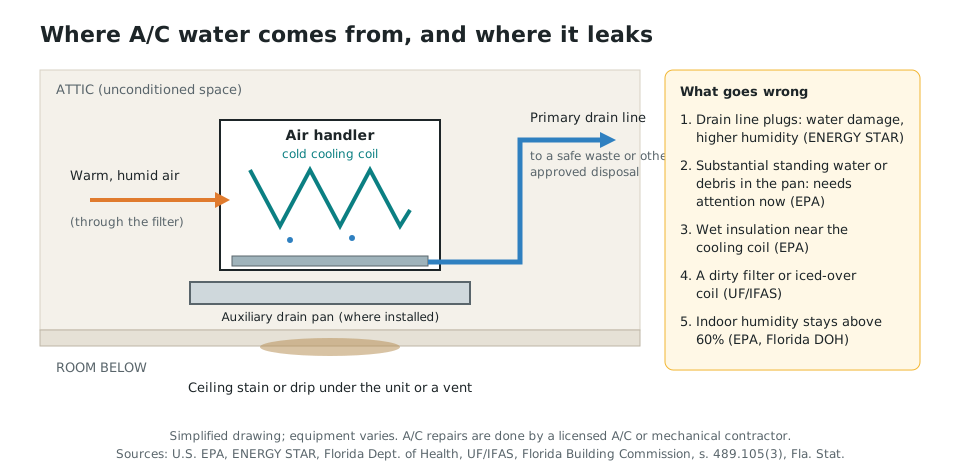
How condensate leaks happen
- A clogged drain line. ENERGY STAR says "A plugged drain can cause water damage in the house and affect indoor humidity levels."
- A pan that holds water. The EPA says "the presence of substantial standing water and/or debris indicates a problem requiring immediate attention," and its mold course points to drain pans that don't slope toward the drain.
- Wet insulation, a clogged filter or an iced-over coil. The EPA says to check insulation near the cooling coils for wet spots, and a UF/IFAS moisture fact sheet says to make sure "the filter is not clogged and that the evaporator cooling coils are not iced over."
In many homes the air handler sits in the attic, over a ceiling. Where an air handler sits in an auxiliary drain pan, the 8th edition (2023) Florida Building Code, Residential added a rule, summarized by the Florida Building Commission, that the portion of the appliance, equipment and insulation "subject to water damage when auxiliary drain pans fill" be installed above the rim of the pan. Our Seminole post on ceiling stains covers how to tell an A/C drip from a roof or plumbing leak.

Signs to look for
- Water or rust stains on the floor around the air handler or in its closet.
- A ceiling stain under the attic unit or around a supply vent.
- A musty smell when the A/C runs.
- Condensation on windows, walls or pipes. The EPA calls it "a sign of high humidity" and says to dry the surface quickly.
- A humidity reading above 60%.
What humidity a Florida home should have
The Florida Department of Health says to keep indoor humidity below 60%, and that "below 50% is best for controlling both mold growth and dust mites." The EPA says below 60%, ideally 30 to 50%. A UF/IFAS publication suggests 45 to 60%. A hygrometer from a hardware store costs $10 to $50, the EPA says. See our guide to checking your home's humidity.
The health department adds one more point: if you need a dehumidifier to get a home with central air below 60%, "you should have the air conditioning system examined for problems." Our Belleair post on moisture in older homes covers what lasting dampness does to plaster, floors and framing.

Photograph it before you touch anything
Before cleanup, photograph the stain, the wet floor, the air handler and the drain pan, wide and close up. Write down when you first saw it, and keep any service invoices. Then dry what you can: the health department says "when water stands for even 24 hours, common molds can take hold." For mold, see our Oldsmar post on mold after water damage.
Who fixes what
Florida's contractor law lists installing a condensate drain in the scope of Class A and Class B air-conditioning contractors and mechanical contractors (s. 489.105(3)), and says a general contractor must subcontract that work unless it holds the trade license (s. 489.113(3)). Check any license on DBPR's license search. As a certified general contractor, our part is the damage the water left behind; on projects we manage, A/C work is done by licensed trade partners.
Permits for A/C work in Palm Harbor
Palm Harbor is unincorporated, so Pinellas County is the building department: 440 Court Street, Clearwater, (727) 464-3888. The county's express permits cover "A/C Equal Change Out" jobs, and the county says online express permits are only for licensed contractors, while homeowners can apply in person. The county's under-$7,500 permit exemption doesn't apply to mechanical, electrical, plumbing or gas work.
The county's FY27 adopted budget lists $140 for an A/C equal changeout (no gas, oil or electrical), $240 with electrical and $340 with electrical and ducts. For a Notice of Commencement, the county's permitting guide uses project values over $5,000, or over $15,000 for mechanical equal changeouts. Those figures follow s. 713.135(1): the permit office asks for a copy of the recorded notice before the first inspection when the direct contract is over $5,000, and that subsection doesn't apply to a contract under $15,000 to repair or replace an existing heating or air-conditioning system. The county's "Applying for a building permit" page lists different figures ($2,500, or $7,500 for HVAC), so confirm with the county before work starts. Our Palm Harbor bathroom post covers the rest of the county's permit basics.
What you can safely do yourself
- Check or change the A/C filter monthly or as the package says (ENERGY STAR, EPA).
- Look for standing water around the air handler and in the drain pan you can see (Florida DOH, EPA).
- Check humidity with a hygrometer: how to check your home's humidity.
- Dry condensation and small wet spots quickly (EPA).
- Clean a small mold patch under about 10 sq ft: how to clean a small mold patch.
Leave to a pro: clearing drain lines inside the unit, drain pans, condensate pumps, overflow switches, refrigerant and wiring (licensed A/C contractor); our sources give no homeowner steps for these, so follow your equipment maker's manual. Also: cutting out a wet ceiling, and mold over 10 sq ft.
What it costs
| Job | Typical cost | Scope | Do it yourself? |
|---|---|---|---|
| A/C drain line cleaning | $75–$250 | Tampa (Angi, May 2026) | Some of it: only what your owner's manual covers |
| Condensate pump replacement | $100–$450 | National (HomeGuide, 2025) | No: licensed A/C contractor |
| Primary drain pan replacement | $600–$1,200 | National (HomeGuide, 2025) | No: licensed A/C contractor |
| Ceiling repair | $280–$984, average $576 | Tampa (Angi, Mar. 2026) | Some of it: small patches; a sagging or wet ceiling is a pro job |
| Water-damaged walls | $610–$1,570 | Tampa (Angi, Jul. 2026) | Some of it: see our drywall guide |
| Mold remediation | $1,347–$3,778, average $2,548 | Tampa (Angi, Oct. 2025) | Some of it: patches under about 10 sq ft (EPA) |
| Whole-house dehumidifier, installed | $1,500–$3,500 | National (HomeGuide, Feb. 2026) | No: installed in the ductwork by a licensed A/C contractor |
How much does it cost to fix an AC leaking water?
In Tampa, Angi lists A/C drain line cleaning at $75 to $250 (May 2026). A new pump or drain pan costs more, and the ceiling or flooring the water reached is a separate bill. See the full price guide for AC drain line repair costs, and our drywall repair price guide for the ceiling.
How we help
After the A/C contractor fixes the leak, our drywall, ceiling and interior repairs put the room back: cutting out and replacing wet ceiling drywall, texture and paint, baseboards, trim and flooring. You get a written quote within 48 hours of the estimate visit. On projects we manage, A/C, electrical and plumbing work is done by licensed trade partners.
Frequently asked questions
Why is my AC leaking water inside the house?
The most common reason is that the condensate the A/C makes can't drain: a clogged drain line or a pan holding water. ENERGY STAR says a plugged drain can cause water damage in the house, and the EPA says substantial standing water or debris in the pan needs immediate attention.
Can an AC leak cause ceiling damage?
Yes, when the air handler is in the attic. Overflow from the drain pan soaks the drywall below and shows up as a stain or drip. Dry it fast: the Florida Department of Health says common molds can take hold when water stands for 24 hours.
What humidity should my house be in Florida?
The Florida Department of Health says below 60%, and below 50% is best for mold and dust mites. The EPA says below 60%, ideally 30 to 50%; a UF/IFAS publication suggests 45 to 60%.
Do I need a permit to replace an AC in Palm Harbor?
Yes. Pinellas County is the building department for Palm Harbor, and it issues express permits for A/C equal changeouts. Its FY27 fee schedule lists $140 for an equal changeout without electrical work.
Sources
- Pinellas County: Applying for a building permit
- Pinellas County: Building frequently asked questions
- Pinellas County: Residential permits
- Pinellas County: Express permits
- Pinellas County: Permitting guide
- Pinellas County: Permit exemptions for work under $7,500
- Pinellas County: FY27 Adopted Budget Book, Building and Development Review Services fee schedule (PDF)
- Florida Statutes s. 489.105 (2026)
- Florida Statutes s. 489.113 (2026)
- Florida Statutes s. 713.135 (2026)
- Florida Building Commission: Analysis of Changes, 8th Edition (2023) FBC-Residential (PDF)
- U.S. EPA: A brief guide to mold, moisture and your home
- U.S. EPA: Mold course, chapter 2
- U.S. EPA: Should you have the air ducts in your home cleaned?
- ENERGY STAR: Maintenance checklist
- U.S. EPA: Care for your air, a guide to indoor air quality
- Florida Department of Health: Mold
- UF/IFAS: Energy efficient homes, indoor air quality and energy (FY1044)
- UF/IFAS: Moisture control in your home, part 1 (FCS3256, archival)
- National Weather Service Tampa Bay: Dew point statistics
- U.S. Census Bureau, ACS 2024 5-year, Palm Harbor CDP: Year structure built (B25034)
- U.S. Census Bureau, ACS 2024 5-year, Palm Harbor CDP: Median year structure built (B25035)
- Angi: HVAC repair cost in Tampa (updated May 5, 2026)
- HomeGuide: AC repair cost (Aug. 22, 2025)
- Angi: Ceiling repair cost in Tampa (updated Mar. 19, 2026)
- Angi: Drywall repair cost in Tampa (Jul. 6, 2026)
- Angi: Mold remediation cost in Tampa (updated Oct. 15, 2025)
- HomeGuide: Whole-house dehumidifier cost (Feb. 6, 2026)