

When an evacuation order comes, the whole island has to clear out. The city says that if an evacuation order is issued, "Treasure Island must be fully evacuated due to its low elevation and the high likelihood of storm surge and flooding," and that the city is in an "A" evacuation zone: "we are the first to evacuate." So getting ready here is about how well the house holds up while you're gone, and how fast you can get back in.
Most homes on the island are older. U.S. Census estimates put the median year built in Treasure Island at 1970, and about 75% of its 6,192 housing units were built before 1980. About 29% are held for seasonal or occasional use.
Is this urgent?
- Call now: an evacuation order is out for Zone A. Finish only what's quick, then go. The city says emergency services "will not be available during the height of the storm and possibly for hours afterward" for people who stay.
- Call today: a hurricane watch or warning is posted and your shutters, panels or garage door brace aren't ready, or you don't have a re-entry hangtag yet.
- Can wait: it's the off-season. Plan permanent upgrades (impact windows, a wind-rated garage door, permanent shutter anchors) now, with permits, before stores sell out.
Local resources for Treasure Island
- City of Treasure Island: Hurricane and storm preparedness
- City of Treasure Island: Re-entry hangtags
- City of Treasure Island: Building Division
- Pinellas County: Find your evacuation zone
- Pinellas County: Look up your flood zone
- Pinellas County: Alert Pinellas sign-up
- Pinellas County: 2026 Hurricane Guide
The countdown
The National Hurricane Center issues a hurricane watch 48 hours before tropical-storm-force winds are expected, and a warning 36 hours before. Pinellas County's 2026 Hurricane Guide says a warning means "It is time to complete your preparations." On a barrier island, that's later than it sounds: the hurricane center says emergency managers plan to finish evacuations "before the onset of tropical storm-force winds."
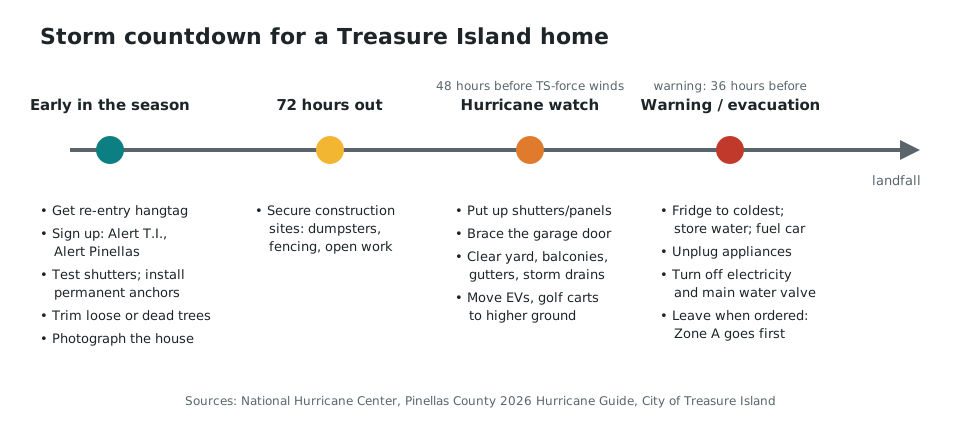
Early in the season. Get your re-entry hangtag (below), sign up for Alert T.I. and Alert Pinellas, and photograph the house and belongings, as the county's checklist suggests. The county's guide lists "Test shutters and generators regularly" for July and "Trim/remove loose or dead trees" for February.
72 hours out, if you have work going on. The city's construction-site checklist says contractors and property owners should secure the site "no later than seventy-two (72) hours before anticipated landfall," including dumpsters, fencing and "partially completed structures."
At a watch. Put up shutters or panels, brace the garage door, and clear the yard (below).
At a warning or evacuation order. The city's list: "Bring in outdoor objects such as lawn furniture, toys, and garden tools," "Turn the refrigerator and freezer to the coldest settings," "Store drinking water," and "Fuel the car." Before you leave, the city says to secure your home "by unplugging appliances and turning off electricity and the main water valve."
Windows and doors
All of Treasure Island is in a wind-borne debris region, according to the city's Building Division, with design wind speeds of 147 to 150 mph. The state's Hurricane Retrofit Guide recommends permanently installed, corrosion-protected fasteners for shutters, because "Repeatedly installing shutters with nails or screws can damage your walls and weaken the connection when you really need it to work."
If you use plywood, the Florida Building Code (8th Edition, Residential, R301.2.1.2) allows wood structural panels at least 7/16 inch thick on homes with a mean roof height of 33 feet or less, precut to extend at least 2 inches past the fasteners and "secured with corrosion-resistant attachment hardware permanently installed on the building." Our new DIY guide walks through it: how to put up plywood storm shutters.
Two warnings from the state guide: "Using spring clips, Velcro, barrel bolts, or wedging techniques will not provide a tested and reliable attachment system," and don't leave a shutter you can't open quickly from inside on a bedroom's only exit. Permanent options are in our Safety Harbor impact windows post.
The garage door
The state guide says garage doors "can be pushed in by winds blowing onto the door... or pulled out as winds whip around the corner of the house."
- Check for a rating. The guide says a wind-rated door has a sticker showing its design pressure; "If you don't know then most likely it is not."
- Brace it before the storm. Pinellas County says to "Reinforce doors with brace kit or use long steel or aluminum bars." The state guide says "The only do-it-yourself options that seem to make sense are to add vertical support posts," and to "close the door and install it before the storm."
- Don't count on the car. The guide says backing your car against the door "will do nothing to help with negative (outward acting) pressures."
- Never touch the springs. It warns they "can be very dangerous" and should be adjusted only by professional garage door installers.
If you replace the door, the city's garage door permit checklist says it "must be impact resistant." Costs are in our hurricane garage door price guide.

What to bring in or tie down
The hurricane center says "Debris, such as signs, roofing material, siding and small items left outside become flying missiles during hurricanes." Pinellas County's checklist:
- "Take all yard items inside" and "Clear balconies, steps and porches."
- "Secure detached structures and items that could become windborne, including grills, pool furniture and propane tanks."
- "Super-chlorinate your pool and move pool chemicals indoors."
- "Remove debris from your gutters and nearby storm drains if possible."
Electric vehicles, golf carts and e-bikes need a plan too. The city says to move them "to higher ground or off the island," not to leave them in a garage in a flood-prone area, and to park them "at least 50 feet away from any structure or other vehicles."
Sandbags won't stop surge
The city is blunt about this: "Sandbags will not protect against storm surge from the bay or tidal waters," and county, state and federal emergency managers "have agreed that sandbags are not meant for people who live in evacuation zones to use in protecting against storm surges." Instead, the city suggests moving furniture and valuables to a second floor or raising them off the floor.

Get your re-entry hangtag now
After an evacuation, you can't just drive back. The city says that once the order is lifted, "Emergency Access Permits will be required to re-enter an evacuated area," and officers at the entry points "will scan the barcode on your permit." Hangtags are free from City Hall's customer service desk or online through the Pinellas County Sheriff's Office. The city says you can't sign up by phone or by email. The county guide adds that "All bridges will remain closed until inspections are done and it is deemed safe to allow traffic." Our Treasure Island post on the first 48 hours after a storm covers what to do when you get back.
What you can safely do yourself
- Put up precut plywood or storm panels on permanent anchors: how to put up plywood storm shutters.
- Install a garage door brace kit made for your door, following the maker's instructions.
- Clear the yard, balconies, gutters and storm drains; move pool chemicals inside.
- Find your evacuation and flood zones: how to look up your flood zone.
- Photograph the house and belongings, and get your re-entry hangtag.
Leave to a pro: garage door springs, installing new shutters, windows or doors (permits), roof-to-wall straps, generator hookups (licensed electrician) and tree work near power lines.
What storm protection costs
| Job | Typical cost | Scope | Do it yourself? |
|---|---|---|---|
| Storm panels | $10–$20 per sq ft | Tampa (Angi, Mar. 2026) | Some of it: putting them up and taking them down; the city lists replacing shutters among projects needing a permit |
| Plywood shutters, 3/4-inch CDX cut to fit | $400–$1,200 one-time materials | Florida (BuildPriced, May 2026) | Yes, once anchors are in (ask the city about the anchors; see our guide) |
| Hurricane-rated garage door | $1,200–$3,500 installed | Florida (BuildPriced) | No: permit, and must be impact resistant in Treasure Island |
| Garage door bracing kit | $150–$400 | Florida (BuildPriced) | Some of it: only a kit made for your door |
| Roof-to-wall clip retrofit | $5,700 (Tampa region estimate) | Florida (My Safe Florida Home calculator) | No: structural and roof work |
How much does it cost to hurricane-proof a garage door?
In Florida, BuildPriced puts a hurricane-rated garage door at about $1,200 to $3,500 installed, and a bracing kit at $150 to $400 (May 2026). Door size, material and impact glass move the price most, and in Treasure Island a replacement door must be impact resistant. See the full price guide for hurricane garage door costs, and our impact windows price guide for shutters and windows.
How we help
Our exterior repairs work includes replacing windows and exterior doors, with the permits and Florida product approvals they need; you get a written quote within 48 hours of the estimate visit. Treasure Island's window, door and shutter permit checklist requires product approvals and an in-progress inspection, so plan upgrades for the off-season. We don't do roof work or generator hookups; those need a licensed roofing contractor and a licensed electrician.
Frequently asked questions
Does Treasure Island have to evacuate for a hurricane?
The city says that if an evacuation order is issued, Treasure Island must be fully evacuated because of its low elevation and storm surge risk. It's in evacuation Zone A, the first to evacuate.
How do I get back onto Treasure Island after an evacuation?
You need a free Emergency Access Permit (re-entry hangtag), available at City Hall or online through the Pinellas County Sheriff's Office. Officers scan it at the entry points once the evacuation order is lifted.
Will sandbags protect my Treasure Island home from storm surge?
No. The city says sandbags won't protect against storm surge from the bay or tidal waters, and suggests moving valuables to a second floor or raising them instead.
How thick should plywood hurricane shutters be?
The Florida Building Code allows wood structural panels at least 7/16 inch thick for homes with a mean roof height of 33 feet or less, attached with permanently installed, corrosion-resistant hardware. The state's retrofit guide recommends plywood over OSB.
Do I need a permit for hurricane shutters in Treasure Island?
The city lists replacing impact-resistant coverings such as windows, doors or shutters among projects that need a permit, and has a permit checklist for shutters. Ask the city at permits@mytreasureisland.org before you install anchors or shutters.
Sources
- City of Treasure Island: Hurricane and storm preparedness
- City of Treasure Island: What to do if an evacuation order is issued
- City of Treasure Island: What to do when a hurricane or storm warning is issued
- City of Treasure Island: Preparing for a hurricane or storm
- City of Treasure Island: Construction site storm preparation checklist
- City of Treasure Island: Re-entry hangtags
- City of Treasure Island: Sandbag information
- City of Treasure Island: Building Division
- City of Treasure Island: When homeowners must obtain permits
- City of Treasure Island: Window, door or hurricane shutter permit checklist (PDF)
- City of Treasure Island: Garage door replacement permit checklist (PDF)
- Pinellas County: 2026 Hurricane Guide (PDF)
- Pinellas County: Sandbags
- Pinellas County: Alert Pinellas
- Pinellas County: Find your evacuation zone
- U.S. Census Bureau, ACS 2024 5-year, Treasure Island city: Year structure built (B25034)
- U.S. Census Bureau, ACS 2024 5-year, Treasure Island city: Median year structure built (B25035)
- U.S. Census Bureau, ACS 2024 5-year, Treasure Island city: Vacancy status (B25004)
- National Hurricane Center: Glossary (watches and warnings)
- National Hurricane Center: Hurricane hazards
- Florida Division of Emergency Management: Hurricane Retrofit Guide, openings
- Florida Division of Emergency Management: Hurricane Retrofit Guide, do-it-yourself shutters
- Florida Building Code, Residential, 8th Ed. (2023), Chapter 3 (R301.2.1.2)
- FEMA: Protect your property from severe winds (PDF, 2023)
- Ready.gov: Hurricanes
- Angi, hurricane shutters cost in Tampa (updated Mar. 19, 2026)
- BuildPriced, Florida hurricane home prep checklist (updated May 10, 2026)
- My Safe Florida Home: Cost calculator