

"Storm damage from Helene, Milton called worst in Seminole's history." That was the Tampa Bay Times headline in October 2024, reporting that hundreds of single-family homes in the city were damaged, nearly $25 million worth, according to the city manager. Some of that damage shows up months later as a brown ring on a bedroom ceiling.
A ceiling stain after a storm is easy to ignore and expensive to put off. Here's how to find the source, what Seminole requires and what repairs cost.
Is this urgent?
- Call now: a ceiling that is sagging or bulging, water dripping from a light fixture, or water near outlets or the electrical panel. Turn off power to that area at the breaker, stay out from under the sag, and call a licensed electrical contractor if water reached wiring.
- Call today: an active drip, a stain that is still growing, or wet insulation in the attic. Put a bucket under it and move what you can.
- Can wait: an old, dry stain that hasn't changed in weeks. Still have the roof checked before the next storm.
The short answer
- Make sure it's the roof. Plumbing and A/C condensate leaks make ceiling stains too.
- Look uphill from the stain. Water can run along the roof framing before it drips.
- Roof work for hire needs a licensed roofing contractor (Florida Statutes 489.105 and 489.113) and, in most cases, a permit from the City of Seminole or Pinellas County.
- Fix the roof first, then the ceiling. A typical roof leak repair runs about $350 to $1,550 in Florida.
Photograph it before you touch anything
Before buckets get moved and stains get painted over:
- Photograph the stain with a tape measure in the shot, then again every day or two to show whether it's growing.
- Note when it drips: during rain, after a shower, or when the A/C runs. That timing is your best clue.
- From the ground only, photograph missing shingles, lifted flashing, damaged soffits and debris in the yard.
Is it the roof, the plumbing or the A/C?
A ceiling stain only tells you water got there. Bob Vila's guide and BuildingAdvisor suggest a few checks:
- It shows up after rain: most likely the roof. BuildingAdvisor says roof leaks most often start at flashing around something that passes through the roof, like a plumbing vent, skylight or chimney.
- It's under a bathroom or near a pipe: suspect plumbing. Bob Vila suggests turning off the water inside the house and watching the meter. If it keeps moving, there's likely a leak.
- It happens in summer or when the A/C runs: check the condensate drain line and drain pan. The EPA says to keep A/C drip pans clean and drain lines flowing. A stain in a straight line may follow ductwork above.
- Damp spots in the middle of the ceiling with no rain pattern: Bob Vila says that can point to poor attic ventilation.
Why the stain isn't under the hole
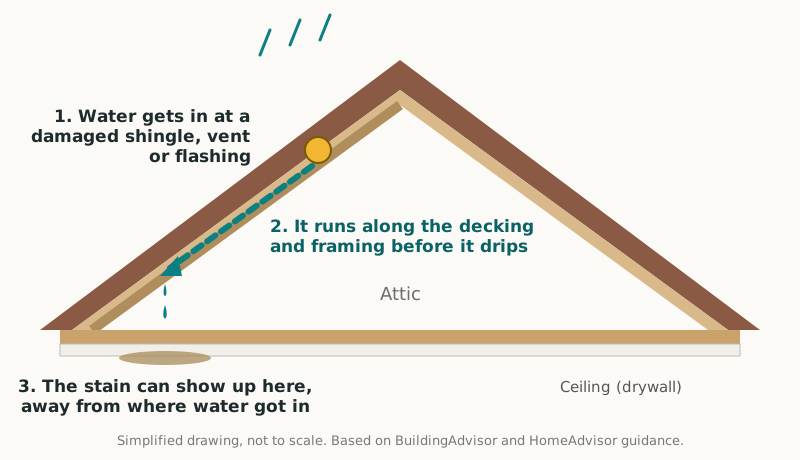
BuildingAdvisor explains that water from a leak can run horizontally or at an angle along pipes, framing and other parts of the house before it shows up in the ceiling. HomeAdvisor notes that leaks often run along the trusses before dripping. Home Depot's guide adds a useful clue: if the stain is round, the water likely started at its center; if it's cone-shaped, the source is likely at the narrow end.
If you can get into your attic safely, look uphill from the stain with a flashlight for wet decking, dark streaks or damp insulation. Step only on the framing; the ceiling between it won't hold you.
What storms do to roofs here

After Hurricane Ian, FEMA's building experts reported that "the most common building envelope damage observed was roof covering failure," with wind-driven rain getting in through damaged roofs. After Hurricane Michael, FEMA described a home where the ridge shingles and ridge vent failed and "the ceilings in several rooms were saturated with water and collapsed." It also notes that soffits have historically performed poorly in hurricanes, and when they fail, a lot of water can get in.
The Insurance Institute for Business & Home Safety (IBHS) studied Michael too. Every home with 3-tab shingles it investigated was damaged, while fewer than half of metal roofs were. IBHS says a sealed roof deck (a secondary water barrier under the shingles or tile) can limit how much water gets in when the roof covering is lost.
Seminole's housing makes this worth checking. Census data shows the median home or apartment in the City of Seminole was built in 1979, and about 54% were built before 1980.
Repair or replace? Florida's 25% roof rule
The Florida Building Code, Existing Building has a "25 percent rule" for existing roofs (Section 706.1.1). In the 2020 edition's wording, as quoted by the Florida Building Commission, "not more than 25 percent of the total roof area or roof section of any existing building or structure shall be repaired, replaced or recovered in any 12-month period unless the entire existing roofing system or roof section is replaced to conform to requirements of this code." The commission's analysis of the current 2023 edition says that once the rule is triggered, it now applies to a roof replacement and a roof recover. But under a 2022 law, Florida Statute 553.844(5), roofs built, repaired or replaced under the 2007 Florida Building Code or later only need the repaired part brought up to today's code. Older roofs can still trigger a full replacement.
Permits in Seminole
- Inside city limits, the City of Seminole's Building Division issues permits through its online portal and does most plan reviews in-house. Call 727-392-1966 (ext. 126 for permits).
- Some "Seminole" mailing addresses are outside city limits and go through Pinellas County instead. The county says roof repair or installation needs a permit, even after a storm. Check your address on the Property Appraiser's site.
- On a city re-roof, a licensed contractor, engineer, architect or inspector certifies the deck was re-nailed to the 2023 Florida Building Code, and crews can send photos instead of waiting on a late inspector.
- Permits pulled after the work is done cost double under the city's fee schedule.
- A new state exemption (Florida Statute 553.79(1)(g), since July 1, 2026) requires local governments to exempt a single-family owner (or the owner's contractor) from a building permit for work valued under $7,500, on a written request with the contract or other documentation. It doesn't apply to property partly or entirely in a flood hazard area, or to any electrical, plumbing, structural, mechanical or gas work, and a project can't be split to fit. The city's website doesn't explain how it handles these requests yet, so call first.
- Flood zone homes: the City of Seminole uses 50% for substantial damage and improvement. Unincorporated Pinellas County uses 49%.
What it costs

| Work | Typical cost | Do it yourself? |
|---|---|---|
| Typical roof leak repair (Florida, Angi Orlando, 2026) | $350–$1,550 | No: hire a licensed roofing contractor |
| Flashing replacement (Florida, Angi Orlando, 2026) | $200–$500 | No: licensed roofing contractor |
| Emergency roof tarp (national, HomeAdvisor, 2026) | About $450 average; $150–$3,300 | No: stay off the roof |
| Ceiling repair after a leak (Tampa, Angi, 2026) | $280–$984, about $576 average | Some of it: a small, dry stain, yes; wet or sagging drywall, no |
| Attic insulation removal (national, HomeAdvisor, 2026) | $600–$1,200 | No: hot, tight space over a fragile ceiling |
How much does it cost to fix a roof leak in Seminole?
Most roof leak repairs land around $350 to $1,550 in Florida, and simple fixes like a few broken shingles can start around $150 (national). Damage to the decking, wet insulation or a ceiling that has to be replaced adds to the bill. See the full roof leak repair cost guide for costs by roof type, flashing and vents, tarps, inspections and the 25% rule.
What you can safely do yourself
- Contain the water and protect your belongings: how to handle a ceiling leak until the roofer arrives.
- Turn off power at the breaker to any light or outlet near the water.
- Photograph the stain and the outside of the roof from the ground.
- Once the roof is fixed and the ceiling is dry, seal a small stain with a stain-blocking primer before painting.
- If drywall got soaked: how to cut out wet drywall.
Leave to a pro: anything on the roof, a sagging ceiling, wet wiring, and mold over about 10 square feet.
How we help
We're a Florida Certified General Contractor (Lic. #CGC1541672). Roof repairs must be done by a licensed roofing contractor, who contracts with you directly. Once the roof is fixed, we can handle the ceiling, insulation and paint: the attic insulation, the ceiling drywall, texture and paint, and rotted wood inside the house. For drying out a room, see the first 48 hours after water damage and our storm damage checklist.
Local resources for Seminole
Frequently asked questions
Do I need a permit to repair my roof in Seminole?
In most cases, yes. Inside city limits, the City of Seminole Building Division issues roof permits; unincorporated Seminole addresses go through Pinellas County, which says roof repairs need a permit even after a storm.
Why is my ceiling stain not under the roof leak?
Water can run along the roof decking and framing before it drips onto the ceiling, so the stain can appear away from where water got in. Look uphill from the stain in the attic.
Does Florida's 25% roof rule mean I need a whole new roof?
Not if your roof was built under the 2007 Florida Building Code or later. Florida Statute 553.844(5) says only the repaired portion of those roofs must meet current code. Older roofs may need a full replacement.
Does Seminole use the 49% or 50% flood rule?
The City of Seminole uses 50%. Pinellas County's 49% applies to unincorporated areas, including homes with a Seminole mailing address that are outside city limits.
Sources
- Tampa Bay Times: Storm damage from Helene, Milton called worst in Seminole's history (Oct. 23, 2024)
- City of Seminole: Building Division
- City of Seminole: Permits
- City of Seminole: Roofing Compliance Affidavit (PDF)
- City of Seminole: Permit Fee Schedule (PDF)
- City of Seminole: Flood Protection Information
- Pinellas County: Building departments in Pinellas County
- Pinellas County: Storm Recovery Permitting
- Pinellas County: Substantial damage and substantial improvement
- Florida Statutes s. 553.844 (2026)
- Florida Statutes s. 553.79 (2026)
- Pinellas County: Permit exemptions for work under $7,500
- Florida Statutes s. 489.105, roofing contractor definition
- Florida Statutes s. 489.113, license required
- Florida Building Commission: Analysis of Changes, 8th Edition (2023) FBC, Existing Building (Section 706.1.1, 25 percent rule)
- Florida Building Commission: Declaratory Statement DS 2021-039 staff analysis (quotes Section 706.1.1, 7th Edition 2020)
- Census Reporter: ACS 2024 5-year, Seminole, FL housing (B25034, B25035)
- FEMA P-2342: Hurricane Ian in Florida, Mitigation Assessment Team report (Dec. 2023)
- FEMA Hurricane Michael Recovery Advisory 2 (June 2019), Florida Building Commission copy
- IBHS: Hurricane Michael wind damage assessment, executive summary
- Bob Vila: Water stains on ceiling
- BuildingAdvisor: What causes water stains on the ceiling
- Home Depot: How to repair a water-damaged ceiling
- U.S. EPA: A brief guide to mold, moisture and your home
- U.S. EPA: Mold cleanup in your home
- Angi: Roof repair costs in Orlando, FL (July 9, 2026)
- Angi: Ceiling repair costs in Tampa (March 19, 2026)
- HomeAdvisor: Roof tarping cost (June 19, 2026)
- HomeAdvisor: Roof repair cost (June 19, 2026)
- HomeAdvisor: Insulation removal cost (June 20, 2026)