

Storms aren't the only way water gets into a Largo home. Pipes, slab leaks and water heaters do it too, often slowly and out of sight. Pinellas County Utilities says "approximately 50 percent of all households have some kind of plumbing leak," and the EPA says the average household's leaks can waste more than 9,300 gallons of water a year.
Largo's housing is at the age when plumbing starts to show it. U.S. Census estimates put the median year built at 1978, and about 56% of the city's 46,806 housing units were built before 1980; the 1970s alone account for nearly 15,900. About a quarter of Largo's homes are mobile homes.
Is this urgent?
- Call now: water reaching outlets, cords or the electrical panel, a ceiling that's sagging or bulging, or water spraying from a pipe or water heater. Close the house valve (below) if you can do it safely, keep clear of anything electrical, and call a licensed plumber (and a licensed electrical contractor for wet wiring). Pinellas County Utilities' 24-hour line is (727) 464-4000.
- Call today: a steady leak under a sink, water around the base of the water heater, or wet drywall or flooring. The EPA says materials dried within 24 to 48 hours usually won't grow mold.
- Can wait: a dripping faucet, a toilet that runs, or a water bill that crept up. Do the meter test below and book a plumber.
Local resources for Largo
First: shut off the water
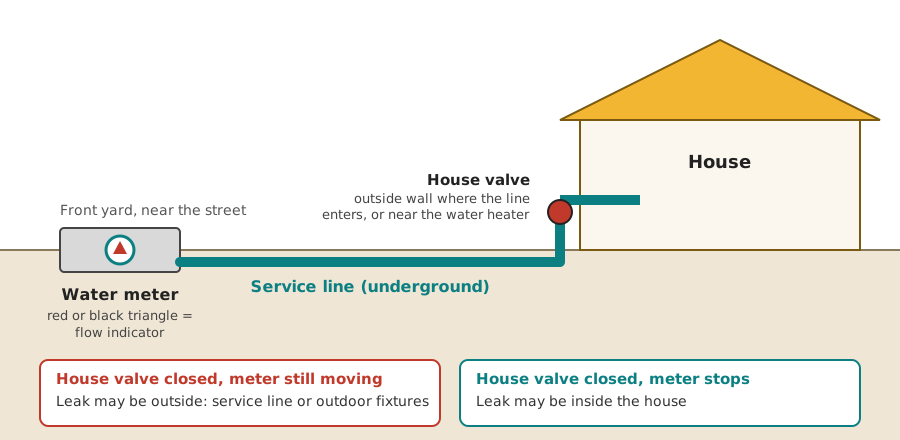
Find your house valve before you need it. Pinellas County Utilities says it's "generally located on an outside wall where the waterline enters the dwelling, or near the water heater." Our advice: if the valve won't budge, don't force it; call Pinellas County Utilities or a plumber.
If the leak is at the water heater, our advice is to also turn off its cold-water supply valve and, for an electric heater, switch off its breaker. The CPSC says to shut off the power at the breaker before working on an electric water heater's thermostat. For a gas heater, leave the gas to a licensed plumber or your gas company.
How to tell if you have a hidden leak
Pinellas County Utilities' Leak Detector Guide says the water meter is "typically" in the front yard near the street, and that with no water in use, a moving flow indicator (a small red or black triangle) is "a good indication that there may be a leak." For smaller leaks, write down the reading, use no water for two hours and read it again. The EPA gives the same test and adds a rule of thumb: if a family of four uses more than 12,000 gallons in a winter month, "there could be serious leaks."
Then close the house valve and test again. If the meter still moves, the county says the leak may be outside, in the service line between the meter and the house; if it stops, the leak may be inside. Our step-by-step guide covers it: how to check for a water leak using your water meter.
Slab leaks
In a home built on a concrete slab, water lines can run under or through the slab, so a leak there doesn't drip where you can see it. Our advice: if the meter shows a leak inside, nothing visible is dripping and every toilet passes the dye test, suspect a hidden leak, and don't start breaking tile or concrete to look. Finding a slab leak is a job for a licensed plumber with leak-detection equipment, and the fix is either a repair through the slab or a new line run around it (a reroute). Both are plumbing work (s. 489.105(3)(m), Fla. Stat.).
Water heaters
The U.S. Department of Energy says "most storage water heaters last 10-15 years, while tankless water heaters can last more than 20 years." Its maintenance tip: drain a quart of water from the tank every three months to remove sediment, following the manufacturer's directions. The DOE and the CPSC both recommend setting it to 120°F to save energy and prevent scalds.
Every tank heater has a temperature and pressure relief valve near the top. Montana State University Extension says it lets steam or hot water escape "should a thermostat malfunction occur," should be checked yearly, and should never be covered. Our advice: if that valve is dripping or the tank itself is leaking from the bottom, call a plumber. A leaking tank is usually replaced, not repaired.

Photograph it before you touch anything
Before cleanup, photograph the leak, the water on the floor, stains on walls and ceilings, the cabinet floor under any sink, and the meter reading, and write down the date and time. If you'll make an insurance claim, ask your insurer what they need; this is general information, not insurance advice.
Who does what: you, the plumber, and us
Florida law puts repairing water supply piping within a licensed plumbing contractor's scope (s. 489.105(3)(m)). A general contractor like us must subcontract plumbing to a licensed plumbing contractor (s. 489.113(3)), and Largo's permit FAQ says permits "will not be issued until all required licensed contractors are properly listed." On jobs we manage, plumbing is done by licensed trade partners who pull their own permits. For what a handyman can and can't do, see handyman or licensed contractor?
Permits in Largo
Largo lists "electrical, plumbing, mechanical, or gas work" among projects that generally require a permit. Its permit types page says like-for-like plumbing changeouts "are typically done over the counter and require no plan for review," while new plumbing installations may need plans. Florida's new under-$7,500 permit exemption doesn't cover plumbing, and Largo says it applies only when the property isn't in a flood hazard area and the Building Official approves a written request first (s. 553.79(1)(g)).
The repairs after the plumber are different. Largo's list of work that generally doesn't need a permit includes replacing flooring, insulation, painting, and "cabinet replacement that does not require plumbing, electrical, or structural modifications." To confirm an address is in the city, Largo says to check that the "Current Tax District" on the Property Appraiser's site reads "LARGO(LA)." Confirm your project with Largo Building Services, (727) 586-7488.
What you can safely do yourself
- Find your house valve and your water heater's cold-water valve and breaker, and label them.
- Test for hidden leaks with the meter and dye-test every toilet: how to check for a water leak.
- Drain a quart from the water heater every three months if the manufacturer's directions allow it (DOE).
- Cut out wet drywall below the waterline: how to cut out wet drywall.
- Dry out a wet wood floor: how to dry out a wet hardwood floor.
Leave to a pro: any pipe, slab or water heater repair (licensed plumber), gas, wet wiring (licensed electrician), and mold over about 10 square feet.
The repairs after the plumber
Once the leak is fixed, what's left is usually drywall, flooring, baseboard and cabinets. The EPA lists "areas inside walls around pipes" and the underside of carpet among places mold hides, so wet materials should be opened up and dried, not just painted over. A sink cabinet with a swollen particleboard floor usually gets a new floor panel or a new cabinet. We handle this part, from drywall repair to flooring and cabinets; see our water damage repair service.

What repairs typically cost
| Job | Typical cost | Source | Do it yourself? |
|---|---|---|---|
| Pipe leak repair | $252 to $858 (average $505) | Angi, Tampa, 2026 | No: licensed plumber |
| Slab leak detection | $150 to $400 | HomeAdvisor, national, 2026 | No: licensed plumber |
| Slab leak repair | $630 to $4,400 (average $2,280) | HomeAdvisor, national, 2026 | No: licensed plumber |
| Water heater replacement | $709 to $1,397 (average $1,034) | Angi, Tampa, updated Oct. 2025 | No: plumbing permit and licensed plumber |
| Water heater repair | $248 to $938 | Angi, Tampa, updated Oct. 2025 | No: licensed plumber |
| Drywall repair | $324 to $1,017 | Angi, Tampa, 2026 | Some of it: cutting out wet drywall; finishing takes practice |
| Water damage restoration | $1,962 to $7,250 | Angi, Tampa, 2026 | Some of it: drying out and removing wet materials |
| Water-damaged cabinets | $150 to $500 per affected area | Angi, national, 2026 | Some of it: emptying and drying; reconnecting the sink is the plumber's |
We couldn't find Florida prices for slab leaks or cabinet repair, so those rows are national.
How much does it cost to fix a slab leak?
HomeAdvisor's national range is $630 to $4,400, with an average of $2,280, and finding the leak first runs about $150 to $400. What moves the price is how the plumber fixes it: a spot repair through the concrete, a reroute around the slab or a pipe lining, plus the flooring that has to come up and go back down. See the full price guide for slab leak repair costs.
If you fixed a leak, Pinellas County Utilities says you may qualify for a leak adjustment on your water bill, with a plumber's invoice or a notarized Statement of Repaired Leak form.
Frequently asked questions
How do I know if I have a slab leak?
The usual first sign is a water meter that keeps moving when no water is in use, with no leak you can see. Pinellas County Utilities says closing the house valve helps tell an inside leak from an outside one. A licensed plumber confirms and pinpoints it.
Do I need a permit to replace a water heater in Largo?
Usually, yes. Largo lists plumbing work among projects that generally require a permit, and says like-for-like plumbing changeouts are typically handled over the counter. A licensed plumber usually pulls it. You can as an owner-builder (s. 489.103(7)) if you do or supervise the work yourself and meet the other conditions on Largo's permit FAQ (property in your own name, no sale or lease within a year, a signed Homeowner Builder Affidavit). Confirm with Largo Building Services.
How long does a water heater last?
The U.S. Department of Energy says most storage water heaters last 10 to 15 years and tankless heaters can last more than 20.
Who do I call first for a leak: a plumber or a contractor?
A licensed plumber, to find and fix the leak. Once the plumbing is fixed, a contractor repairs the drywall, flooring and cabinets.
Sources
- Pinellas County Utilities: Leak Detector Guide (PDF)
- Pinellas County: Water Leak Resources
- EPA WaterSense: Fix a Leak Week
- EPA: A Brief Guide to Mold, Moisture and Your Home
- U.S. Census Bureau, ACS 2024, table B25034: Largo year structure built
- U.S. Census Bureau, ACS 2024, table B25035: Largo median year built
- U.S. Census Bureau, ACS 2024, table B25024: Largo units in structure
- U.S. Department of Energy: Energy Saver Guide (PDF)
- U.S. CPSC: Avoiding Tap Water Scalds (PDF)
- Montana State University Extension: Water heater maintenance (PDF)
- City of Largo: Building Services
- City of Largo: Permit types
- City of Largo: Permits FAQ
- City of Largo: Work exempt from building permits (PDF)
- Florida Statutes s. 489.105, definitions (plumbing contractor)
- Florida Statutes s. 489.113, subcontracting trade work
- Florida Statutes s. 489.103, owner-builder exemption
- Florida Statutes s. 553.79, building permits
- Angi: Cost to repair a leaking pipe in Tampa
- HomeAdvisor: Slab leak repair cost
- Angi: Water heater installation cost in Tampa
- Angi: Water heater repair cost in Tampa
- Angi: Drywall repair cost in Tampa
- Angi: Water damage restoration cost in Tampa
- Angi: Cabinet repair cost