

After a strong storm, the first damage many Safety Harbor homeowners notice is at the roof edge: a strip of soffit hanging from the overhang, a fascia board pulled loose, a gutter dangling at one end. It looks like trim, but it's part of what keeps wind and rain out of the attic.
That matters here because of when most of the town was built. U.S. Census estimates put Safety Harbor's median home at 1984, with almost half of its 7,650 homes built in the 1980s and about nine in ten built before 2000. A University of Florida report for the Florida Building Commission notes that wind load requirements for soffits "were not codified in Florida until 2006."
Is this urgent?
- Call now: a ceiling that's sagging or dripping near a light fixture, or a downed power line touching the house or gutter. Stay out from under the sag, keep away from the line and call your power company or 911; a licensed electrical contractor checks any wiring that got wet.
- Call today: soffit panels missing or hanging, a fascia board pulled away from the roof edge, or rain getting into the attic. Open overhangs let wind-driven rain into the attic, and the next storm can do more damage.
- Can wait: a single loose panel with no water inside, faded or peeling trim, or old dry stains with no new water.
Local resources for Safety Harbor
What the soffit and fascia do
The fascia is the board along the edge of the roof; the gutter usually hangs from it, and it's often wrapped in an aluminum or vinyl cover. The soffit is the underside of the overhang, between the fascia and the wall, and it's often vented. The drip edge is the metal strip at the roof's edge, installed with the roofing underlayment.
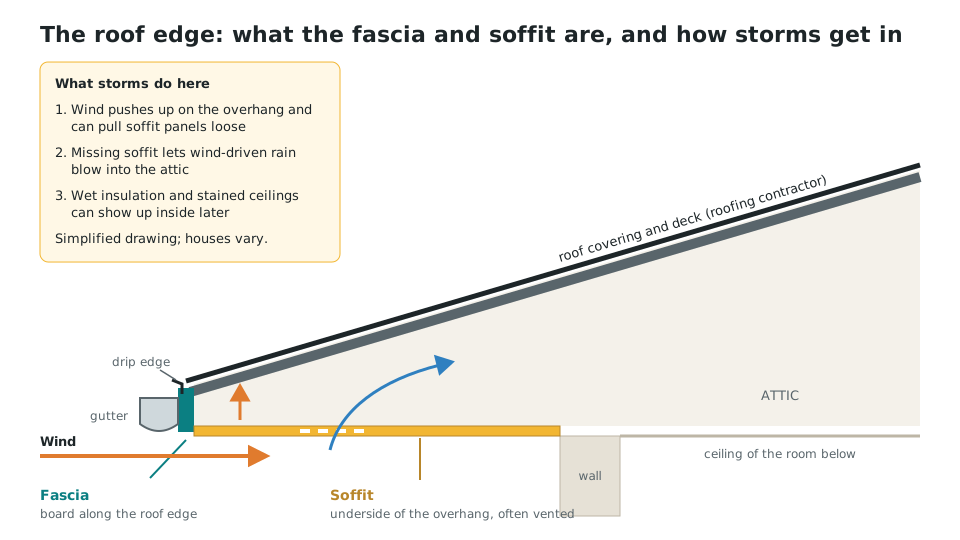
How wind damages the roof edge
FEMA's advisory after Hurricane Michael is blunt: "Soffits have historically performed poorly in hurricanes and are commonly damaged in high-wind events," and "When soffits fail, the result is often significant water intrusion." The same advisory notes that water can get in "through soffits and soffit vents" even when the soffits don't fail.
The Florida Division of Emergency Management's Hurricane Retrofit Guide explains why: hurricane rains "travel almost perfectly horizontally." It says solid plywood soffits haven't been as great a problem as "light weight vinyl or aluminum soffits," that "The key to keeping large amounts of water from entering through soffit vents is to keep them in place," and that fascia covers usually hold the soffit panels' outer ends. Gable overhangs get a warning of their own: soffits there, if vented to the attic, "are almost certain to allow water to enter attic spaces even in rather mild storms."

What Safety Harbor's recent storms looked like
The National Hurricane Center's report on Hurricane Milton (October 2024) has no wind reading from Safety Harbor itself. Nearby, it recorded a 78-knot gust at Clearwater Beach, a 64-knot gust at the Dunedin Causeway and an 83-knot gust at Tampa International Airport. Soffits that stayed up can still have been loosened, so a check after each storm is worth it.

Signs to look for after a storm
- Soffit panels missing, sagging or bowed, or gaps where the panels meet the wall or fascia.
- Fascia covers bent outward or lifted at the corners of the roof.
- A gutter pulled away from the fascia, or water running behind the gutter.
- Lifted or missing shingles or drip edge.
- Inside: wet attic insulation near the eaves, or new ceiling stains along exterior walls.
Photograph it before you touch anything
Safety Harbor's After the Storm page says to "Document any property damage with photographs." Take wide photos of each side of the house, close-ups of each damaged section, and any ceiling stains inside, and note the date. Photograph pieces that came down before you move them. The city's After the Storm page says construction debris other than fence panels requires a dumpster rental, so call the city before putting soffit or trim pieces at the curb.
Who fixes what
Florida's contractor law sets the lines here. A roofing contractor's scope includes "any repair or replacement of wood roof sheathing or fascia as needed during roof repair or replacement" (s. 489.105(3)(e), Fla. Stat.), and a contractor must subcontract roofing work unless it holds a roofing certificate or registration (s. 489.113(3)). The law also lets a local government continue to offer a license for "veneer, including aluminum or vinyl gutters, siding, soffit, or fascia" if it had that licensing requirement before January 1, 2021 (s. 489.117(4)(a)3.).
In practice: when the roof covering, deck or drip edge is damaged, a licensed roofing contractor does that work, including fascia replaced along with it. We don't do roofing. Damage limited to the soffit, the fascia or the overhang framing is work we handle as a Florida certified general contractor, and we coordinate with the roofer when a job needs both. Our storm damage repair service covers the rest of what a storm leaves behind.
The code has caught up with this part of the house. The Florida Building Commission's summary of the 8th Edition (2023) residential changes says R704.2.1 now covers aluminum soffit panels as well as vinyl, and a new Section R704.3 sets "the minimum thickness and attachment of aluminum fascia."

Permits in Safety Harbor
Most permits in Safety Harbor start at City Hall, 750 Main St., (727) 724-1515, open 8 a.m. to 4:30 p.m. weekdays (until 3 p.m. on the fourth Wednesday of each month). The city's permit summary sends roofs and re-roofs straight to Pinellas County Building Services at 440 Court St., Clearwater, (727) 464-3888, under its agreement with the county. Neither the city's permit page nor the summary mentions soffit or fascia on its own, so call before you start.
Pinellas County's page on the July 1, 2026 permit exemption for work under $7,500 lists soffit/fascia among its examples, but that page is written for unincorporated Pinellas County, and the exemption does not apply to property partly or entirely in a flood hazard area, or to structural, electrical, plumbing, mechanical or gas work (s. 553.79(1)(g), Fla. Stat.). Whether it applies to your Safety Harbor address is a question for the city.
What you can safely do yourself
- Look over the roof edge from the ground with binoculars, as the state's Hurricane Retrofit Guide suggests. Our guide to checking the roof edge and soffit after a storm walks through it.
- Photograph the damage and any ceiling stains inside.
- Pick up fallen panels and debris (gloves on) and set them aside. Call the city before putting soffit or trim pieces at the curb: its After the Storm page says construction debris other than fence panels requires a dumpster rental.
- Clear debris from gutters you can reach safely before the next storm, as the city's Prepare Your Home page suggests.
Leave to a pro: anything on the roof, second-story ladder work, reattaching soffit and fascia, and any work near power lines.
What it costs
We couldn't find a Tampa Bay price page for this work. Angi gives a Florida average for soffit replacement; the other figures are national.
| Job | Typical cost | Source | Do it yourself? |
|---|---|---|---|
| Soffit replacement | $2,300 average | Angi, Florida | No: ladder work and wind-rated fasteners |
| Soffit and fascia repair | $300–$7,200 | Angi, national (2026) | Some of it: you can photograph and clean up |
| Fascia board replacement | $6–$20 per linear foot | Angi, national (2026) | No: work at the roof edge |
| Soffit repair | $4–$22 per linear foot | HomeGuide, national | No |
| Full eaves (soffit and fascia) | $9–$34 per linear foot | HomeGuide, national | No |
| Patch a hole in the soffit or fascia | $100–$200 per hole | Fixr, national (2025) | Some of it: ground-floor eaves only |
How much does soffit and fascia repair cost?
Angi's national range for soffit and fascia repair is $300 to $7,200, and its Florida average for soffit replacement is $2,300. The price moves with the linear feet damaged, the material, rot in the fascia board behind the cover, and second-story work. See the full price guide for soffit and fascia repair costs.
Frequently asked questions
Can wind damage soffits?
Yes. FEMA says soffits "have historically performed poorly in hurricanes and are commonly damaged in high-wind events," and that failed soffits often lead to "significant water intrusion."
Can rain get into the attic through soffit vents?
It can. FEMA notes water can get in "through soffits and soffit vents" in high winds even when the soffits stay in place, and Florida's Hurricane Retrofit Guide says keeping the soffits in place is the key to keeping large amounts of water out.
Does a roofer or a general contractor fix soffit and fascia?
It depends on the job. Florida law puts fascia replaced during a roof repair or replacement in the roofing contractor's scope (s. 489.105(3)(e)). Soffit or fascia damage without roof work can be repaired by a licensed general contractor.
Do I need a permit to repair soffit and fascia in Safety Harbor?
The city's pages don't list soffit or fascia on their own. Roofs and re-roofs go to Pinellas County. Call the city's permit office at (727) 724-1515 before you start.
Sources
- U.S. Census Bureau: ACS 2024 5-year, Safety Harbor city, FL, year structure built (B25034, B25035)
- Florida Building Commission: Structural and wind-driven rain resistance of soffits, Task 5 final report (University of Florida; PDF)
- FEMA: Best practices for minimizing wind and water infiltration damage, Hurricane Michael Recovery Advisory 2 (2019; copy posted by the Florida Building Commission; PDF)
- Florida Division of Emergency Management: Hurricane Retrofit Guide, roof and attic water intrusion
- Florida Division of Emergency Management: Hurricane Retrofit Guide, recovering from storm damage
- National Hurricane Center: Tropical Cyclone Report, Hurricane Milton (PDF)
- City of Safety Harbor: Permits
- City of Safety Harbor: Permit and inspection summary (PDF)
- City of Safety Harbor: After the Storm
- City of Safety Harbor: Prepare Your Home
- Pinellas County: Permit exemptions for work under $7,500
- Florida Building Commission: Analysis of Changes, 8th Edition (2023) Florida Building Code, Residential (PDF)
- Florida Statutes s. 489.105 (2026)
- Florida Statutes s. 489.113 (2026)
- Florida Statutes s. 489.117 (2026)
- Florida Statutes s. 553.79 (2026)
- Angi: Soffit replacement cost
- Angi: Soffit and fascia repair cost (updated Mar. 17, 2026)
- HomeGuide: Soffit and fascia repair cost
- Fixr: Roof eaves repair cost (Jan. 31, 2025)