

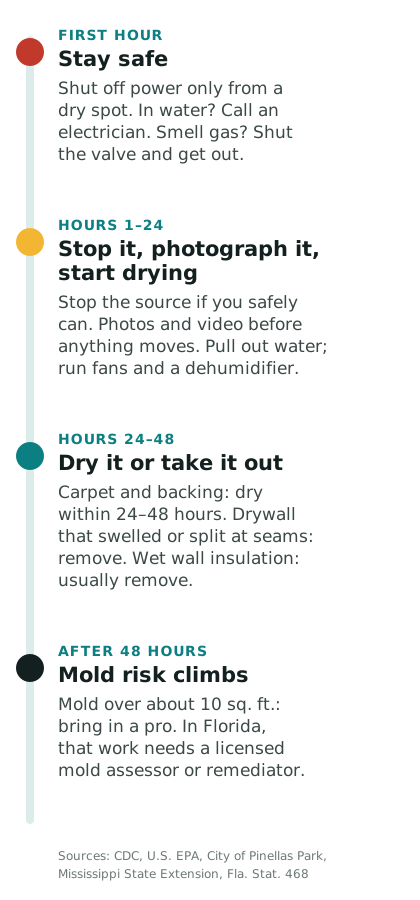
Hurricane Milton dropped 15.03 inches of rain on Pinellas Park in October 2024. Storm, burst supply line or failed water heater, the first two days decide how big the repair gets. The EPA's guidance is built around one window: dry things within 24 to 48 hours to help prevent mold growth.
Is this urgent?
- Call now: water near outlets, the electrical panel or appliances; a sagging or bulging ceiling; a gas smell (leave the house first). Call your power company, the gas company or 911 as fits.
- Call today: water still coming in, standing water on the floor, or wet drywall, carpet or cabinets.
- Can wait: an old, dry stain that isn't growing and isn't soft to the touch.
The first hour: stay safe
The CDC's advice for going back into a wet home is simple:
- Power: shut off the main breaker only if you can reach it from a dry spot. Never touch the panel while standing in water; call a licensed electrical contractor instead, and have one check the system before the power goes back on.
- Gas: if you smell gas, shut off the main valve, open windows and leave right away.
- Structure: if the home looks damaged, stay out until a building inspector has checked it.

Photograph it before you touch anything
Pinellas Park's own post-storm permitting plan encourages owners to photograph all storm damage before repairs begin and to keep invoices and estimates. Before you move anything:
- A slow video through every room, then close-ups of each wet wall, floor and ceiling.
- The highest water line, the source (roof stain, failed hose, water heater) and labels on damaged appliances.
- A note of when it started, when you found it and what you did.
Hours 1 to 24: stop it and start drying

- Stop the source if you safely can: close the main water valve for a plumbing leak, or tarp a roof opening once the weather allows. Under Pinellas Park's post-storm plan, temporary roof tarping and emergency board-up generally don't need a permit.
- Get the water out with a wet-dry vacuum or extraction equipment, but only once you know the power is safe (the CDC says to have an electrician confirm it first).
- Move air and pull moisture: fans and a dehumidifier (EPA). Mississippi State Extension suggests keeping windows open unless it's raining or damp outside.
Hours 24 to 48: dry it or take it out
This is where you decide what can be saved. The EPA's water damage guide, material by material:
| Material | What the EPA says to do | Do it yourself? |
|---|---|---|
| Carpet and backing | Extract the water, then dry within 24–48 hours with a dehumidifier and fans; dry the subfloor too | Yes, for small areas |
| Drywall | Dry in place only if there's no swelling and the seams are intact; otherwise remove and replace | Yes, the tear-out (our guide) |
| Fiberglass or cellulose insulation | Discard and replace | Yes, with protective gear |
| Ceiling tiles | Discard and replace | Yes, if the ceiling isn't sagging |
| Wood (trim, framing, floors) | Dry right away with fans, dehumidifiers and gentle heat; careful with heat on hardwood | Yes |
| Vinyl, tile or linoleum floors | Wipe with mild detergent and let dry; check that the underlayment is dry | Yes |
| Upholstered furniture | Extract the water and dry; may be hard to dry within 48 hours | Valuable pieces: a furniture restoration pro |
The EPA notes these steps are for clean water. For floodwater or sewage, wear protective gear, don't run fans until you know the water was clean, and consider a professional experienced with contaminated water.
Mississippi State University Extension adds that drywall should come out from the floor up to the visible high water line, and the muck-and-gut guide posted by Charlotte County goes further after a flood: at least 2 feet above the water line. Mississippi State notes framing can take weeks or even months to dry.
What you can safely do yourself
- Photograph and document the damage
- Pull out wet carpet, pad, rugs and ceiling tiles
- Run fans and a dehumidifier, and check progress with a moisture meter
- Cut out wet drywall and insulation: step-by-step DIY guide with tools, materials and photos
Leave to a pro: anything electrical, mold over about 10 square feet, sewage or heavily contaminated floodwater, sagging ceilings and structural damage. See all DIY guides
How to tell when it's dry
Texas A&M AgriLife Extension's guidance for drying out a house:
- Measure, don't guess. Studs should read under 15% moisture on a wood moisture meter before insulation or drywall goes back on. You can often borrow or rent a meter from a hardware store or lumberyard.
- Expect weeks. It can take weeks for framing to dry enough to close a wall, and walls may need to stay open for up to a month.
- Use the right tool for the air. Fans work best when the outside air is drier; a dehumidifier works when it's humid outside, with the house closed up. At 80°F and 60% humidity, most units pull about 1 to 2 pints of water an hour.
What it costs
| Work | Typical cost | Do it yourself? |
|---|---|---|
| Interior water cleanup: extraction, disinfecting, drying setup (Tampa, 2026; tear-out costs extra) | $2.14 to $3.64 per sq. ft. (about $3.29) | Some: small clean-water spills, yes; whole rooms need drying equipment |
| Ceiling repair, any cause (Tampa, 2026) | $280 to $984 (about $576) | Small patch, maybe; a sagging ceiling, no |
| Whole water damage restoration job (Angi/HomeAdvisor range, national average, 2023) | $1,305 to $5,707 (about $3,455) | No, for large losses |
| Mold remediation (national, 2023) | $1,100 to $3,400 (about $2,200) | Under about 10 sq. ft., yes (EPA); larger jobs, a professional |
Sources: Tampa figures from Handoff and Angi; restoration and mold figures from Bob Vila, citing Angi and HomeAdvisor data. The 10-square-foot line comes from the EPA; Florida's mold-licensing law also uses 10 square feet (s. 468.8411), with exemptions (s. 468.841).
Costs climb with the kind of water (clean, gray or floodwater), how long it sat, and how much has to come out.
How much does it cost to fix water damage in Pinellas Park?
Cleaning interior water damage in the Tampa area runs about $2.14 to $3.64 per square foot (Handoff's estimate), and fixing a stained or sagging ceiling afterward typically runs $280 to $984. Dirty water, a slow response and mold all push the price up, and replacing wet drywall is a separate cost. See the full water damage repair price guide for cost per square foot by water type, ceiling and drywall repair, mold, and what moves the price.
Permits in Pinellas Park
Pinellas Park has its own Building Development Division at 6051 78th Avenue N, (727) 369-5647. Under the city's Post-Storm Recovery Permitting Plan:
- Generally no permit needed (unless the Building Official decides otherwise): removing wet drywall, insulation, carpet and cabinets, debris removal, temporary roof tarps and emergency board-up.
- Permit needed: electrical repairs, plumbing repairs, water heater replacement, HVAC replacement, roof replacement, window and exterior door replacement, structural repairs, siding, soffit, fascia or stucco replacement, drywall replacement that's part of substantial repairs, and repairs to flood-damaged structures.
If your home is in a special flood hazard area, the city may require a substantial damage review before you rebuild, so check with the Building Development Division first.
Local resources for Pinellas Park
When to call someone else first

-
Floodwater from outside: FEMA notes that most homeowners insurance does not cover flood damage. Call your agent early.
-
Mold over 10 square feet: Florida licenses mold assessors and mold remediators for jobs over 10 square feet (ss. 468.8411, 468.8419, Fla. Stat.). There are exemptions, including homeowners working on their own home and contractors working within their Chapter 489 license (s. 468.841). For a large or recurring mold problem, we recommend an independent licensed mold assessor. PHRS is not a licensed mold assessor or remediator.
- Electrical, plumbing and A/C: on repairs we manage, that work is subcontracted to licensed electrical, plumbing and mechanical contractors who pull their own permits.
After the drying, we rebuild as a Florida Certified General Contractor: drywall, insulation, trim, doors, flooring and cabinets, with any required permits pulled. See our hurricane and storm damage repair page, read our storm damage checklist, or request a free estimate.
Frequently asked questions
How fast does mold grow after water damage?
The EPA's guidance is built around drying wet materials within 24 to 48 hours to help prevent mold growth. Even then it's only a guideline: mold can sometimes grow sooner, and it doesn't always appear after 48 hours.
Can I leave wet drywall in place to dry?
Sometimes. The EPA says drywall can be dried in place if it hasn't swelled and the seams are intact; otherwise it should be removed and replaced.
Do I need a permit to tear out wet drywall in Pinellas Park?
Generally no. Under the city's post-storm plan, removing wet drywall, insulation, carpet and cabinets can usually proceed without a permit unless the Building Official decides otherwise. Electrical and plumbing work, and drywall replacement that's part of substantial repairs, need one.
Does homeowners insurance cover flood damage?
Usually not. FEMA says most homeowners insurance does not cover flood damage; that takes a separate flood policy.
Sources
- Bay News 9: Hurricane Milton by the numbers (rainfall totals)
- U.S. EPA: Mold remediation guide, Chapter 4 (responding to water damage within 24–48 hours)
- U.S. EPA: Mold cleanup in your home
- CDC: Reentering your flooded home
- Mississippi State University Extension: Home cleanup and renovation for walls
- City of Pinellas Park: Permits, inspections and BTRs
- City of Pinellas Park: Post-Storm Recovery Permitting Plan
- Handoff: Cost to clean interior water damage in Tampa (2026)
- Angi: Ceiling repair cost in Tampa (2026)
- SBP, posted by Charlotte County, FL: Muck and Gut guide
- Texas A&M AgriLife Extension: Dry out before rebuilding
- Bob Vila: Water damage restoration cost
- Florida Statutes 468.8411: Mold-related services definitions
- Florida Statutes 468.8419: Mold-related services prohibitions
- Florida Statutes 468.841: Mold-related services exemptions
- FEMA / NFIP: Most homeowners insurance does not cover flood damage