

"Tarpon Springs has been largely spared many times in hurricanes. Hurricane Helene was a different story." That's how ABC Action News opened its report on homes devastated along Seabreeze Drive in September 2024. A year earlier, Hurricane Idalia had already put floodwater in the streets downtown. The city has since been mailing letters to homes in its high-risk flood zone that it believes were damaged by Debby, Helene or Milton but never got a repair permit.
If your home took on water, the big question is whether you can simply repair it, or whether the city will require you to raise or rebuild it. This post explains how that decision works in Tarpon Springs, with the city's own rules.
Is this urgent?
- Call now: water near outlets or the electrical panel, a sagging ceiling, or a gas smell. Call 911, your utility or a licensed electrical contractor, and stay out.
- Call today: standing water inside, or wet drywall and flooring that are still soaking. Every day wet adds mold risk.
- Can wait: old, dry damage. But in the flood zone, don't start repairs until you have the city's storm damage permit.
The short answer
- Tarpon Springs uses 50%, not 49%. If repairs cost 50% or more of the house's pre-damage value (not counting the land), the city treats it as substantially damaged.
- Substantially damaged means bringing the whole house up to current flood rules, which can mean raising it.
- Under 50%, you repair it, but homes in the high-risk flood zone still need a storm damage permit first.
Photograph it before you touch anything
Before anything is moved, cut out or thrown away:
- Video every room, walking slowly, including closets and the garage.
- Close-ups of the water line on walls, cabinets and doors, with a tape measure in the shot to show the height.
- Damaged belongings, before they go to the curb.
- Write it down: the date and time the water came in, when it went down, and what you did first.
Why Tarpon Springs homes are exposed
The city's flood maps include zones AE 6 to 12, Coastal A 10 to 12, and VE 12 to 16. During Helene, the National Weather Service measured a record 6.67 feet above the average high-tide line at Clearwater Beach, and 4 to 7 feet along coastal Pinellas.
The houses themselves are older. Census data put the median home in Tarpon Springs at 1984, and by our count of the Census figures, about two of every three homes were built before 1990. Many were built before today's flood elevations applied, which is why the 50% rule matters here.
How the 50% rule works here
Pinellas County uses a 49% rule, but only for unincorporated areas; the county tells city residents to check with their city. Tarpon Springs calls its version the "FEMA 50% Rule": if the cost to repair flood damage "equals or exceeds 50% of its pre-damage market value," the building is substantially damaged and has to be brought into compliance with current floodplain rules.
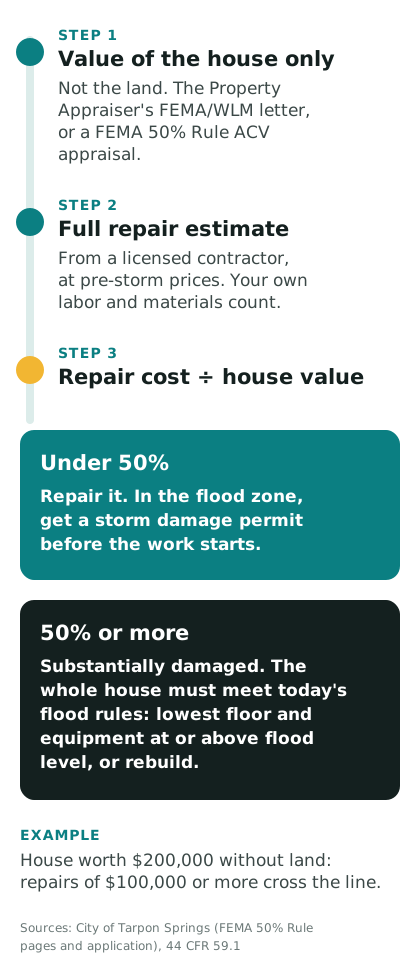
The house value. The city uses the structure's value from the Pinellas County Property Appraiser. On the appraiser's site, look up your address and choose "FEMA/WLM Letter" under the Quick Pick tool; the letter states how much repair the 50% rule would allow. If you think that value is low, the city accepts a "FEMA 50% Rule Actual Cash Value (ACV) Appraisal." It says a typical appraisal will not be accepted.
The repair cost. The city's application asks for a detailed, complete cost estimate prepared and signed by a licensed contractor, using pre-storm prices. Items that aren't a permanent part of the house, like plans, permits, pools, screens, sheds and fences, aren't counted. Volunteer labor is valued at minimum wage scales. An elevation certificate goes in with the packet too.
No adding up past years. A 2025 state law bars cities in the National Flood Insurance Program from enforcing a "cumulative" period that adds up repairs over several years.
If you got a storm damage letter
The city says its "Storm Damage Permit Requirement Letter" goes to homes in the high-risk flood zone believed to have been damaged by Debby, Helene or Milton without a permit. It asks you to contact the Building Department within 60 days.
If repairs were already done, the city treats it as an after-the-fact storm damage permit. It says there are no penalties; only the permit fee applies. Substantial damage questions go to Floodplain Management at 727-938-3737. The same page warns that unpermitted work could cost you tens of thousands of dollars down the road, so don't read "no penalties" as "no consequences."
What "bring it into compliance" means

The city's 50% rule application spells it out. If the lowest floor is below the 100-year flood level, the house must be raised to or above it. Electrical and mechanical equipment, bathrooms and laundry rooms go up too. Below that level, only parking, building access and limited storage are allowed.
How high? The city follows the Florida Building Code's 1 foot of freeboard above the base flood elevation, and gives examples:
- AE-11, single-family detached: lowest living floor at 12 feet or higher. Dry or wet floodproofing is not permitted.
- VE-14, single-family detached: lowest horizontal structural member at 15 feet or higher.
Also new as of October 1, 2026: new construction and additions in a flood zone need a separate Floodplain Permit ($100 new, $50 existing).
Repair, raise or rebuild: what it costs

We couldn't find Tampa Bay figures for this work, so most of these are national; the flood-vent figure is from Delaware.
| Project | Typical cost | Do it yourself? |
|---|---|---|
| Water removal and drying | $4–$12 per sq. ft.; floodwater (black water) runs $9–$12 (HomeGuide, national, 2026) | Some of it: cleanup, following EPA steps |
| Severe whole-house flood or hurricane damage (HomeGuide's Class 4) | $15,000–$100,000 (HomeGuide, national, 2026) | No: permits and licensed trades |
| Raising a house | $25,000–$100,000, about $50,000 average (Fixr, national, 2025) | No: engineering and permits |
| Raising onto piers or pilings | $20,000–$80,000 (HomeGuide, national, 2026) | No: engineering and permits |
| Flood vents | $265–$605 per vent installed (Delaware DNREC, 2022) | No: permitted and sized to FEMA rules |
| Rebuilding a basic home | $180–$280 per sq. ft. (HomeGuide, Florida, 2025) | No: permits and licensed trades |
How much does it cost to raise a house in Tarpon Springs?
The national figures above understate it for coastal Florida slab homes. Tampa Bay news reports, including a local house-lifter's estimate and one homeowner's account, put house elevation at roughly $100 to $175 per square foot, and Pinellas examples in the news have run from roughly $100,000 for a small cottage to $575,000. See the full cost to raise a house in Florida price guide for per-square-foot prices by foundation type and height, real local examples, and the programs that can help pay for it.
Help with the cost
If you carry federal flood insurance, Increased Cost of Compliance (ICC) coverage can pay up to $30,000 toward elevating, floodproofing, demolishing or relocating a home. FEMA says the home must be in the high-risk zone, damaged 50% or more, and declared substantially damaged by the community, among other conditions. Ask your flood insurance agent whether it applies. The city also notes that its Community Rating System class 5 gives a 25% flood insurance discount in the high-risk zone.
What you can safely do yourself
- Photograph and video everything before cleanup (see above).
- Clean and disinfect, following our guide to cleaning up after floodwater.
- Cut out wet drywall and insulation: how to cut out wet drywall.
- Pull your FEMA/WLM letter from the Property Appraiser so you know your 50% number.
- Sort debris into separate piles, as the city asks. Call Solid Waste at 727-943-4837 for construction debris pickup.
Leave to a pro: elevation and foundations, anything electrical, sewage cleanup, and mold over about 10 square feet.
How we help
We're a Florida Certified General Contractor (Lic. #CGC1541672). We can write the detailed, signed repair estimate the city's packet asks for, pull the permits, and handle the rebuild, with electrical, plumbing and HVAC work subcontracted to licensed trade contractors who pull their own permits. For the first days after water gets in, see the first 48 hours after water damage, our storm damage checklist, and the Hurricane Season Guide.
Local resources for Tarpon Springs
Frequently asked questions
Does Tarpon Springs use the 49% rule or the 50% rule?
The 50% rule. The city says a building is substantially damaged when repair costs equal or exceed 50% of its pre-damage market value. Pinellas County's 49% rule applies to unincorporated areas.
Do I need a permit to repair storm damage in Tarpon Springs?
If your home is in the high-risk flood zone (the Special Flood Hazard Area), yes. The city says to get a storm damage permit before starting or continuing repairs.
What if I already made repairs without a permit?
The city calls this an after-the-fact storm damage permit and says there are no penalties; only the permit fee applies.
Does the city add up repairs from past years?
A 2025 Florida law bars cities in the National Flood Insurance Program from enforcing a cumulative substantial improvement period.
How high would my house have to be raised?
For a detached single-family home, to at least the base flood elevation plus 1 foot of freeboard under the Florida Building Code. The city's example: in zone AE-11, the lowest living floor must be at 12 feet or higher. Attached and multifamily homes near the coast need more.
Sources
- WUSF / Tampa Bay Times: This company raises Tampa Bay homes (July 18, 2026)
- Bay News 9: Lifting hurricane-damaged home costs fraction of new build (June 4, 2025)
- Bay News 9: Elevating your home to protect against flooding (May 28, 2025)
- FOX 13: Why is a Pinellas County home sitting 25 feet in the air? (May 27, 2026)
- ABC Action News (WFTS): Tarpon Springs neighbors help each other recover after Hurricane Helene (Sept. 2024)
- CBS News: Hurricane Idalia damage photos, including Tarpon Springs (Aug. 2023)
- National Weather Service Tampa Bay: Hurricane Helene post-storm report
- City of Tarpon Springs: Flood zones
- Census Reporter: Tarpon Springs, ACS 2024 5-year (year built, tables B25034 and B25035)
- City of Tarpon Springs: Hurricane-related topics and permit information
- City of Tarpon Springs: FEMA 50% Rule
- City of Tarpon Springs: 50% Rule application (PDF)
- City of Tarpon Springs: Freeboard
- City of Tarpon Springs: Building Development
- City of Tarpon Springs: Community Rating System
- City of Tarpon Springs: Cleanup and recovery
- City of Tarpon Springs: Solid Waste
- Pinellas County: Substantial damage, substantial improvement and the 50% rule
- Florida Senate: SB 180 (2025), enrolled text (s. 163.31795)
- FloodSmart (NFIP): Increased Cost of Compliance
- FEMA fact sheet: Flood insurance and Increased Cost of Compliance (hosted by Town of Fort Myers Beach)
- HomeGuide: Water damage restoration cost (2026)
- HomeGuide: House lifting cost (2026)
- U.S. EPA: Flood cleanup to protect indoor air and your health
- U.S. EPA: Mold cleanup in your home
- Fixr: Cost to raise a house (2025)
- Delaware DNREC: Flood openings adaptation strategy (2022)
- HomeGuide: Cost to build a house in Florida (2025)