

When Helene came through in September 2024, the National Weather Service measured a peak water level of 6.67 feet above the average high-tide line at Clearwater Beach, a new record, and 4 to 7 feet along coastal Pinellas. A month later, Indian Rocks Beach's City Commission described "record storm surge with extensive flooding that caused widespread damage and some fatalities within the City." The city's own rebuilding guide notes that "The entire City of Indian Rocks Beach is within an SFHA" (Special Flood Hazard Area).
Surge water is saltwater, and it's especially hard on wiring, breakers and outlets. Here's what has to be replaced, how much wall to open up, and how permits work here.
Is this urgent?
- Call now: water reached outlets, the breaker panel or the meter, you smell gas, or a ceiling or floor is sagging. Don't stand in water to reach the breaker. The CDC says that if you'd have to, "call an electrician to turn it off." Call 911 if you smell gas, and Duke Energy or 911 for downed lines.
- Call today: wet drywall, insulation or flooring that hasn't started drying. The EPA says mold can grow on wet drywall and carpet "if they remain wet for more than 24 hours."
- Can wait: dry damage that's been checked by an electrician, or planning repairs after the walls are open and drying.
The short answer
- Keep the power off until a licensed electrician has checked the system. The CDC says to "Have an electrician check the house's electrical system before turning the power on again."
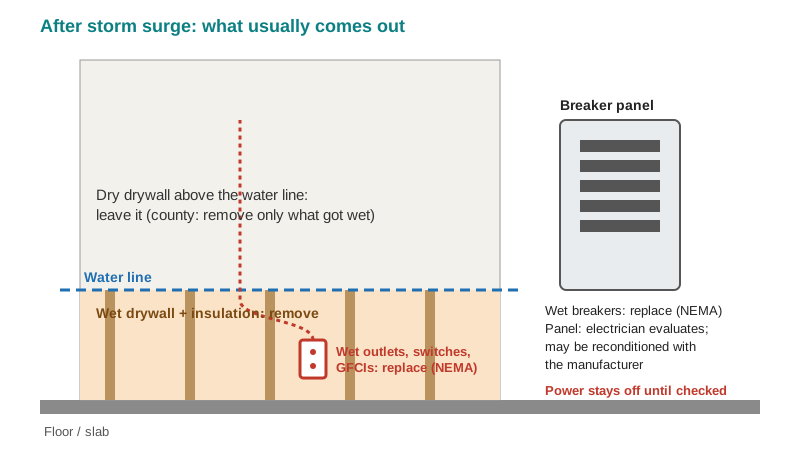
- Most wet electrical parts get replaced, not dried out. Industry guidance lists breakers, outlets, switches, GFCIs and dry-location cable among the items to replace.
- Remove only what got wet. Pinellas County, the building department for Indian Rocks Beach, warns that unnecessary demolition can push a home over the substantial-damage limit.
- Most storm repairs need permits, and many (including storm restoration and interior remodels) need city approval before the county permit. Indian Rocks Beach uses a 50% substantial-damage rule.
Local resources for Indian Rocks Beach
- City of Indian Rocks Beach: Planning, Zoning and Permitting
- City of Indian Rocks Beach: Hurricane Resources
- City of Indian Rocks Beach: Flood Hazard Information
- Pinellas County: Storm Recovery Permitting
- Pinellas County: Flood zone lookup
- Pinellas County: Find your evacuation zone
- Pinellas County: Emergency Management

Photograph it before you touch anything
Pinellas County says it "strongly encourage[s] taking pictures of the property before, during and after the cleanup/demolition process."
- The water line on every wall, inside and out, with a tape measure in the shot.
- The breaker panel, outlets and the outdoor meter before anyone opens them.
- Every room, wide and close, before wet materials go to the curb.
Why saltwater is worse
Industry guidance on water-damaged electrical equipment, published by the electrical manufacturers' association NEMA, says "Salt water exposure can be particularly damaging because of the corrosive and conductive nature of the salt water residue." Salt keeps conducting electricity and corroding metal after the water drains away.
FEMA's guide to flood-resistant materials says "In coastal environments where airborne salts contribute to corrosion, corrosion-resistant connectors and fasteners are recommended," and recommends stainless steel or hot-dip galvanized fasteners below the flood elevation.
Electrical repair after saltwater flooding

What has to be replaced. NEMA's 2026 guide (CS 70006, formerly GD 1) lists equipment to replace after water exposure, including:
- Molded-case circuit breakers and low-voltage fuses
- Switches, receptacles (outlets) and dimmers
- GFCI and AFCI devices: "Air drying and washing of water-damaged products of this type should not be attempted."
- Surge protectors and light fixtures
- Wire or cable listed only for dry locations, like the common NM-B: it "may become a shock hazard when energized after being exposed to water."
Panelboards may be reconditioned with the manufacturer's involvement, but the breakers inside are on the replace list, and the guide recommends replacing most outlet boxes too.
Don't turn it back on. NEMA warns that "Electrical equipment exposed to water can be extremely hazardous if reenergized without performing a proper evaluation." The CDC says to "NEVER turn power on or off yourself or use an electric tool or appliance while standing in water."
The meter base matters too. After Helene, Duke Energy said customers who couldn't receive power "due to damage to the property's meter base, breaker panel or customer-owned electrical wiring" should contact their local municipalities for guidance, and that "Inspections may be required after repairs are complete."
Who does the work. Under Florida law, electrical work for pay is contracting, except where the law exempts it (s. 489.505(9)), and "A person may not … Practice contracting unless the person is certified or registered" as an electrical contractor (s. 489.531). Pinellas County lists electrical among storm repairs that still need a permit. On projects we manage, the electrical work is done by a licensed electrical contractor who pulls its own permit, and we schedule it around the drywall and finish work.
Drywall and insulation: how much comes out
Pinellas County's rule. The county's storm-recovery page says you may "exclusively demolish any damaged materials, such as wet drywall, insulation, and flooring," and gives an example: "if only 2 ft of the lower portion of a drywall panel got wet, you may only remove that 2 ft section. Do not remove 4 ft out of convenience for reinstallation." Why it matters: "Unnecessary demolition and repairs may cause a property to cross the Substantial Damage threshold."
FEMA's older mold brochure says to remove soaked wallboard "to a foot above the water mark." In Indian Rocks Beach, follow the county and city first, and ask before cutting more than what's wet.
Insulation. FEMA's brochure says "Remove all wet insulation," and to discard all but rigid insulation, which can be reinstalled after disinfecting and drying. The EPA says that most of the time you should throw away materials that got wet and "cannot be thoroughly cleaned and dried within 24–48 hours."
Rebuilding smarter. FEMA lists paper-faced drywall, fiberglass batts, cellulose and open-cell foam as unacceptable below the flood elevation, and closed-cell foam and non-paper-faced gypsum board as acceptable.
Permits in Indian Rocks Beach
- Pinellas County is the building department. Since March 2020, the county "has assumed the role of the Building Department" for the city. County Building Services: 440 Court St., Clearwater, (727) 464-3888.
- The city signs off first. Indian Rocks Beach does zoning and flood review before county submittal, including for interior remodels, electrical service upgrades, window and door replacement, reroofs and water heaters. City Hall: 1507 Bay Palm Blvd., (727) 595-2517.
- Drywall needs a permit. The county lists "Drywall repair, replacement and installation" among storm repairs that need one.
- The 50% rule. The city's guide says if repairs "will equal or exceed 50% of the market value of the structure (not including the value of the land)," the home is substantially damaged and must be brought up to current flood standards. Pinellas County uses 49%, but only for unincorporated areas. The city tracks repair costs toward that 50%.
- After-the-fact permits. For floodplain homes damaged by Debby, Helene or Milton, the county waived the after-the-fact penalty (normally double the permit fee) through June 30, 2026; standard permit fees still applied. The county now says "Fees were reinstated July 1, 2026."

What repairs cost
| Repair | Typical cost | Scope | Do it yourself? |
|---|---|---|---|
| Floodwater (Category 3) extraction and drying | $9–$12 per sq ft | National (HomeGuide) | No: contaminated water |
| Repairing water-damaged walls | $610–$1,570 | Tampa (Angi) | Some of it: removal, if the county allows |
| Insulation removal and replacement | $2–$8 per sq ft | National (HomeGuide) | Some of it: removal only, with protective gear |
| Outlet installation | $101–$454 (avg $303) | Tampa (Angi) | No: licensed electrical contractor |
| Electrical box (panel) replacement | $580–$2,140 (avg $1,355) | Tampa (Angi) | No: licensed electrical contractor and permit |
| Electric meter box (meter base) replacement | $505–$2,119 | Tampa (Angi) | No: licensed electrical contractor |
| Rewiring | $2–$4 per sq ft | Tampa (Angi) | No: licensed electrical contractor and permit |
These are typical ranges, not quotes.
How much does it cost to repair storm surge damage?
It depends on how high the water got and how long it stayed. In the Tampa area, repairing water-damaged walls runs about $610 to $1,570, and floodwater cleanup and drying runs about $9 to $12 per square foot nationally. Electrical replacement is the wild card: a new panel averages $1,355 in Tampa, and rewiring runs $2 to $4 per square foot. See the full price guide for water damage repair.
What you can safely do yourself
- Go back in safely once officials give the all-clear, with the power off.
- Photograph everything before cleanup.
- Clean and disinfect after floodwater with the right protective gear.
- Cut out wet drywall, only the wet part, after checking with the county.
Leave to a pro: anything electrical, the meter base, gas, sagging ceilings or floors, and structural damage.
Frequently asked questions
Do I have to replace outlets and breakers after saltwater flooding?
Usually, yes. NEMA's guide lists circuit breakers, outlets, switches and GFCI and AFCI devices among the equipment to replace after water exposure, and says saltwater residue is especially damaging. A licensed electrical contractor should evaluate the whole system.
Can I turn my power back on after a flood?
Not until a licensed electrician has checked the system, the CDC says, and never while standing in water.
Who issues building permits in Indian Rocks Beach?
Pinellas County. For most permit types, the City of Indian Rocks Beach reviews zoning and flood requirements first.
Does Indian Rocks Beach use the 49% or 50% rule?
50%. The city's rebuilding guide says repairs that equal or exceed 50% of the structure's market value make the home substantially damaged. Pinellas County's 49% applies to unincorporated areas.
Sources
- National Weather Service Tampa Bay: Hurricane Helene impact narratives (Nov. 22, 2024, PDF)
- City of Indian Rocks Beach: City Commission agenda packet, Oct. 29, 2024 (PDF)
- City of Indian Rocks Beach: Resident's Guide to Rebuilding (Nov. 4, 2024, PDF)
- City of Indian Rocks Beach: Planning, Zoning and Permitting
- City of Indian Rocks Beach: Flood Hazard Information
- Pinellas County: Building departments in Pinellas County
- Pinellas County: Storm Recovery Permitting (updated May 1, 2026)
- Pinellas County: Substantial Damage and Substantial Improvement
- Pinellas County: After-the-Fact Permitting
- NEMA CS 70006-2026, Evaluating Water-Damaged Electrical Equipment (PDF, hosted by IECI)
- CDC: Reentering Your Flooded Home (updated Aug. 24, 2026)
- Duke Energy Florida: Hurricane Helene restoration update (Oct. 5, 2024)
- Florida Statutes s. 489.505 (2026)
- Florida Statutes s. 489.531 (2026)
- FEMA Technical Bulletin 2: Flood Damage-Resistant Materials Requirements (Jan. 2025, PDF)
- FEMA: Dealing with Mold and Mildew in Your Flood Damaged Home (PDF)
- U.S. EPA: Flood Cleanup to Protect Indoor Air Quality and Your Health (updated Mar. 18, 2026)
- U.S. EPA: Flood Cleanup: Protecting Indoor Air Quality (EPA 402-F-18001, rev. Oct. 2018, PDF)
- HomeGuide: Water Damage Restoration Cost (Feb. 6, 2026)
- HomeGuide: Insulation Cost (Dec. 19, 2025)
- Angi: Drywall Repair Cost in Tampa (July 6, 2026)
- Angi: Outlet Installation Cost in Tampa (June 9, 2026)
- Angi: Electrical Box Replacement Cost in Tampa (July 31, 2026)
- Angi: Electric Meter Box Replacement Cost in Tampa (June 29, 2026)
- Angi: Rewiring Cost in Tampa (July 8, 2026)