

A crack in stucco doesn't have to look like much to let water in. The Florida Division of Emergency Management's Hurricane Retrofit Guide says a hairline crack in stucco only 6 inches long and 1/64 inch wide has the same area to let water in as a square hole over 1/4 inch on a side. In a storm with wind-driven rain, that's a real opening.
Dunedin has plenty of walls to watch. U.S. Census estimates put the median year built in Dunedin at 1976, and about 61% of the city's 21,305 housing units were built before 1980. Paint wears, caulk dries out, soil and mulch build up against the wall, and small cracks open where windows, pipes and wires go through.
Is this urgent?
- Call now: water coming in near outlets or the electrical panel, or a wall that's bulging, leaning or has stucco falling off. Keep clear, shut off power at the breaker only if you can do it from a dry spot, and call a licensed electrician for wet wiring.
- Call today: water inside after rain (wet drywall or baseboard, stains below a window), or stucco that sounds hollow or feels soft when you press it. The EPA says water-damaged areas dried within 24 to 48 hours usually won't grow mold.
- Can wait: fine, dry hairline cracks with no stains inside. Seal them before the next storm season (below).
Local resources for Dunedin
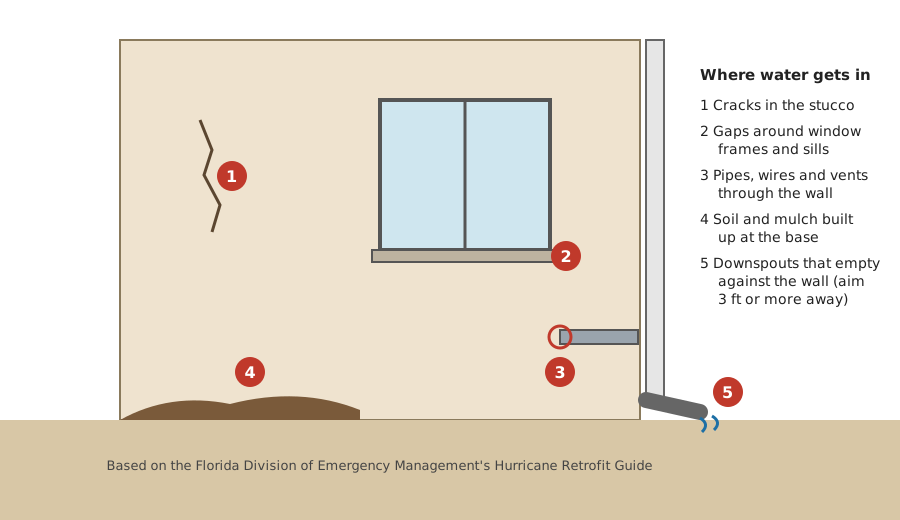
Where water gets behind stucco
Openings are often the bigger problem. After Hurricane Ian, FEMA's investigators reported that stucco on newer Florida homes "performed well overall with infrequent minor damage" from the wind, while they got "numerous homeowner reports of water intrusion at windows and doors." The state's retrofit guide says water "is likely to find its way into your house through any holes, cracks, gaps or wherever a pipe or cable pierces the wall." The usual places:
- Around windows and doors. The guide says a crack between a window frame and the house only 1/64 inch wide lets in as much water as a hole 1/2 inch on a side. It also flags "cracks or voids in mortar under window sills."
- Pipes, wires and vents that go through the wall: hose bibs, A/C lines, electrical boxes, light fixtures, dryer and range vents.
- The base of the wall. The guide says soil can build up "sometimes by several inches" as mulch and plants accumulate, and you can get leaks at the base of the wall if the floor isn't well above the ground.
- Downspouts that dump water against the wall. The guide says they should discharge at least 3 feet away.
- Worn paint. The guide says some houses "simply did not have thick enough suitable paint" to keep block and stucco walls from soaking through.
Which cracks you can seal, and which need a pro
The state guide says you can use a single application of exterior caulk for small cracks up to about 1/4 inch wide, and multiple applications for cracks up to about 1/2 inch. It warns that caulks made for interior paint work aren't suitable outside. The Park Service says small hairline cracks in historic stucco "usually are not serious," while larger cracks have to be cut out for a proper repair. For historic stucco it prefers sealing hairline cracks with a thin slurry coat rather than caulk, which it says can be highly visible; the state guide's caulk advice is about keeping water out.
Our advice: call a pro instead of caulking when a crack is wider than 1/2 inch, runs in a stair-step or diagonal line from a window corner, keeps growing, has rust or brown stains running from it, or the stucco around it bulges or sounds hollow when tapped. The Park Service says loose stucco that has lost its bond "will echo with a hollow sound when tapped gently."

What's behind the stucco
On a wood-framed wall, water that gets behind stucco reaches the sheathing and framing. The Park Service says water infiltration "will cause wood lath to rot, and metal lath and nails to rust," which eventually makes stucco lose its bond and pull away. It also says to fix the cause of the water first, before repairing the stucco. If the wood behind it is soft, see our post on wood rot and the wood rot repair price guide.
Photograph it before you touch anything
Photograph each crack with a tape measure or a coin in the frame for scale, the wall inside the room behind it, any stains, and the base of the wall. Write down the date and check the same cracks again after a hard rain. If you'll make an insurance claim, ask your insurer what they need; this is general information, not insurance advice.
What you can safely do yourself
- Seal small cracks and gaps up to about 1/2 inch with exterior caulk: how to seal small stucco cracks and wall gaps.
- Pull soil and mulch back from the base of the wall (the state guide's fix for base-of-wall leaks).
- Point downspouts so water lands at least 3 feet from the wall.
- If water got into the wall, see our guide to cutting out wet drywall.
Leave to a pro: cracks wider than 1/2 inch, hollow or bulging stucco, anything on a ladder, rotted sheathing or framing, and sanding or scraping paint on a pre-1978 home (the EPA says those homes are more likely to have lead-based paint).
Who can do stucco work in Florida
Florida law lists "stuccoing" and "plastering" among the job scopes a local government may not require a license for (s. 489.117(4)(a)1., Fla. Stat.). The state also created a certified "plaster and lath specialty contractor" category in 2024 (Rule 61G4-15.100, F.A.C.), and the Construction Industry Licensing Board has adopted a one-hour continuing education requirement on stucco, plastering and lath for general, building, residential and specialty structure contractors, starting with licenses that expire August 31, 2027 (registered) and August 31, 2028 (certified). The statute limits local licensing; check with DBPR whether state certification applies to your job. Repairs to the wood framing behind stucco are a different job: under s. 489.113(3)(a), a general, building or residential contractor is responsible for work on structural components. You can check any license at myfloridalicense.com.
Permits for stucco in Dunedin
- After a storm, stucco over frame needs a permit. Dunedin's storm recovery FAQ lists "Replacing, repairing, or installing siding, soffit, fascia, stucco over frame" among repairs that require a permit, and says "Any repair work that normally requires a permit will still require a permit, even after a storm event." The city's storm fact sheet says to apply as an "Alteration to Residential Building."
- What doesn't need one. Dunedin's residential permits brochure lists painting and "ordinary minor repairs" among work that doesn't need a permit, and its fee schedule says no permit is required when the work is valued at $500 or less unless an inspection is required. The city doesn't say where small crack sealing on a block wall falls, so call before you start.
- The under-$7,500 exemption. Dunedin's summary of the new state law says it doesn't apply to electrical, plumbing, structural, mechanical or gas work or to properties in flood hazard areas, and requires a written request (s. 553.79(1)(g)). Pinellas County lists stucco as a possible example for unincorporated areas, but Dunedin's summary doesn't mention stucco.
- Flood zones. Dunedin's substantial improvement packet uses 50% of the structure's market value and counts "exterior wall finishes (e.g. brick, stucco, or siding)" in the cost.
Dunedin's Building Division is at City Hall, 737 Louden Ave., Suite 137, (727) 298-3210, with permits through the city's Citizen Self Service portal. The city's permitting guide says to expect fees of about 1% of the construction value. We repair stucco across Dunedin and Pinellas County; see our stucco repair service.
What stucco repairs typically cost
| Repair | Typical cost | Source | Do it yourself? |
|---|---|---|---|
| Stucco crack repair | $255 to $810 | Angi, Tampa, 2026 | Some of it: small cracks up to about 1/2 inch with exterior caulk |
| Hole or puncture repair | $305 to $910 | Angi, Tampa, 2026 | Some of it: small holes around pipes and fixtures |
| Typical stucco repair or partial replacement | $476 to $2,041 (average $1,258) | Angi, Tampa, 2026 | No: matching and bonding new stucco takes a pro |
| Stucco water damage repair | $1,010 to $3,030 | Angi, Tampa, 2026 | No: the stucco comes off and what's behind it gets fixed |
| Full resurfacing | $3,030 to $8,080 | Angi, Tampa, 2026 | No |
| Stucco inspection with moisture probes | $600 to $1,500 | Angi, national, 2026 | No |
We couldn't find a Florida price for moisture-probe inspections, so that row is national.
How much does it cost to repair stucco?
In Tampa, Angi puts traditional cement stucco repair at $10 to $35 per square foot, with a typical repair or partial replacement averaging $1,258. A simple crack runs $255 to $810, while water damage repair, where the stucco comes off to fix what's behind it, runs $1,010 to $3,030. The size of the area, matching the texture, and any rotted sheathing or framing move the price most. See the full price guide for stucco repair costs.
Frequently asked questions
Are small cracks in stucco normal?
The Park Service says small hairline cracks in historic stucco usually aren't serious, but the Florida Division of Emergency Management notes even a 6-inch hairline crack has the same area to let water in as a square hole over 1/4 inch on a side, and says sealing cracks is critical.
Can I caulk stucco cracks myself?
For small cracks, yes. The state's Hurricane Retrofit Guide says a single application of exterior caulk works for cracks up to about 1/4 inch, and multiple applications for cracks up to about 1/2 inch. Wider cracks need a proper repair.
Do I need a permit to repair stucco in Dunedin?
After a storm, Dunedin lists repairing or replacing "stucco over frame" as work that needs a permit. Painting and ordinary minor repairs don't. Call the Building Division at (727) 298-3210 to confirm your job.
How do I know if water is behind my stucco?
Stains on the wall inside, soft or bubbling paint, and stucco that sounds hollow when tapped are warning signs. The Park Service says stucco that has lost its bond echoes when tapped. A pro can open a small area to check the sheathing.
Sources
- Florida Division of Emergency Management: Hurricane Retrofit Guide, "Water Leaks Through Walls" (PDF)
- FEMA P-2342: Hurricane Ian in Florida, Mitigation Assessment Team Report (PDF)
- National Park Service: Preservation Brief 22, The Preservation and Repair of Historic Stucco (PDF)
- U.S. Census Bureau, ACS 2024, table B25034: Dunedin year structure built
- U.S. Census Bureau, ACS 2024, table B25035: Dunedin median year built
- City of Dunedin: Permits and inspections
- City of Dunedin: Storm recovery permitting FAQs (PDF)
- City of Dunedin: Storm recovery permitting, residential (PDF)
- City of Dunedin: Residential building permits brochure (PDF)
- City of Dunedin: Practical guide to permitting (PDF)
- City of Dunedin: Fee schedule, Appendix C (PDF)
- City of Dunedin: Permit exemptions effective July 1, 2026 (PDF)
- City of Dunedin: Substantial improvement or damage review packet (PDF)
- Pinellas County: Permit exemptions for work under $7,500
- Florida Statutes s. 489.117
- Florida Statutes s. 489.113
- Florida Statutes s. 553.79
- Florida Administrative Code Rule 61G4-15.100, specialty contractors
- DBPR Construction Industry Licensing Board: Hot topics (stucco continuing education)
- Angi: Stucco repair cost in Tampa
- Angi: Stucco inspection cost
- EPA: A Brief Guide to Mold, Moisture and Your Home
- EPA: Protect your family from sources of lead