

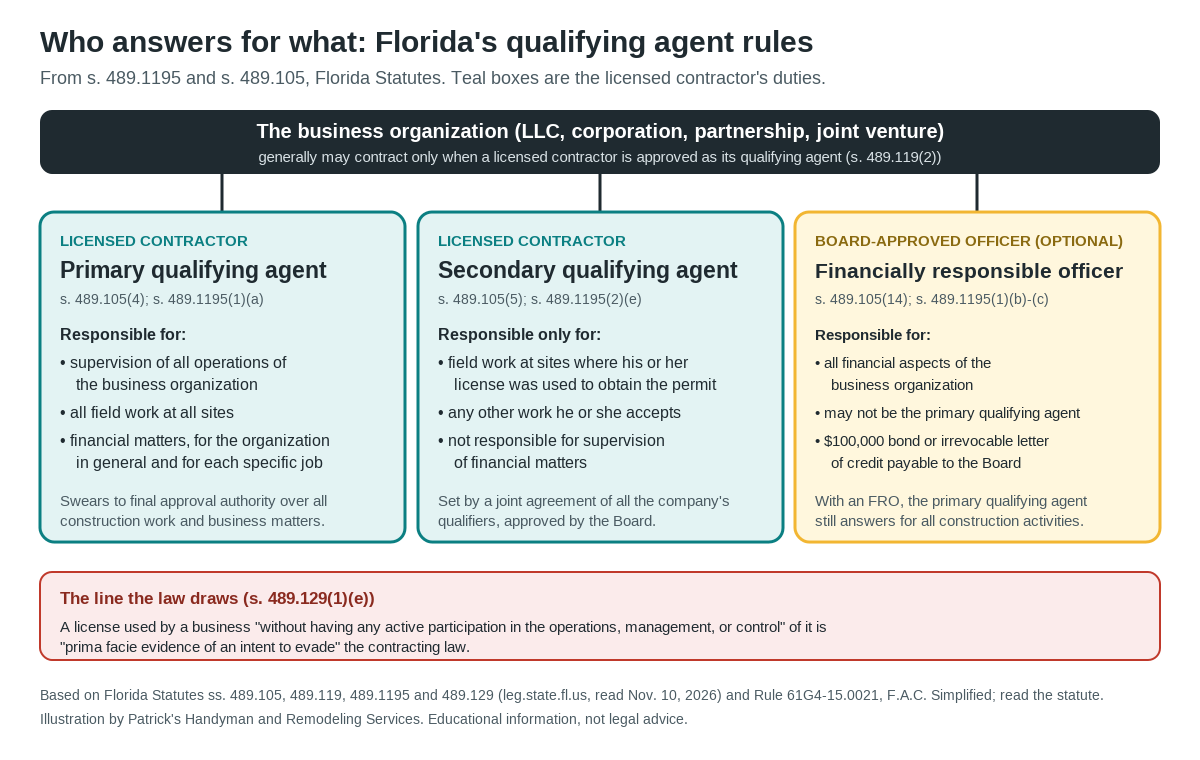
Short answer: In Florida, a contractor's license belongs to a person. A business organization generally can contract only through a licensed contractor the Board approves as its qualifying agent (s. 489.119(2)). That person is "jointly and equally responsible for supervision of all operations of the business organization; for all field work at all sites; and for financial matters" (s. 489.1195(1)(a)). Letting a company use your license without running it is "prima facie evidence of an intent to evade" the law (s. 489.129(1)(e)).
Most handymen who look into getting legal in Florida run into the phrase "qualifying agent" within a day, and much of what gets repeated about it isn't what the statute says. The rules are public, and they're worth reading in full before you sign anything, because the qualifier is the person the law holds responsible when a job goes bad (s. 489.1195(1)(a)).
This guide covers the law as written: the definitions, what the qualifier swears to, who carries the financial side, what the Board checks, what happens when a qualifier leaves, and where a license arrangement stops being a business structure and becomes a crime. It is educational information, not legal advice. Your own situation belongs with a Florida construction attorney or the Department of Business and Professional Regulation (DBPR).
What is a qualifying agent in Florida?
Chapter 489 licenses people. DBPR's Construction Industry Licensing Board page says it plainly: "Each construction business must be qualified by a properly licensed individual contractor in order to engage in construction activities in Florida," and the approved business's name "will appear on the contractor's individual license." A contractor operating with no business name gets the word "INDIVIDUAL" on the license instead (DBPR, Business Information).
The statute puts it this way: if the applicant "proposes to engage in contracting as a business organization, including any partnership, corporation, business trust, or other legal entity," the applicant "must apply for registration or certification as the qualifying agent of the business organization" (s. 489.119(2)). A "business organization" is "any partnership, corporation, business trust, joint venture, or other legal entity which engages or offers to engage in the business of contracting" (s. 489.105(13)). A joint venture, even one made up of qualified companies, "is itself a separate and distinct organization that must be qualified" (s. 489.119(2)(e)).
The old separate "qualified business license" or Certificate of Authority was dropped on October 1, 2009; today the business is simply added to the qualifier's license (CILB FAQs).
Primary and secondary qualifying agents
The statute defines two kinds.
A primary qualifying agent "possesses the requisite skill, knowledge, and experience, and has the responsibility, to supervise, direct, manage, and control the contracting activities of the business organization with which he or she is connected," and has the same responsibility for "construction activities on a job for which he or she has obtained the building permit" (s. 489.105(4)).
A secondary qualifying agent has that responsibility only for "construction activities on a job for which he or she has obtained a permit" (s. 489.105(5)).
| Primary qualifying agent | Secondary qualifying agent | |
|---|---|---|
| Supervision of all company operations | Yes (s. 489.1195(1)(a)) | No |
| Field work | "all field work at all sites" | Only sites "where his or her license was used to obtain the building permit" and other work he or she accepts (s. 489.1195(2)(e)) |
| Financial matters | Yes, "both for the organization in general and for each specific job" | "not responsible for supervision of financial matters" |
| How the role is set | Default: every qualifier is primary unless designated secondary (s. 489.1195(1)) | By a joint agreement of all the company's qualifiers, approved by the Board (s. 489.1195(2)(a)-(c)) |
A company can have more than one qualifier; DBPR says "There is no limit." When a company with several qualifiers names one as sole primary by joint agreement, that person "is jointly and equally responsible with secondary qualifying agents for field work supervision" (s. 489.1195(2)(d)).
What the qualifier swears to
The application to qualify a business includes an affidavit "attesting that the applicant has final approval authority for all construction work performed by the business organization and that the applicant has final approval authority on all business matters, including contracts, specifications, checks, drafts, or payments, regardless of the form of payment, made by the business organization, except where a financially responsible officer is approved" (s. 489.119(2)(b)1.). The business itself signs a statement of authority (its partners, certified corporate minutes, or the people who can legally bind it) confirming the applicant "is legally qualified to act for the business organization in all matters connected with its contracting business" and "has authority to supervise construction undertaken by such business organization as the organization's primary qualifying agent" (Rule 61G4-15.002, F.A.C.).
The qualifier doesn't have to own the company. DBPR's answer: "No, however, the contractor must have supervisory authority and must have final approval authority for all of the construction affairs of the business" (CILB FAQs).
Once approved, the responsibility is spelled out in one sentence: "All primary qualifying agents for a business organization are jointly and equally responsible for supervision of all operations of the business organization; for all field work at all sites; and for financial matters, both for the organization in general and for each specific job" (s. 489.1195(1)(a)). Nothing in the section lets a primary qualifier disclaim supervision. If the company folds with jobs open, DBPR says the qualifier is "responsible, as a qualifying agent, for jobs that were not completed."

The financially responsible officer
The money side can be moved to a Board-approved financially responsible officer (FRO): "a person other than the primary qualifying agent who with the approval of the board assumes personal responsibility for all financial aspects of the business organization" (s. 489.105(14)). The FRO "may not be designated as the primary qualifying agent," and once an FRO is in place "the primary qualifying agent shall be responsible for all construction activities of the business organization, both in general and for each specific job" (s. 489.1195(1)(b)-(c)).
The FRO's affidavit says the officer's "approval is required for all checks, drafts, or payments" made by the company (s. 489.119(2)(b)2.). The FRO must post "a bond or irrevocable letter of credit, in the amount of $100,000 payable to the Board for fines and costs" (Rule 61G4-15.0021(2)); the application fee is $200 (DBPR form CILB 8, effective July 2024).
What the Board checks before it approves a qualifier
- Credit. The statute asks for a credit report showing "financial responsibility, credit, and business reputation of either himself or herself or the business organization he or she desires to qualify" (s. 489.115(5)(b)); the Board's rule requires the applicant's report with no unsatisfied judgments or liens against the applicant or the business, and a FICO-derived score of 660 or higher or a Board-approved 14-hour financial responsibility course; DBPR's application pages ask for credit reports on both the applicant and the business (Rule 61G4-15.006; DBPR CILB application list). DBPR says no minimum net worth is required.
- Insurance. General and building contractors: $300,000 public liability and $50,000 property damage; residential and other categories: $100,000 and $25,000, in aggregate, carried in the licensee's name and showing "the exact name of the business organization qualified by the applicant" (Rule 61G4-15.003(2)(c), (2)(h), (3)), plus workers' comp coverage or an exemption. Our contractor insurance guide covers the policies.
- Fees. DBPR's fee notice for a new certified general contractor applying to qualify a business (CILB 6-A) reads "The current fee for this application is $245. If you submit this application after August 31, 2027 the fee will be $145" (DBPR fee page, read Nov. 10, 2026). A change of status from individual to qualifying a business is $50 (CILB 15). Licenses that qualify a business pay a $50 business qualification fee at each renewal (CILB FAQs).
- Past discipline. The Board "may deny an application" if the applicant or any partner, officer, director, trustee or member named in the application "has been involved in past disciplinary actions" (s. 489.119(2)(c)).
- More than one company. A licensee may qualify additional businesses, but "the board shall require the qualifying agent to present evidence of his or her ability to supervise the construction activities of each such organization. Approval of each business organization is discretionary with the board" (s. 489.119(6)). Each entity is qualified on its own; "subsidiaries or parents of qualified business organizations must be separately qualified" (Rule 61G4-15.0021(4)). A qualifier who wants to contract in his or her own name too must qualify that as an additional business (CILB FAQs).

What happens when the qualifier leaves
A qualifier who leaves "shall inform the department," and if that person was the company's only licensed contractor, the company "shall have 60 days from the termination of the qualifying agent's affiliation with the business organization in which to employ another qualifying agent." Until then it "may not engage in contracting," unless the Board's executive director or chair grants a temporary nonrenewable certificate to the financially responsible officer, the president or a partner (the general partner of a limited partnership) "who assumes all responsibilities of a primary qualifying agent," and that temporary certificate "shall only allow the business organization to proceed with incomplete contracts" (s. 489.119(3)(a)). Operating "after 60 days following the termination of its only qualifying agent without designating another primary qualifying agent" is a prohibited act (s. 489.127(1)(g)).
The Board must hear about it within 30 days (Rule 61G4-15.007(1)), and a licensee can't just mail a letter asking to be removed; DBPR requires an application to inactivate the license or change its status (CILB FAQs). Responsibility runs forward only: a new qualifier "is not responsible for his or her predecessor's actions but is responsible, even after a change in status, for matters for which he or she was responsible while in a particular status" (s. 489.1195(3)(d)).
Where it turns into a crime
The statute draws the line for the licensee, not just the unlicensed side. A certified or registered contractor "may not enter into an agreement, oral or written, whereby his or her certification number or registration number is used, or to be used, by a person who is not certified or registered" or "by a business organization that is not duly qualified," and may not "knowingly allow" that use (s. 489.127(4)(a)-(b)). A licensed contractor also may not pull a permit "unless the certified or registered contractor ... or business organization duly qualified by said contractor, has entered into a contract" for that property, apart from unpaid work for someone else or work on the contractor's own property (s. 489.127(4)(c)). The first violation is a first-degree misdemeanor; a repeat is a third-degree felony (s. 489.127(4)(d)).
The Board's discipline statute adds two grounds aimed at the same conduct:
- "Performing any act which assists a person or entity in engaging in the prohibited uncertified and unregistered practice of contracting, if the certificateholder or registrant knows or has reasonable grounds to know that the person or entity was uncertified and unregistered" (s. 489.129(1)(d)).
- "Knowingly combining or conspiring with an uncertified or unregistered person by allowing his or her certificate or registration to be used by the uncertified or unregistered person with intent to evade the provisions of this part. When a certificateholder or registrant allows his or her certificate or registration to be used by one or more business organizations without having any active participation in the operations, management, or control of such business organizations, such act constitutes prima facie evidence of an intent to evade the provisions of this part" (s. 489.129(1)(e)).
The Board's normal penalty for either one starts at a $5,000 fine with probation or suspension and runs to a $10,000 fine with probation, suspension or revocation (Rule 61G4-17.001(1)(d)-(e), effective Jan. 18, 2026). When the violation was "performed in connection with a construction project undertaken by that business organization," the Board can also fine the business, or any partner, officer, director, trustee or member who "participated in the violation or knew or should have known of the violation and failed to take reasonable corrective action," up to $5,000 more per violation (s. 489.129(2)). A revoked licensee can't be an officer, director, partner, trustee or manager of a contracting business for five years (s. 489.129(9)).
For the unlicensed side, a company "is unlicensed if the business organization does not have a primary or secondary qualifying agent" for the scope of the work, its contracts are unenforceable by it, and it has no lien or bond rights (s. 489.128(1)(a), (2)). The criminal side, DBPR citations and Pinellas County's own fines are in our guide to the penalties for unlicensed contracting in Florida.
Why this matters if you're a handyman wanting bigger jobs
Read the responsibility sentence again and the structure of the law makes sense. Florida lets a licensed contractor's company take permitted work because a named person with a tested license stands behind every job, every site and every dollar. Anyone offering you a "license to work under" without that person running the operation is offering you the s. 489.129(1)(e) fact pattern, and the licensee's exposure is the Board's whole toolbox: probation, reprimand, suspension, revocation, restitution and fines up to $10,000 per violation (s. 489.129(1)).
Done the legal way, working with a certified or registered contractor's company changes what you can take on:
- Permitted and larger jobs become possible. The statute allows a subcontractor who is not licensed to work "under the supervision of a person who is certified or registered, provided that the work is within the scope of the supervising contractor's license, the supervising contractor is responsible for the work," and the work isn't in a separately licensed trade (s. 489.113(2)). Electrical, plumbing, mechanical, roofing, sheet metal, pool and A/C work still go to contractors licensed in those trades (s. 489.113(3)).
- You stay inside the handyman limits where they apply. The $2,500 casual-work exemption and its traps are in what a handyman can legally do in Florida without a license and the handyman dollar limits in Pinellas.
- The company you work with is on record. Every offer, bid, contract and ad has to carry the qualifier's license number, "regardless of medium" (s. 489.119(5)(b)), so a customer or inspector can check it on DBPR in a minute. Registration with each Pinellas city is a separate step, covered in contractor registration in Pinellas County.
- The record matters too. Under s. 489.113(2), supervised work has to be within the supervising contractor's license scope and that contractor has to be responsible for it; permits, written contracts carrying the license number (s. 489.119(5)(b)) and the qualified company's insurance are part of the public record of who is responsible for a job.
We work with handymen and contractors in Pinellas County on qualifying and partnering questions. How a particular arrangement is set up depends on the Board's rules and on your situation, so it isn't something we lay out in an article. If you want to grow into permitted work the legal way, talk to a Florida Certified General Contractor about your options.

Frequently asked questions
Does a qualifying agent have to own the company?
No. DBPR's FAQ says the contractor doesn't have to own the business but "must have supervisory authority and must have final approval authority for all of the construction affairs of the business," and if the contractor lacks financial responsibility for the company, "the company must obtain a Financially Responsible Officer."
Can one contractor qualify more than one business in Florida?
Yes, with Board approval for each one. The statute requires "evidence of his or her ability to supervise the construction activities of each such organization," and "Approval of each business organization is discretionary with the board" (s. 489.119(6)).
What is a financially responsible officer?
A Board-approved person, other than the primary qualifying agent, who "assumes personal responsibility for all financial aspects of the business organization" (s. 489.105(14)), signs an affidavit that his or her approval is required for all payments (s. 489.119(2)(b)2.), and posts a $100,000 bond or irrevocable letter of credit payable to the Board (Rule 61G4-15.0021(2)).
What happens if a company's qualifying agent quits?
The company must notify the department and has 60 days to employ another qualifying agent; it "may not engage in contracting" in the meantime unless the Board grants a temporary nonrenewable certificate to the financially responsible officer, the president or a partner, and only to finish incomplete contracts (s. 489.119(3)(a)).
Is it illegal to let someone use your contractor's license in Florida?
Yes. A licensed contractor may not agree to let, or knowingly allow, his or her license number to be used by an unlicensed person or an unqualified business; a first offense is a first-degree misdemeanor and a repeat is a third-degree felony (s. 489.127(4)). The Board can also discipline the licensee under s. 489.129(1)(d)-(e), with a normal penalty of $5,000 to $10,000 plus probation, suspension or revocation (Rule 61G4-17.001).
Sources
- Florida Statutes s. 489.105, Definitions (2026)
- Florida Statutes s. 489.113, Qualifications for practice; restrictions (2026)
- Florida Statutes s. 489.115, Certification and registration (2026)
- Florida Statutes s. 489.119, Business organizations; qualifying agents (2026)
- Florida Statutes s. 489.1195, Responsibilities (2026)
- Florida Statutes s. 489.127, Prohibitions; penalties (2026)
- Florida Statutes s. 489.128, Contracts entered into by unlicensed contractors unenforceable (2026)
- Florida Statutes s. 489.129, Disciplinary proceedings (2026)
- Rule 61G4-15.002, F.A.C., Statement of Authority
- Rule 61G4-15.0021, F.A.C., Business Organizations
- Rule 61G4-15.003, F.A.C., Public Liability Insurance
- Rule 61G4-15.006, F.A.C., Financial Responsibility and Financial Stability
- Rule 61G4-15.007, F.A.C., Notification of Changes
- Rule 61G4-17.001, F.A.C., Normal Penalty Ranges
- DBPR Construction Industry Licensing Board: Business Information
- DBPR Construction Industry Licensing Board: Frequently Asked Questions (read Nov. 10, 2026)
- DBPR Construction Industry Licensing Board: applications and fees (fee notices read Nov. 10, 2026)
- DBPR form CILB 8, Financially Responsible Officer (PDF, eff. July 2024)
- DBPR form CILB 15, Change of Status, Individual to Qualifying Business (PDF, eff. July 2024)