

Short answer: Certified or registered general and building contractors must keep $300,000 public liability and $50,000 property damage coverage in aggregate (Rule 61G4-15.003), plus workers' comp as required by chapter 440. We found no state liability minimum for unlicensed handyman work, but the Division of Workers' Compensation says construction employers with one or more employees, including owners who are corporate officers or LLC members, must have workers' comp; an owner with a valid exemption isn't counted. Insureon says its Florida handyman customers average $98 per month for general liability.
Insurance is one of the first real costs of running a handyman or contracting business, and one of the most misunderstood. Some handymen think they need no coverage because they don't hold a license. Some newly licensed contractors think the policy they bought for their license application covers every job. Florida law treats liability insurance and workers' compensation very differently, and neither one depends only on whether you're licensed.
This guide starts with what Florida handymen actually pay, then walks through what the law requires, policy by policy. It's educational information, not legal advice or insurance advice. Confirm your own situation with an insurance professional, the Florida Division of Workers' Compensation and, for licensing questions, the Department of Business and Professional Regulation (DBPR).
How much is handyman insurance in Florida?
Insureon, an online insurance agency, publishes what its handyman customers pay. On its Florida page, Insureon says Florida handyman contractors who buy policies through it pay an average of:
| Policy | Insureon Florida customers (average) | Insureon national figure |
|---|---|---|
| General liability | $98 per month | $81 per month ($978 a year) |
| Workers' compensation | $45 per month | $108 per month ($1,295 a year) |
| Commercial auto | $487 per month | $188 per month ($2,252 a year) |
| Business owner's policy (liability + property) | not listed | $105 per month ($1,266 a year) |
| Tools and equipment (inland marine) | not listed | $42 per month ($505 a year) |
| Commercial umbrella | not listed | $93 per month ($1,111 a year) |
| Surety bond | not listed | $9 per month ($112 a year) |
The national figures come from Insureon's handyman cost page (updated July 31, 2026), which says its numbers are the median cost of policies for handymen who apply for quotes through it, and that most of those customers have fewer than five employees. The typical general liability policy it describes has limits of "$1 million per occurrence; $2 million aggregate" and a $500 deductible.
Read these as rough benchmarks, not quotes. They reflect one agency's customers, and two things move your price more than anything else:
- What work you do. Insurers price risk by trade. Painting, drywall and carpentry are rated differently.
- For workers' comp, your payroll and class code. Workers' comp is priced on the payroll in each job classification. Insureon doesn't explain why its Florida workers' comp average ($45) is lower than its national figure ($108). Both reflect the mix of customers who bought through Insureon (and the national figure is a median), not a rate you can expect. A one-person company whose owner holds an exemption (explained below) may buy little or no workers' comp at all.
One piece of good news: Florida's Office of Insurance Regulation approved a 6.9% statewide overall decrease in workers' comp rates for new and renewal policies starting January 1, 2026, the ninth year in a row that rates came down.
What insurance does a handyman need?
The answer depends on three questions: whether you're licensed, whether you have anyone working for you, and what you tell customers.
Licensed contractors: liability and property damage minimums
If you're certified or registered by the Construction Industry Licensing Board (CILB), insurance is a condition of your license. Section 489.115(5)(a), Florida Statutes, requires an affidavit at initial licensure and every renewal that you have workers' compensation "as required by chapter 440, public liability insurance, and property damage insurance" in amounts set by board rule. Section 489.114 separately requires evidence of workers' comp coverage at issuance and renewal.
The amounts are in Rule 61G4-15.003, Florida Administrative Code, as the "proper aggregate amount of public liability and property damage":
| License | Public liability | Property damage |
|---|---|---|
| General contractor, building contractor | $300,000 | $50,000 |
| Residential contractor | $100,000 | $25,000 |
| Roofing, plumbing, air conditioning, mechanical, pool, sheet metal, solar, underground utility and excavation, pollutant storage, and specialty contractors (unless the rule specifies otherwise) | $100,000 | $25,000 |
Electrical contractors are licensed by a different board, the Electrical Contractors' Licensing Board, and its own insurance rule (Rule 61G6-5.008) applies instead, according to the PCCLB's processing manual.
Three parts of the rule catch people:
- It's continuous. The rule says it "shall be a violation of this rule for any licensee to fail to continually maintain" the coverage, for the life of an active license.
- The board audits. The CILB runs random audits by zip code. A selected licensee has 30 days to prove coverage, and the proof must show the coverage "has been continually maintained since the time of the last license renewal."
- The name must match. The certificate must show "the exact name of the business organization qualified by the applicant," and the rule says the insurance must "at all times, be carried in the name of the licensee." (What the law makes a company's qualifying agent responsible for is covered in what a qualifying agent is in Florida.)
If you hold a Pinellas County "C-" license instead of a state license, the Pinellas County Construction Licensing Board's processing manual says its rule requires general liability of at least "$100,000 per occurrence/$300,000 aggregate and $50,000 property damage."
Building departments check too. Under s. 489.113(4)(c), a local government "may also deny issuance of, or may suspend, any outstanding building permit" when a contractor fails or refuses to provide proof of the required liability and workers' comp coverage. What each Pinellas department wants on your certificate is in our guide to contractor registration in Pinellas County.
Unlicensed handymen: no state liability minimum we could find
The liability minimums above are tied to a CILB certificate or registration. We found no Florida statute or rule that sets a general liability minimum for handyman work that doesn't need a license, like painting or flooring. That's the absence of a rule we could find, not an official statement that none exists, so check with your agent and with any city where you register. Some do ask: Clearwater's May 2026 registration form for contractors without a DBPR or PCCLB license asks for a certificate of insurance.

Going without liability coverage is still a business risk. If a ladder goes through a window or a leak you caused ruins a floor, the homeowner can come after you for it.
Workers' comp: the license doesn't decide it, the industry does
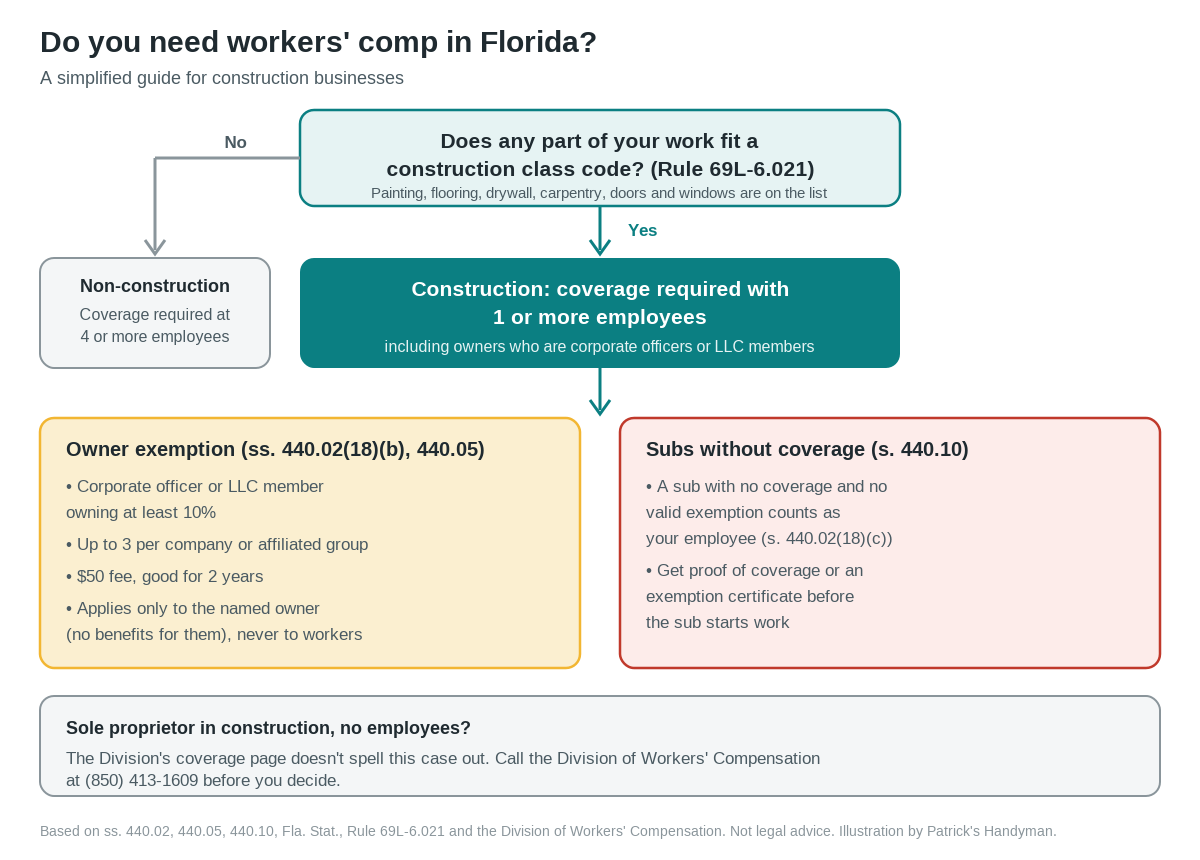
This is the part most handymen get wrong. Florida's workers' comp law turns on whether you're in the "construction industry" and how many employees you have, not on whether you hold a license.
- Section 440.02(10) defines the construction industry as "for-profit activities involving any building, clearing, filling, excavation, or substantial improvement in the size or use of any structure or the appearance of any land."
- Rule 69L-6.021 lists the construction class codes and says a business is in the construction industry "when any portion of the employer's business operations" fits one of them. The list includes painting (5474), floor covering installation (5478), wallboard installation (5445), carpentry on one- and two-family dwellings (5645) and door and window installation (5102). The rule adopts the codes from a national manual "including updates through January 1, 2011," so confirm your current class with your agent or the National Council on Compensation Insurance.
So painting and flooring need no state license (s. 489.117(4)(a)1.), but for workers' comp they're construction work.
The Division of Workers' Compensation's coverage requirements page says construction "Employers with one or more employees, including the owner of the business who are corporate officers or Limited Liability Company (LLC) members, must have workers' compensation coverage." Outside construction, the threshold is four employees. Two more points from the statute matter for small crews:
- Your "1099 sub" may count as your employee. Under s. 440.02(18)(c), employees include "All persons who are being paid by a construction contractor as a subcontractor," unless the sub has a valid exemption or its own coverage, and "An independent contractor working or performing services in the construction industry."
- You can end up paying for your sub's injured worker. Under s. 440.10(1), a contractor is liable for compensation to a subcontractor's employees unless the sub "has secured such payment," and "A contractor shall require a subcontractor to provide evidence of workers' compensation insurance." The Division's page puts it plainly: if the sub has no coverage, "those workers become the employees of the contractor."
Sole proprietors: the statute lists "A sole proprietor who engages in the construction industry" as an employee (s. 440.02(18)(c)4.), construction exemptions are issued only to corporate officers and LLC members, and the Division's "Election of Coverage" option is for non-construction sole proprietors only. The Division's coverage page doesn't spell out what a one-person construction sole proprietorship must buy, so call the Division at (850) 413-1609 before you decide.
How to get a workers' comp exemption in Florida (construction)
A construction exemption lets a business owner exclude himself or herself from workers' comp, not the business or its workers. Under ss. 440.02(18)(b)2. and 440.05, Florida Statutes, and the Division's construction exemption page:
- Who qualifies: an officer of a corporation, or a member of an LLC, registered and listed as active with the Florida Division of Corporations, who owns at least 10% of it and is listed there as an officer or member.
- How many: no more than three officers or members of a company, or of a group of affiliated companies.
- Cost and term: a $50 fee, and the certificate is valid for 2 years.
- What you certify: that any employees of the company are covered by workers' comp, and that you've completed the Division's online coverage and compliance tutorial.
- What it isn't: by law, the certificate must say it "is NOT a license issued by the Department of Business and Professional Regulation (DBPR)."
Once you're exempt, the Division says, you're "not considered an employee of the business and may not recover workers' compensation benefits." In other words, if you get hurt, the exemption means you're not covered. Our guide to Florida workers' comp exemptions for contractors goes through the application, renewals and what to collect from a subcontractor who has one.
You'll need proof every time you pull a permit. Under s. 440.103, every employer must show a certificate of coverage, a valid exemption certificate or authority to self-insure "each time the employer applies for a building permit."
What happens if you don't carry workers' comp
The Division of Workers' Compensation enforces the law directly. Under s. 440.107(7), if the Division finds an employer that was required to carry coverage hasn't, it must issue a stop-work order "requiring the cessation of all business operations," and the order applies to all of that employer's non-compliant worksites in Florida. Stop-work order information stays on the Division's website for at least 5 years.
The penalty is 2 times what you would have paid in premium for the uninsured period in the preceding 12 months, or $1,000, whichever is greater. The look-back is 24 months if the stop-work order is for materially understating or concealing payroll, or if you've previously been issued a stop-work order or penalty assessment order.
Don't say "insured" unless the job is covered

"Licensed and insured" is a claim the law takes seriously. Under s. 489.119(5)(f), a local government may fine a person who isn't certified or registered if that person "Claims to be insured in any offer of services, business proposal, bid, contract, or advertisement, but whose performance of the subject work is not covered by a general liability or workers' compensation insurance policy." The same subsection covers an uncertified, unregistered person who claims to be licensed without a valid competency-based local license.
Read your policy's description of covered operations. If it lists painting and you're quoting a fence, ask your agent before you call yourself insured on that job. For more on staying inside the law without a license, see what a handyman can legally do in Florida without a license.
Docks and seawalls: ask about Longshore coverage
If you work on docks, piers or seawalls, the Pinellas County Construction Licensing Board's processing manual says contractors who perform marine work must carry United States Longshore and Harbor Workers' Compensation (USL&H) insurance, and that "Jones Act insurance, Marine insurance, and Inland Marine insurance are not a replacement for Longshore insurance." That's the board's summary of a federal requirement; confirm whether it applies to your work with the U.S. Department of Labor or an insurance professional.
A certificate isn't the policy
When a customer, a general contractor or a building department asks for proof, you'll send a certificate of insurance, usually the standard ACORD 25 form. The form itself says it "CONFERS NO RIGHTS UPON THE CERTIFICATE HOLDER" and doesn't change the policy. If a customer or general contractor needs to be an additional insured, the policy must have additional insured provisions or be endorsed. Being named as certificate holder alone doesn't do that.
Insurance is also one of the things that opens up bigger, permitted work. If you're thinking about growing into licensed jobs and aren't sure where insurance and licensing fit for your business, talk to a Florida CGC about your options. For the penalties when someone works without the license a job needs, see penalties for unlicensed contracting in Florida.
Frequently asked questions
How much is handyman insurance per month in Florida?
Insureon says its Florida handyman customers pay an average of $98 per month for general liability, $45 per month for workers' compensation and $487 per month for commercial auto. Your price depends on your trade, payroll, claims history and the limits you choose.
Does a handyman need insurance in Florida?
We found no Florida rule setting a liability minimum for unlicensed handyman work, but workers' comp is required for construction businesses with one or more employees, including owners who are corporate officers or LLC members. An owner with a valid exemption isn't counted, but an exemption never covers anyone else who works for you (Division of Workers' Compensation; ss. 440.02 and 440.05, Florida Statutes). Some cities ask for a certificate of insurance when you register.
What insurance does a Florida general contractor need?
Rule 61G4-15.003 requires certified or registered general and building contractors to keep $300,000 in public liability and $50,000 in property damage coverage for the life of an active certificate or registration, plus workers' comp as required by chapter 440 (s. 489.115(5)(a)).
Is a workers' comp exemption a license?
No. Under s. 440.05(4), the certificate must state it "is NOT a license issued by the Department of Business and Professional Regulation (DBPR)." It only excludes the named officer or LLC member from workers' comp.
How long is a Florida construction workers' comp exemption good for?
Two years from its effective date, and each application or renewal costs $50 (s. 440.05(6) and (8)(a)).
Sources
- Insureon: Handyman insurance in Florida
- Insureon: How much does handyman insurance cost? (updated July 31, 2026)
- Florida Office of Insurance Regulation: 6.9% workers' compensation rate decrease effective Jan. 1, 2026 (Nov. 17, 2025)
- Florida Statutes s. 489.115, Certification and registration; endorsement; reciprocity; renewals; continuing education (2026)
- Florida Statutes s. 489.114, Evidence of workers' compensation coverage (2026)
- Florida Statutes s. 489.113, Qualifications for practice; restrictions (2026)
- Florida Statutes s. 489.117, Registration; specialty contractors (2026)
- Florida Statutes s. 489.119, Business organizations; qualifying agents (2026)
- Florida Administrative Code Rule 61G4-15.003, Public liability insurance
- Florida Statutes s. 440.02, Definitions (2026)
- Florida Statutes s. 440.05, Election of exemption (2026)
- Florida Statutes s. 440.10, Liability for compensation (2026)
- Florida Statutes s. 440.103, Building permits; identification of minimum premium policy (2026)
- Florida Statutes s. 440.107, Department powers to enforce employer compliance (2026)
- Florida Administrative Code Rule 69L-6.021, Construction industry classification codes
- Florida Division of Workers' Compensation: Coverage requirements
- Florida Division of Workers' Compensation: Exemptions
- Florida Division of Workers' Compensation: Construction industry exemptions
- Florida Division of Workers' Compensation: Election of coverage
- Pinellas County Construction Licensing Board: License validation and insurance processing training manual (PDF)
- City of Clearwater: Contractor registration form, without DBPR/PCCLB license (PDF, May 2026)
- ACORD 25 Certificate of Liability Insurance (sample form published by NYC Department of Design and Construction, PDF)