

Short answer: In Florida construction, a workers' comp exemption belongs to one person, not to a company: a corporate officer, or an LLC member, who owns at least 10 percent (s. 440.02(11), (18)(b)2.). No more than three officers of a corporation, or of a group of affiliated corporations, may elect it. Each request or renewal costs $50, the certificate is valid for 2 years, and the exempt officer "may not recover benefits or compensation" (s. 440.05). Employees still have to be covered.
Our guide to contractor insurance in Florida covers when the law requires workers' compensation and what a policy costs. This guide stays on the exemption: who can elect one, what the application asks, what ends it, and what a contractor has to collect from a subcontractor who hands one over. It is educational information, not legal advice. Your own situation belongs with the Division of Workers' Compensation at the Department of Financial Services, at (850) 413-1609, or with a Florida attorney. The statutes say "the department"; this guide says the Division, the office that handles exemptions.
Who counts as an employee in Florida construction?
More people than most small contractors expect. In construction, one employee is enough to bring an employer under the law; outside construction the number is four (s. 440.02(20)(b)2.). The definition of "employee" in s. 440.02(18) also takes in corporate officers who work for pay (paragraph (b)), people paid by a construction contractor as subcontractors unless they hold a valid exemption or have secured their own coverage (paragraph (c)2.), independent contractors in construction (paragraph (c)3.) and construction sole proprietors and partners (paragraph (c)4.). Our contractor insurance guide quotes those paragraphs and explains how the Division's class code list decides what counts as construction.
Who can get a construction exemption?
An officer, and only on these terms. "As to officers of a corporation who are engaged in the construction industry, no more than three officers of a corporation or of any group of affiliated corporations may elect to be exempt," and those officers "must be shareholders, each owning at least 10 percent of the stock of such corporation and listed as an officer of such corporation with the Division of Corporations of the Department of State" (s. 440.02(18)(b)2.).
Limited liability companies come in through the definition of "officer of a corporation," which "includes a member owning at least 10 percent of a limited liability company" (s. 440.02(11)). Rule 69L-6.012, F.A.C. adds that only a business entity organized under chapter 607 or 617 qualifies as a corporation for an exemption.
The Division's construction exemption page lists what it checks. The company must be "registered and listed as active" with the Division of Corporations, and the applicant must attest to "a minimum 10 percent ownership." It also says an "Applicant cannot be affiliated with an ACTIVE Stop Work Order (SWO) or Working in Violation (WIV)."
Two details catch new companies:
- A fictitious name isn't enough. The application form says "A Fictitious Name Registration does not satisfy Workers' Compensation Exemption requirements."
- Licensed contractors: the names must match. "If the applicant is required to obtain a license issued pursuant to Chapter 489, F.S., the business name listed on the license must match the name of the corporation or limited liability company listed on" the notice (Rule 69L-6.012(2)(b)). How a license attaches to a company is in our guide to qualifying agents in Florida.
How does the three-officer limit work across affiliated companies?
The limit counts a group of affiliated companies together. "Affiliated" means "one or more corporations or entities, any one of which is a corporation engaged in the construction industry, under the same or substantially the same control of a group of business entities which are connected or associated so that one entity controls or has the power to control each of the other business entities" (s. 440.02(18)(b)2.).
The statute also says what counts as proof: "The ownership by one business entity of a controlling interest in another business entity or a pooling of equipment or income among business entities shall be prima facie evidence that one business is affiliated with the other." It gives no ownership percentage for "substantially the same control." The application asks whether you are affiliated with any other corporation or LLC, so if your companies share owners, equipment or income, ask the Division how it counts them before you apply.
The answers are given under penalty:
- The notice must warn that a person who, "knowingly and with intent to injure, defraud, or deceive," files one "containing any false or misleading information is guilty of a felony of the third degree" (s. 440.05(4)).
- An employer may not knowingly "Coerce or attempt to coerce, as a precondition to employment or otherwise, an employee to obtain a certificate of election of exemption pursuant to s. 440.05," a first-degree misdemeanor (s. 440.105(2)(a)1.).
Can a sole proprietor or partner get an exemption?
Not a construction exemption. It belongs to an "officer of a corporation," and the Division's exemptions page says "Exemptions are issued to officers of a corporation and members of limited liability companies - not to the business." A sole proprietorship or a partnership has neither.
The statute sorts sole proprietors and partners by industry:
- Outside construction, one counts as an employee only if he or she "elects to be included in the definition of employee" (s. 440.02(18)(c)1.). The Division's Election of Coverage is that filing, and its page says the applicant "Must be in the Non-Construction industry."
- In construction, the list of employees includes "A sole proprietor who engages in the construction industry" (s. 440.02(18)(c)4.), with no election attached.
The Division says the same. Its flyer for contractors reads: "Corporate officers, limited liability company members, sole proprietors, partners, and independent contractors engaged in the construction industry are considered employees under Florida's workers' compensation law." Its notice on sole proprietors and partners says that when one "engages in a construction-related activity," "the business must comply with the workers' compensation coverage requirements for the construction industry."
For a sole proprietor working as someone's subcontractor, paragraph (c)2. finishes the thought: a person paid by a construction contractor as a subcontractor is that contractor's employee unless the subcontractor has a valid exemption or has secured coverage. A sole proprietor can't elect the exemption. Of those two, that leaves coverage.
What we did not find is a Division page that says, in so many words, what a one-person construction sole proprietorship with no helpers, working only for homeowners, has to buy. The pages above point the same way and stop short of that sentence. Call the Division at (850) 413-1609 and get the answer for your own business.
What does an exemption cover, and what does it leave out?
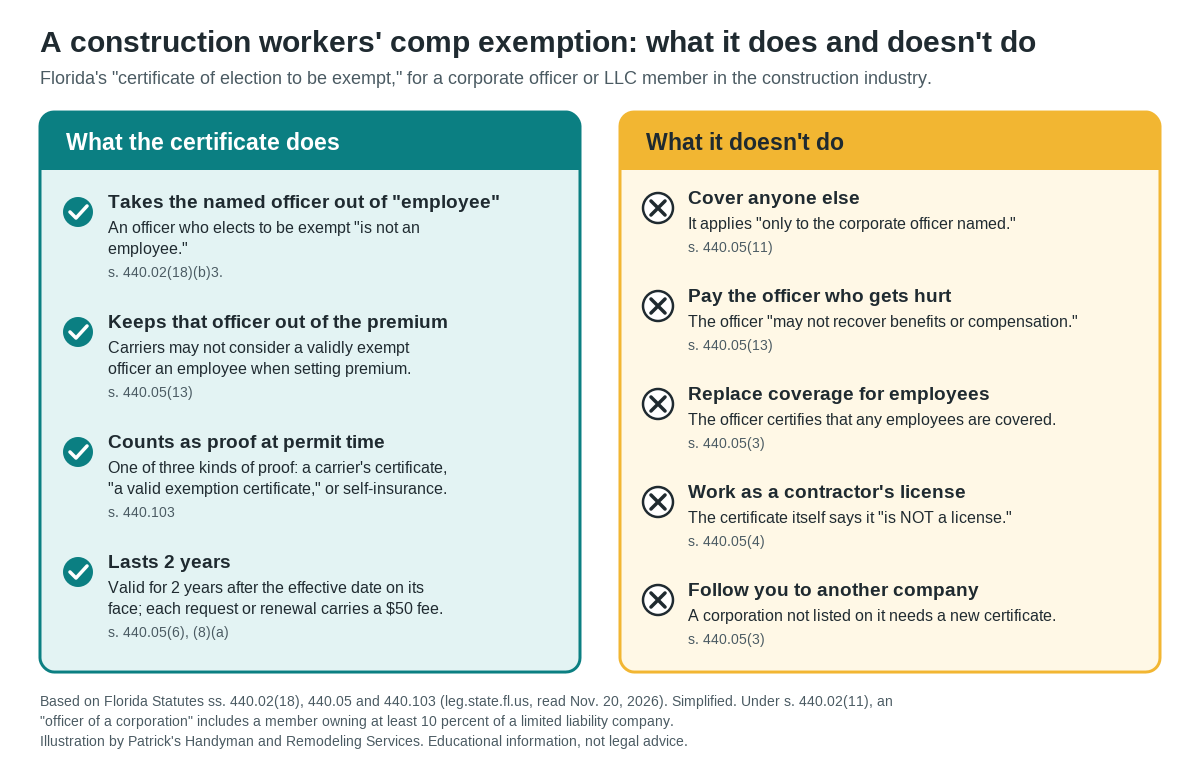
It covers one named person at one named company, and it takes that person out of the benefits as well as the premium.
- One person. Certificates "apply only to the corporate officer named on the notice of election to be exempt" (s. 440.05(11)).
- No benefits. An officer who elects exemption "may not recover benefits or compensation under this chapter" (s. 440.05(13)).
- Employees are still covered. The notice must "certify that any employees of the corporation whose officer elects an exemption are covered by workers' compensation insurance" (s. 440.05(3)).
- One company. "A new certificate of election must be obtained each time the person is employed by a new or different corporation that is not listed on the certificate of election" (s. 440.05(3)).
The trade is that "carriers may not consider any officer of a corporation who validly meets the requirements of this section to be an employee" when they set the premium (s. 440.05(13)).

How do you apply, and what does it cost?
Online, through the Division's Notice of Election to be Exempt system. The steps come from s. 440.05(3) to (5), Rule 69L-6.012 and that system's own page, read Nov. 20, 2026.
- Take the tutorial. The notice must certify that the officer "has completed an online workers' compensation coverage and compliance tutorial developed by the department."
- Fill in the notice. It lists your name, date of birth, a "valid driver license number or Florida identification card number," every chapter 489 license you hold, the company's registration number with the Division of Corporations and your percentage of ownership.
- Sign it yourself. The Division's exemptions page warns that "any person other than the applicant signing the application may be guilty of a felony of the third degree."
- Wait for the review. The system page says "The Division has 30 days from the date the Notice of Election to be Exempt is received to review and determine your eligibility to be exempt." By statute a notice becomes effective "when issued by the department or 30 days after it is received by the department, whichever occurs first" (s. 440.05(5)).
- Print the certificate. "Certificate holders are required to print their Certificate of Election to be Exempt," and the exemption shows in the Division's Exemption Search database the day after it is issued.
| Cost | Amount | Where it's stated |
|---|---|---|
| Each construction request or renewal | $50 | s. 440.05(8)(a) |
| Online convenience fee | $1 | The Division's application system page (marked updated 04/26/2023) |
| A payment that is returned | $15 fee, and the exemption may be revoked | The same page; Rule 69L-6.012(3) |
| Applying again after a denial | Another $50 | Rule 69L-6.012(4)(a) |

How long does it last, and how do renewals work?
A certificate "is valid for 2 years after the effective date stated thereon," and "must expire at midnight, 2 years from its issue date" (s. 440.05(6)).
Timing the renewal matters:
- Too early. The system page says "Do not apply for renewal more than 90 days PRIOR to the expiration date." A renewal that arrives earlier and is approved starts on the approval date, and the earlier certificate for the same business "shall be null and void as of the issue date of the new" one (Rule 69L-6.012(4)(b)).
- Within 90 days. The renewal's issue date is "the expiration date of the current" certificate (Rule 69L-6.012(4)(c)), so the two run back to back.
- Late. A renewal received after the expiration date is issued on the date it is approved (Rule 69L-6.012(4)(d)), which leaves a gap between certificates.
What makes an exemption void, or gets it revoked?
- You stop qualifying. The Division "shall revoke a certificate at any time for failure of the person named on the certificate to meet the requirements of this section" (s. 440.05(12)).
- The company goes inactive. The revocation date "is the date that the corporation becomes dissolved or inactive" or the date the Division determines the person no longer qualifies (Rule 69L-6.012(12)). The application form says an annual report must be filed with the Division of Corporations each year to keep a company's active status.
- The payment bounces. If the payment "was returned to the Department for non-sufficient funds," the certificate "shall be revoked" (Rule 69L-6.012(3)).
The holder has a duty to tell the Division about a change of address, "the dissolution or reinstatement of the corporation or limited liability company," or when the holder "is no longer a corporate officer or member" of the company on the certificate (Rule 69L-6.012(11)).
An officer can also give the exemption up "at any time" (s. 440.04(3)), with one more call to make: "Upon filing a notice of revocation of election, an officer who is a subcontractor or an officer of a corporate subcontractor must notify her or his contractor" (s. 440.05(3)).
What do you show at permit time?
Proof, every time. The employer shows "a certificate of coverage issued by the carrier, a valid exemption certificate approved by the department, or a copy of the employer's authority to self-insure," presented "electronically or physically, each time the employer applies for a building permit" (s. 440.103). Which jobs need a permit is in our guide to what requires a permit in Pinellas County, and what each local office asks for is in contractor registration in every Pinellas city.
What does a contractor have to collect from a subcontractor?
Proof, and the Division says to get it before the work starts. "A contractor shall require a subcontractor to provide evidence of workers' compensation insurance. A subcontractor who is a corporation and has an officer who elects to be exempt as permitted under this chapter shall provide a copy of his or her certificate of exemption to the contractor" (s. 440.10(1)(c)).
Rule 69L-6.032, F.A.C. lists the evidence. By its own terms it is written for a contractor "who is not securing the payment of compensation pursuant to Section 440.38(1)(a), F.S.," the paragraph on insuring with a carrier. The Division's employer FAQ gives the same list to contractors in general, to be obtained "Prior to the beginning of the job."
| The subcontractor has | What the rule tells the contractor to get |
|---|---|
| A workers' comp policy | One of three: a copy of the policy's "Information Page"; a screen print from the Division's Proof of Coverage database; or a Certificate of Liability Insurance with written confirmation from the producer or carrier that coverage is in effect |
| An exempt officer and no employees | A copy of the officer's certificate, or a screen print from the Division's Exemptions Search database |
| An exempt officer and employees | Both: insurance evidence for the employees, and "evidence of every valid Certificate of Election to Be Exempt" |
On the certificate, the rule has the contractor check that the person named "is designated as a corporate officer of the subcontractor" and that the work date "falls within the Effective and Expiration dates listed on the Certificate of Election to Be Exempt" (Rule 69L-6.032(4)(c), (d)). Three more points:
- An exempt sub who hires help owes you new proof first. That subcontractor "must provide the contractor with evidence of workers' compensation insurance before any such employee or employees can perform any work related to that contract" (Rule 69L-6.024, F.A.C.).
- The duty moves down the chain. "a subcontractor becomes a contractor when such subcontractor sublets any part or parts of his or her subcontract work to another subcontractor" (Rule 69L-6.032(9)).
- Keep the paper. A contractor must maintain each subcontractor's insurance evidence and exemption certificates "for the current calendar year to date and for the preceding two calendar years" (Rule 69L-6.015(9)(c), (11), F.A.C.).
What rides on it: a contractor is liable for compensation to a subcontractor's employees unless the subcontractor has secured it (s. 440.10(1)(b)). If the contractor didn't get the evidence and the subcontractor turns out to be uninsured, the contractor has to secure compensation for the subcontractor's employees. A contractor who hasn't gets a stop-work order and a penalty, and "the payroll for the contractor shall also include the payroll of all uninsured subcontractors and their employees" when that penalty is calculated (Rule 69L-6.032(6)). A contractor who got all of it "will not be issued a Stop-Work Order unless it has failed to secure the payment of compensation for its employees other than the employees of the subcontractor" (Rule 69L-6.032(7)).
Which work a general contractor has to subcontract in the first place is in our guide to trade licenses in Florida.
How do you look up a Florida workers' comp exemption?
The Division runs public databases, linked from its employer page:
- Exemption Search, to verify a certificate.
- Proof of Coverage, to look up an employer's policy.
- Stop-Work Order database, to see orders issued to an employer.
- Construction Policy Tracking, which the Division's coverage and exemption brochure says sends registered users "automatic notifications of changes to the status of the specified policy and/or exemption."
What are the penalties when coverage is missing?
The stop-work order and the basic penalty, 2 times the premium you would have paid or $1,000, whichever is greater, are covered in the insurance guide. The rest of s. 440.107 fills in how it runs:
- It moves fast. Once the Division determines an employer has failed to secure coverage, it "shall issue a stop-work order within 72 hours" (subsection (7)(a)).
- Working through an order costs more: "$1,000 per day against an employer for each day that the employer conducts business operations that are in violation of a stop-work order" ((7)(c)).
- Getting released takes money down. A conditional release requires proof of coverage, "a penalty of $1,000 as a down payment," and a payment agreement for the rest, or payment in full ((7)(a)).
- DBPR hears about it. If the employer is certified or registered under part I or part II of chapter 489, the Division "shall immediately notify the Department of Business and Professional Regulation" ((14)).
Two more statutes sit behind the civil penalties. It is unlawful for an employer to knowingly "Fail to secure workers' compensation insurance coverage if required to do so by this chapter" (s. 440.105(4)(a)3.), which that subsection treats as insurance fraud, a third-degree felony when the monetary value is less than $20,000 (s. 440.105(4)(f)1.). And an employee hurt while the employer had no coverage "may elect to claim compensation under this chapter or to maintain an action at law or in admiralty for damages," in which the employer can't argue fellow-employee negligence, assumed risk or comparative negligence (s. 440.11(1)(a)).
Workers' comp enforcement is separate from licensing enforcement. DBPR's side is in our guide to the penalties for unlicensed contracting in Florida.

Frequently asked questions
Does an LLC need workers' comp in Florida if the only workers are its members?
In construction, a member who owns at least 10 percent of the LLC is treated as a corporate officer, and an officer who works for pay is an employee unless he or she holds a valid exemption (s. 440.02(11), (18)(b)). No more than three people in the company or its affiliated group can be exempt, and the LLC's employees still have to be covered (s. 440.05(3)).
How long does it take to get a workers' comp exemption in Florida?
The Division says it has 30 days from the date it receives the notice to review it. By statute the notice takes effect when the Division issues the certificate or 30 days after it is received, whichever comes first (s. 440.05(5)).
Can I have a helper get an exemption instead of putting him on my policy?
No. An employer may not knowingly coerce or attempt to coerce an employee to obtain a certificate of exemption, a first-degree misdemeanor (s. 440.105(2)(a)1.). A construction exemption is also open only to an officer or LLC member who owns at least 10 percent of the company (s. 440.02(11), (18)(b)2.).
Do sole proprietors need workers' comp in Florida construction?
Florida's definition of "employee" includes a sole proprietor who engages in the construction industry (s. 440.02(18)(c)4.), and the construction exemption is issued only to corporate officers and LLC members. For a one-person business with no helpers, confirm what to buy with the Division at (850) 413-1609.
Sources
- Florida Statutes s. 440.02, Definitions (2026)
- Florida Statutes s. 440.04, Waiver of exemption (2026)
- Florida Statutes s. 440.05, Election of exemption; revocation of election; notice; certification (2026)
- Florida Statutes s. 440.10, Liability for compensation (2026)
- Florida Statutes s. 440.103, Building permits; identification of minimum premium policy (2026)
- Florida Statutes s. 440.105, Prohibited activities; reports; penalties; limitations (2026)
- Florida Statutes s. 440.107, Department powers to enforce employer compliance with coverage requirements (2026)
- Florida Statutes s. 440.11, Exclusiveness of liability (2026)
- Florida Statutes s. 440.38, Security for compensation; insurance carriers and self-insurers (2026)
- Rule 69L-6.012, F.A.C., Notice of Election to Be Exempt (effective July 18, 2023)
- Rule 69L-6.015, F.A.C., Record Maintenance and Production Requirements for Employers (effective Mar. 21, 2017)
- Rule 69L-6.024, F.A.C., Subcontractors Requirement Regarding Proof of Coverage (effective July 21, 2004)
- Rule 69L-6.032, F.A.C., Contractor Requirements for Obtaining Evidence That Subcontractors Possess Workers' Compensation Insurance or Otherwise Comply with Chapter 440, F.S. (effective July 18, 2023)
- Form DFS-F4-DWC-250, Notice of Election to be Exempt (revised 01/23), incorporated by Rule 69L-6.012
- Florida Division of Workers' Compensation: Construction industry exemptions (read Nov. 20, 2026)
- Florida Division of Workers' Compensation: Exemptions (read Nov. 20, 2026)
- Florida Division of Workers' Compensation: Notice of Election to be Exempt online system (page marked updated 04/26/2023; read Nov. 20, 2026)
- Florida Division of Workers' Compensation: Election of Coverage (read Nov. 20, 2026)
- Florida Division of Workers' Compensation: Employer frequently asked questions (read Nov. 20, 2026)
- Florida Division of Workers' Compensation: Enforcement (read Nov. 20, 2026)
- Florida Division of Workers' Compensation: Employers, with links to its databases (read Nov. 20, 2026)
- Florida Division of Workers' Compensation databases: Exemption Search, Proof of Coverage, Stop-Work Orders, Construction Policy Tracking
- Florida Division of Workers' Compensation: Important Workers' Compensation Information for Contractors (PDF) (read Nov. 20, 2026)
- Florida Division of Workers' Compensation: Determining Workers' Compensation Coverage for Sole Proprietors and Partners Engaged in the Non-Construction Industry (PDF) (read Nov. 20, 2026)
- Florida Division of Workers' Compensation: Key Coverage and Exemption Eligibility Requirements (PDF, revised November 2022) (read Nov. 20, 2026)