

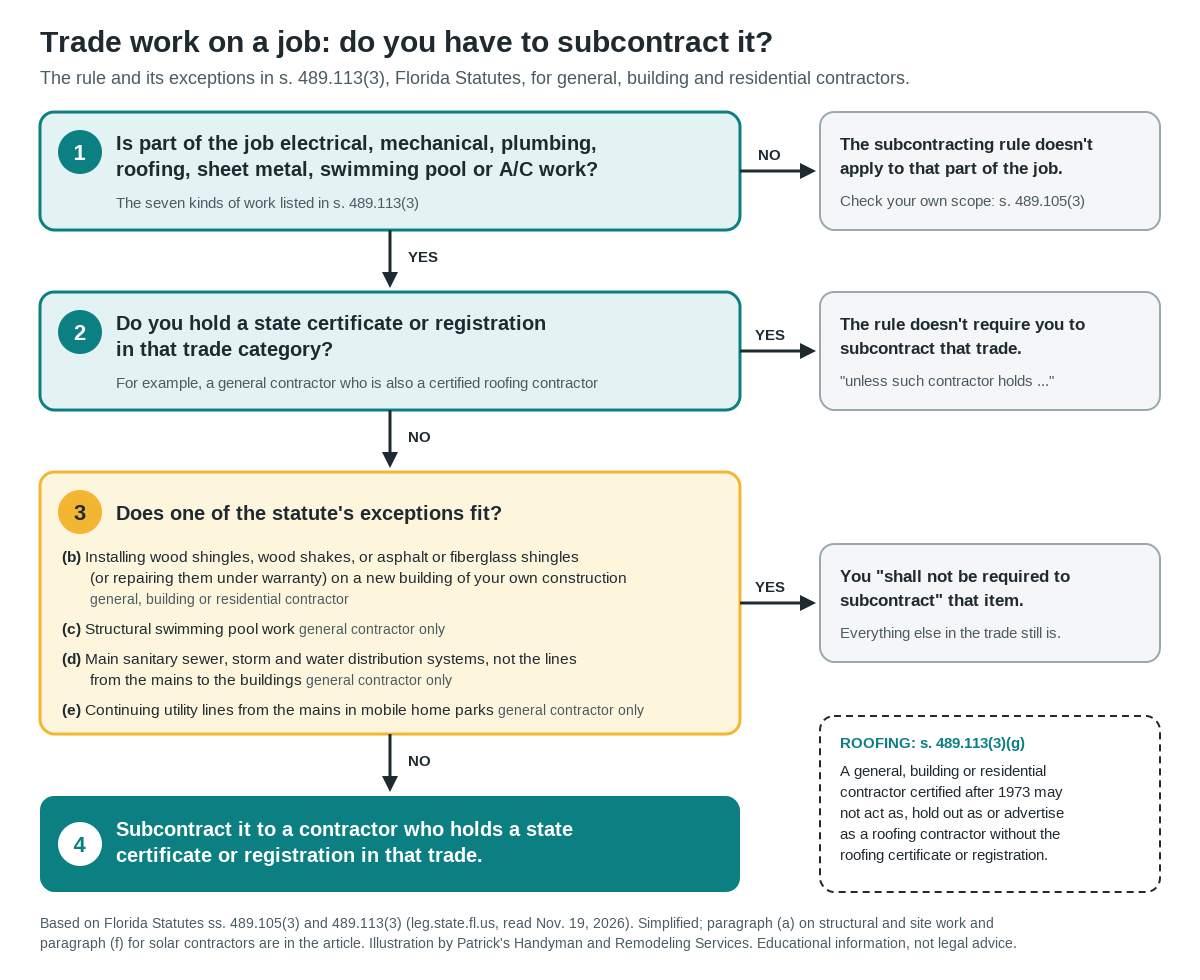
Short answer: Generally, no. In Florida a contractor "shall subcontract all electrical, mechanical, plumbing, roofing, sheet metal, swimming pool, and air-conditioning work, unless such contractor holds a state certificate or registration in the respective trade category" (s. 489.113(3)). The statute lists a few exceptions, such as shingle roofing on a new building of the contractor's own construction. Electrical contracting has its own licensing law, with no small-job exemption for hired work.
Florida defines a general contractor's services as "unlimited as to the type of work," and the license still isn't a trade license. This guide follows the statutes that draw the line, from the subcontracting rule and its exceptions to the separate electrical law and the penalties. It is educational information, not legal advice. Your own job belongs with the Department of Business and Professional Regulation (DBPR), the building department or a Florida construction attorney.
Why isn't a general contractor license a trade license?
Chapter 489, part I splits contractors into two divisions. Division I is the general, building and residential contractor. Division II is every category in paragraphs (d) through (q) of s. 489.105(3), which is where the trades are.
A general contractor "may contract for any activity requiring licensure under this part" and "may perform any work requiring licensure under this part, except as otherwise expressly provided in s. 489.113" (s. 489.105(3)(a)). That last clause is the subject of this guide. Building and residential contractors have narrower definitions, covered in our guide to getting a general, building or residential contractor license.
| Trade license | In its scope, in the statute's words | DBPR code |
|---|---|---|
| Sheet metal (s. 489.105(3)(d)) | Metal work "of U.S. No. 10 gauge or its equivalent or lighter gauge" and air-handling systems | CS, RS |
| Roofing (s. 489.105(3)(e)) | "all kinds of roofing, waterproofing, and coating," skylights, and wood roof sheathing or fascia "as needed during roof repair or replacement" | CC, RC |
| Air-conditioning, Class A and B (s. 489.105(3)(f), (g)) | Central air-conditioning, refrigeration, heating and ventilating systems; Class B is "limited to 25 tons of cooling and 500,000 Btu of heating in any one system" | CA, RA |
| Mechanical (s. 489.105(3)(i)) | The Class A systems, plus items such as "natural gas fuel lines within buildings" | CM, RM |
| Pool/spa (s. 489.105(3)(j)-(l)) | Commercial, residential and servicing categories | CP, RP |
| Plumbing (s. 489.105(3)(m)) | Services "unlimited in the plumbing trade," including "swimming pool piping, irrigation systems, and solar heating water systems" | CF, RF |
| Electrical (s. 489.505(12)) | "electrical wiring, fixtures, appliances, apparatus, raceways, conduit, or any part thereof" | Part II, its own board |
The codes are from DBPR's Construction Industry Licensing Board page, read Nov. 19, 2026.
What does s. 489.113(3) require, and what are the exceptions?
The rule is the sentence quoted in the short answer (s. 489.113(3)). Seven lettered paragraphs follow it:
- (a) Structure and site work. A general, building or residential contractor "shall be responsible for any construction or alteration of a structural component of a building or structure." A certified general contractor may do "clearing and grubbing, grading, excavation, and other site work for any construction project in the state"; certified building and residential contractors, the same work "limited to the lot on which any specific building is located."
- (b) Shingle roofs on your own new building. A general, building or residential contractor "shall not be required to subcontract the installation, or repair made under warranty, of wood shingles, wood shakes, or asphalt or fiberglass shingle roofing materials on a new building of his or her own construction."
- (c) Structural pool work. "A general contractor shall not be required to subcontract structural swimming pool work. All other swimming pool work shall be subcontracted to an appropriately licensed certified or registered swimming pool contractor."
- (d) Main utility systems. A general contractor need not subcontract "a main sanitary sewer collection system, storm collection system, or water distribution system, not including the continuation of utility lines from the mains to the buildings."
- (e) Mobile home parks. A general contractor need not subcontract "the continuation of utility lines from the mains in mobile home parks."
- (f) Solar contractors. A solar contractor need not subcontract "minor, as defined by board rule, electrical, mechanical, plumbing, or roofing work" within its license that "exclusively pertains to the installation of residential solar energy equipment."
- (g) Roofing. "No general, building, or residential contractor certified after 1973 shall act as, hold himself or herself out to be, or advertise himself or herself to be a roofing contractor unless he or she is certified or registered as a roofing contractor."
Paragraph (b) names only those shingle materials and only new buildings the contractor built. Paragraphs (c), (d) and (e) name the general contractor only. Apart from the solar paragraph's "minor" work, nothing in subsection (3) turns on the price or size of the job.

Can a general contractor take the contract and sub the trade work out?
Subsection (9)(a) describes trade work that sits inside a larger job. Part I "does not prevent any contractor from acting as a prime contractor where the majority of the work to be performed under the contract is within the scope of his or her license or from subcontracting to other licensed contractors that remaining work which is part of the project contracted" (s. 489.113(9)(a)). A kitchen remodel with a moved sink and new circuits is the plain case: most of the work is within the contractor's own license, and the plumbing and electrical portions go to contractors licensed in those trades.
Subsection (9)(a) doesn't speak to a contract that is all trade work. The general contractor definition says "may contract for any activity requiring licensure under this part," subject to s. 489.113; subsection (9)(a) speaks to jobs where "the majority of the work" is within the prime contractor's license; and paragraph (3)(g) bars holding yourself out as a roofing contractor. For a job that is entirely one trade, read them with a Florida construction attorney, or ask the Board: a substantially affected person may petition an agency for a declaratory statement on how a statute applies to "the petitioner's particular set of circumstances" (s. 120.565(1)).
The statute does settle one thing: trade work can't go to an unlicensed helper. An unlicensed subcontractor may work under a licensed contractor's supervision only if the work is within the supervising contractor's license and the subcontractor "is not engaged in construction work that would require a license as a contractor under any of the categories listed in s. 489.105(3)(d)-(o)" (s. 489.113(2)). Those paragraphs include every part I trade in the table above.
Why is electrical work different?
Electrical contracting is licensed under part II of chapter 489, by the Electrical Contractors' Licensing Board, and part II's definitions reach far:
- "Contracting" means "engaging in business as a contractor or performing electrical or alarm work for compensation." The definition adds: "The attempted sale of contracting services and the negotiation or bid for a contract on these services also constitutes contracting" (s. 489.505(9)).
- An electrical contractor includes any person or firm that "undertakes, offers to undertake, purports to have the capacity to undertake, or submits a bid to engage in the business of electrical contracting; or that does itself or by or through others engage in the business of electrical contracting" (s. 489.505(12)).
- Without the license, a person may not "advertise himself or herself or a business organization as available to practice electrical or alarm system contracting" (s. 489.531(1)(b)).
Is there a small-job exemption? Not for hired work. Part I exempts "casual, minor, or inconsequential" jobs under $2,500; the part II exemptions in s. 489.503 have no counterpart. They do cover products "which are not actually fabricated into, and do not become a permanent fixed part of, the structure" (subsection (5)) and low-voltage landscape lighting with "a factory-installed electrical cord with plug" (24). The one dollar figure for small hired jobs is for a person licensed under part I of chapter 475 (real estate brokers and sales associates) acting as the owner's agent on jobs under $5,000, and only "where all work requiring a contractor is performed by a contractor who has a current, valid certificate or registration" (20).
Certified, registered and specialty: three labels to read before you hire a sub
Certified or registered. A certified contractor "shall be allowed to contract in any jurisdiction in the state" (s. 489.105(8)). A registered contractor met one jurisdiction's competency requirements, and "Registered contractors may contract only in such jurisdictions" (s. 489.105(10)). For Construction Industry Licensing Board licenses, DBPR's codes show which is which: certified licenses begin with C, registered licenses with R. The unlicensed contracting statute adds: "Persons working outside the geographical scope of their registration are guilty of unlicensed activity" (s. 489.13(1)).
Specialty. Rule 61G4-15.100, F.A.C. lists 21 certified specialty categories, including window and door installation, garage door installation, gypsum drywall, and glass and glazing. At the state level they are voluntary: a specialty category "does not create a mandatory licensing requirement" (s. 489.113(6)(a)). A county license can be a separate matter: the Pinellas County Construction Licensing Board's notice on specialty licensing (updated May 22, 2024) says a county license is still required for trades that include drywall, garage door, and glass and glazing work, and our handyman dollar limits guide lists them. A specialty certificate also covers only the scope the rule gives it. A certified garage door installer may run low-voltage safety wiring, but "any other electrical work related to the installation of a garage door shall be subcontracted to a licensed electrical contractor" (Rule 61G4-15.100(1)(k)).

Does the handyman exemption cover any trade work?
The $2,500 exemption in s. 489.103(9) is an exemption from part I, so it never reaches electrical work. Inside part I it excludes permit work and life-safety work (Rule 61G4-12.011(2), F.A.C.).
Two narrow items are written into the plumbing definition: a plumbing contractor "may perform drain cleaning and clearing and install or repair rainwater catchment systems; however, a mandatory licensing requirement is not established for the performance of these specific services" (s. 489.105(3)(m)). Our guides to what a handyman can do without a license and the handyman dollar limits in Pinellas cover the rest.
Job by job: which license does the work?
| Work on the job | License the statute points to | For a general, building or residential contractor | Notes |
|---|---|---|---|
| Re-roof or roof repair on an existing building | Roofing | Subcontract it unless you also hold the roofing license, and don't act as, hold yourself out as or advertise as a roofing contractor without it (s. 489.113(3), (3)(g)) | Fascia and wood sheathing replaced during a roof job are roofing scope |
| Shingle roof on a new building you built | Roofing, or you | Not required to subcontract wood shingles, wood shakes, or asphalt or fiberglass shingles (s. 489.113(3)(b)) | Other roofing materials aren't named |
| Moving a sink, new supply or drain lines | Plumbing | Subcontract it (s. 489.113(3)) | Drain cleaning has no mandatory license |
| New circuits, panel work, wired-in fixtures | Electrical (part II) | Subcontract the electrical portion of the project (s. 489.113(3)); don't advertise electrical contracting (s. 489.531(1)(b)) | No minor-work exemption for hired work in s. 489.503 |
| Central A/C changeout, ductwork for a system | Class A or B air-conditioning, or mechanical | Subcontract it (s. 489.113(3)) | Class B: 25 tons of cooling per system |
| Swimming pool | Pool/spa | A general contractor need not subcontract structural pool work; all other pool work is subcontracted (s. 489.113(3)(c)) | Building and residential contractors aren't named in (c) |
| Framing, structural repairs | Your own Division I license | You "shall be responsible for any construction or alteration of a structural component" (s. 489.113(3)(a)) | Each Division I license has its own limits |
\"Subcontract it\" assumes you don't hold that trade's certificate or registration.
Who pulls the permit for trade work?
State law sets the floor. A building department "shall not issue a building permit to any contractor, or to any person representing himself or herself as a contractor, who does not hold a valid active certificate or registration in the appropriate category" (s. 489.13(5)). And a contractor "may not apply for or obtain a building permit for construction work" unless it "has entered into a contract to make improvements to, or perform the contracting at, the real property specified in the application or permit" (s. 489.127(4)(c)).
Section 489.113(3) says who must do the work. It doesn't lay out permit paperwork, and Pinellas building departments handle that differently:
- Clearwater. Before "any electrical, gas, plumbing, mechanical, roofing, or other work under a combination permit, the contractor or the subcontractor engaged to do the work shall file with Development Services a form showing the name and certification number of the subcontractor" (Clearwater building permit fee schedule, which the city says is current as of Feb. 2, 2022).
- Largo. "Subcontractors may not sign on individually and must be registered and listed on the permit application prior to its issuance" (Largo permit FAQ).
- Pinellas Park. The city's procedures for a house or addition say, in a note addressed to owners: "If you use subcontractors, each one must come into the Building Division to register his/her license with Pinellas Park and sign the permit form to take full responsibility for their part of the work, before they begin their work" (Pinellas Park building permit procedures, revised May 8, 2024).
For any other address, ask that building department how it wants trade contractors shown on the permit. Our guides to what requires a permit in Pinellas County and contractor registration in every Pinellas city list the offices and portals.
What happens if you work outside your license?
A license in one category doesn't protect you in another.
- It's unlicensed contracting. Anyone performing an activity that requires a part I license "is guilty of unlicensed contracting if he or she does not hold a valid active certificate or registration authorizing him or her to perform such activity" (s. 489.13(1)). A first offense by someone who holds a state or local construction license draws a notice of noncompliance (s. 489.13(2)).
- The Board can discipline the license you hold. Grounds include "Failing in any material respect to comply with the provisions of this part," and penalties run up to revocation and "an administrative fine not to exceed $10,000 per violation" (s. 489.129(1)). Absent aggravating or mitigating circumstances, the Board's guideline for "Contracting beyond scope of practice allowed by license, no safety hazard" runs from a $1,000 fine or probation or suspension to a $3,000 fine and probation or suspension on a first offense. Where a "safety hazard is created," the first-offense range runs from a $4,000 fine and probation or suspension to an $8,000 fine and probation, suspension or revocation (Rule 61G4-17.001(1)(i), F.A.C., effective January 18, 2026).
- Electrical violations carry their own criminal penalties. Any person who violates s. 489.531(1) commits a first-degree misdemeanor (s. 489.531(2)). For an unlicensed person, a violation "after having been previously found guilty of such violation," or one "during the existence of a state of emergency declared by executive order of the Governor," is a third-degree felony (s. 489.531(3)(b), (c)).
- You may not be able to collect. For contract purposes, "an individual is unlicensed if the individual does not have a license required by this part concerning the scope of the work to be performed under the contract," and the contract is "unenforceable in law or in equity by the unlicensed contractor" (s. 489.128(1); s. 489.532(1) for electrical).
The criminal penalties in s. 489.127, DBPR's fines and Pinellas County's citations are in our guide to the penalties for unlicensed contracting in Florida.
How to check a trade sub, and what to put in the subcontract
Check the license. Search the sub on DBPR's license lookup; our guide to checking a Florida contractor's license walks through it. Read the category (the codes are in the first table), whether the license is certified or registered for your jurisdiction, and who qualifies the company (see what a qualifying agent is). A contractor's license number must appear "in each offer of services, business proposal, bid, contract, or advertisement" (s. 489.119(5)(b); for electrical contractors, s. 489.521(7)(b)), so a proposal with no number on it is a reason to stop.
Write it down. General points to raise with your attorney, not a form:
- The sub's name as DBPR shows it, with the license number and category, and a scope that stays inside that license.
- Who files for the trade permit or signs on to yours, the way that building department requires.
- Payment terms. Under a section added by chapter 2026-3, Laws of Florida, effective July 1, 2026, a licensed contractor "must compensate a subcontractor or supplier, unless there is a bona fide dispute regarding the amount due," within 45 days after being paid for that work or as the contract provides (s. 489.1295).
Where we stand, and where you might
We're a Florida Certified General Contractor (Lic. #CGC1541672). We are not a roofing, plumbing, electrical, air-conditioning or mechanical contractor. On projects we manage, electrical, plumbing, HVAC and roofing work is subcontracted to and performed by our licensed trade partners.
If you're a handyman moving toward licensed work, or a new contractor sorting out which parts of a job are yours, start with the statutes above. For questions about your own path, talk to a Florida Certified General Contractor about your options.
Frequently asked questions
Can a general contractor do electrical work in Florida?
Generally not with the general contractor license alone. A contractor must subcontract electrical work unless it holds a state certificate or registration in that trade (s. 489.113(3)), and electrical contracting is licensed separately under chapter 489, part II (s. 489.505, s. 489.531).
Can a general contractor do roofing in Florida?
Only within the statute's exception, unless the contractor also holds a roofing license. A general, building or residential contractor isn't required to subcontract wood shingles, wood shakes, or asphalt or fiberglass shingles on a new building of its own construction (s. 489.113(3)(b)), and may not act as or advertise as a roofing contractor (s. 489.113(3)(g)).
Can a general contractor do plumbing in Florida?
Generally no. Plumbing is on the list of work a contractor must subcontract unless it holds the plumbing license (s. 489.113(3)). The general contractor's exception covers main sewer, storm and water distribution systems, not the lines from the mains to the buildings (s. 489.113(3)(d)).
Can a handyman do plumbing or A/C work under a general contractor's supervision?
Not through that rule. The supervised-subcontractor rule applies only when the unlicensed subcontractor isn't doing work that needs a license under s. 489.105(3)(d)-(o), which include plumbing, roofing, air-conditioning and mechanical work (s. 489.113(2)).
Sources
- Florida Statutes s. 120.565, Declaratory statement by agencies (2026)
- Florida Statutes s. 489.103, Exemptions (2026)
- Florida Statutes s. 489.105, Definitions (2026)
- Florida Statutes s. 489.113, Qualifications for practice; restrictions (2026)
- Florida Statutes s. 489.119, Business organizations; qualifying agents (2026)
- Florida Statutes s. 489.127, Prohibitions; penalties (2026)
- Florida Statutes s. 489.128, Contracts entered into by unlicensed contractors unenforceable (2026)
- Florida Statutes s. 489.129, Disciplinary proceedings (2026)
- Florida Statutes s. 489.1295, Prohibition against nonpayment (2026)
- Florida Statutes s. 489.13, Unlicensed contracting (2026)
- Florida Statutes s. 489.503, Exemptions, electrical and alarm system contracting (2026)
- Florida Statutes s. 489.505, Definitions, electrical and alarm system contracting (2026)
- Florida Statutes s. 489.531, Prohibitions; penalties, electrical and alarm system contracting (2026)
- Florida Statutes s. 489.532, Contracts entered into by unlicensed contractors unenforceable, electrical (2026)
- Rule 61G4-12.011, F.A.C., Definitions (effective May 16, 2023)
- Rule 61G4-15.100, F.A.C., Certified Specialty Contractors (effective Aug. 28, 2024)
- Rule 61G4-17.001, F.A.C., Normal Penalty Ranges (effective Jan. 18, 2026)
- DBPR, Construction Industry Licensing Board: license types and codes (read Nov. 19, 2026)
- DBPR, license lookup
- City of Clearwater, Building Permit Fee Schedule (read Nov. 19, 2026)
- City of Largo, Permit FAQ (read Nov. 19, 2026)
- City of Pinellas Park, Building Permit Procedures: Single Family Home / Addition (PDF, revised May 8, 2024) (read Nov. 19, 2026)
- Pinellas County Construction Licensing Board, notice on specialty licensing (PDF, updated May 22, 2024) (read Nov. 19, 2026)