

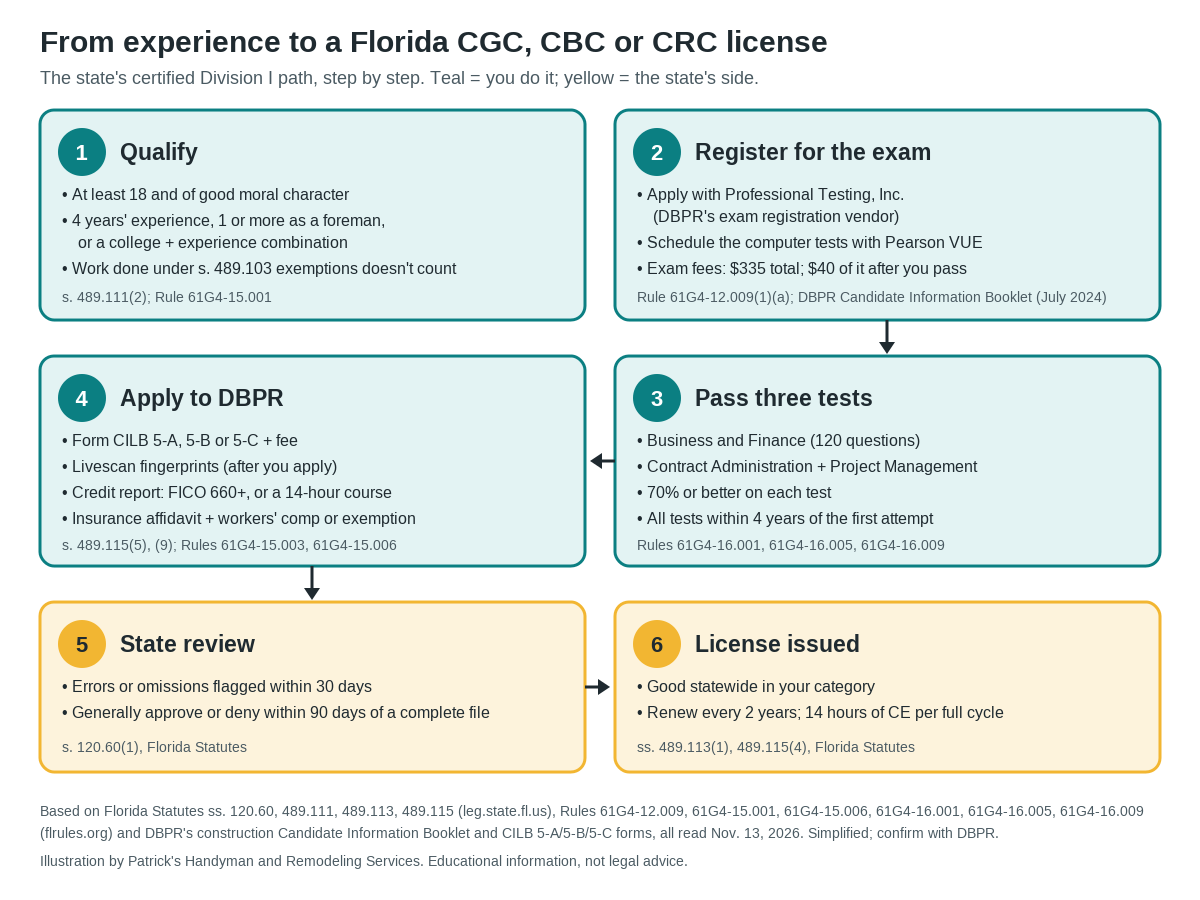
Short answer: To become a Florida certified general (CGC), building (CBC) or residential (CRC) contractor, you need at least four years of qualifying experience, with one year as a foreman, or a mix of college credit and experience (s. 489.111(2)). You then generally pass three state tests at 70% or better each (Rule 61G4-16.001) and apply to DBPR with fingerprints, a credit report and an insurance affidavit (s. 489.115).
The path is public, but the details that stall applications are spread across statutes, Board rules and DBPR forms. This guide puts them in one place, with the official source for each step. It is educational information, not legal advice; confirm your situation with the Department of Business and Professional Regulation (DBPR) before you apply.
What can a CGC, CBC and CRC each build?
Florida groups these three licenses as Division I contractors (s. 489.105(3)):
| License | What the statute allows |
|---|---|
| Certified general contractor (CGC) | Services "unlimited as to the type of work"; may contract for any activity requiring licensure under Part I, except as s. 489.113 provides (s. 489.105(3)(a)) |
| Certified building contractor (CBC) | Commercial buildings and one- or multiple-dwelling residential buildings that "do not exceed three stories in height," plus accessory structures, or remodeling and repair of any size building "if the services do not affect the structural members" (s. 489.105(3)(b)) |
| Certified residential contractor (CRC) | Construction, remodeling, repair or improvement of "one-family, two-family, or three-family residences not exceeding two habitable stories above no more than one uninhabitable story" and accessory structures (s. 489.105(3)(c)) |
None of the three is a trade license: a contractor must subcontract electrical, mechanical, plumbing, roofing, sheet metal, swimming pool and air-conditioning work unless it holds that trade's license, with the exceptions listed in the statute (s. 489.113(3)). Each exception is in our guide to trade licenses and what a general contractor must subcontract.
Certified or registered? Per DBPR, a certified contractor may contract "in any jurisdiction in the state"; a registered contractor met a local jurisdiction's competency requirements and "may contract only in such jurisdictions" (DBPR, Construction Industry). Registering with a city building department is a separate step; see contractor registration in Pinellas County.
What experience do you need for a Florida contractor license?
You must be 18, of good moral character, and meet one of these routes (s. 489.111(2)):
- A bachelor's degree in the appropriate field of engineering, architecture or building construction, plus 1 year of proven experience. For these three licenses the Board lists civil engineering, building construction or architecture (Rule 61G4-15.001(4)(a)).
- 4 years of active experience as a skilled worker or foreman, with at least 1 year as a foreman.
- College credit plus experience: 1 year foreman + 3 years of college credit; 1 year worker + 1 year foreman + 2 years of credit; or 2 years worker + 1 year foreman + 1 year of credit. Junior and community college courses count.
For full-time equivalency, the statute uses "a minimum of 2,000 person-hours" (s. 489.111(2)(c)1.). The DBPR forms also list routes that count military service (CILB 5-A).
The Board's rule adds the details that trip people up (Rule 61G4-15.001, F.A.C.):
- The Board accepts "lawfully acquired experience gained under the supervision of a contractor" properly licensed in the category or a broader one. Experience "acquired by providing services that are exemptions as established in section 489.103, F.S., will not be accepted." Jobs done under the handyman exemption don't count.
- CGC and CBC experience must be commercial construction in four or more of six areas: foundations or slabs over 20,000 square feet, masonry walls, steel erection, elevated slabs, column erection, and formwork for structural reinforced concrete.
- CGC only: unless you are upgrading from an active CRC or CBC license under s. 489.111(2)(c)4., at least one year of that experience must be "in the construction of structures not less than four stories in height."
- CRC experience covers detached one- and two-family homes and townhouses up to three stories, in three or more of five areas: foundations, slabs or structural formwork; masonry walls; structural demolition; structural wood framing (excluding platform framing); and column erection.
The application asks for each employer's qualifying contractor and license number, and DBPR "may contact the supervisor to verify experience" (CILB 5-A). An active CRC can upgrade to CBC after 3 years in that license, and a CRC or CBC to CGC after 4, by passing the new exam (s. 489.111(2)(c)4.).

What is on the Florida contractor exam?
Division I candidates take three tests: Business and Finance, Contract Administration, and Project Management (Rule 61G4-16.001(1)-(3)). DBPR's Candidate Information Booklet (effective July 2024) gives the format:
| Test | Scored questions | Time |
|---|---|---|
| Business and Finance (all three licenses) | 120 | 6.5 hours |
| Contract Administration: GC / BC / RC | 60 / 50 / 45 | 4.5 hours |
| Project Management: GC / BC / RC | 60 / 50 / 45 | 4.5 hours |
- Who runs it. You apply to sit for the exam with Professional Testing, Inc., DBPR's registration vendor, and then schedule the computer tests with Pearson VUE, which offers them daily (Candidate Information Booklet).
- What's tested. On the GC exam, project contracts are about 40% of Contract Administration; construction methods, materials, tools and equipment are about 63% of Project Management; accounting is about 32% of Business and Finance (Rule 61G4-16.001(1), (22)).
- Open book, with limits. Only materials on DBPR's approved reference list may be brought in, and removable tabs or sticky notes are not accepted (Candidate Information Booklet).
- Passing score. At least 70% on each test (Rule 61G4-16.001(37)); DBPR says scores "are NOT rounded," and you get your result at the test center.
- How long scores last. A passing grade is valid for four years from "the most recently passed portion" (Rule 61G4-16.005), and you must pass all tests "within four years of the first attempt" or start over (Rule 61G4-16.009). You retake only the tests you failed.
- Skipping a test. An active CRC or CBC moving up skips Business and Finance if not under investigation or prosecution for a ch. 489, part I violation (or until it is complete) and not disciplined beyond a notice of noncompliance, letter of guidance or citation; active certified Division II licensees taking a Division I exam are also exempt (Rule 61G4-16.0015(1)(a), (4)). A graduate with a bachelor's in building construction from an accredited 4-year college, or a Board-approved related degree, with a 3.0 GPA or higher takes only Business and Finance (s. 489.113(1)).

Credit, insurance and fingerprints: what DBPR checks
- Credit. You submit a credit report from a nationally recognized agency (s. 489.115(5)(b), (7)). It must show no unsatisfied judgments or liens against you or any business you previously qualified as primary qualifier or are applying to qualify, and a FICO-derived score of 660 or higher. Below 660, you meet the stability requirement by completing a Board-approved 14-hour financial responsibility course (Rule 61G4-15.006). The statute lets the Board adopt bond alternatives, but the current rule names only the course. The report needs the FICO score and a statement that local, state and federal records were checked (CILB 5-A). The CILB 5-A checklist asks "ACTIVE License Applicants" for the credit report, and DBPR's Financial Responsibility document also asks for a credit report for the business you intend to qualify.
- Insurance. You sign an affidavit that you carry public liability and property damage insurance: $300,000 and $50,000 for general and building contractors, $100,000 and $25,000 for residential, in aggregate and in the licensee's name (Rule 61G4-15.003). You attest that you have workers' comp coverage as required by chapter 440, or that you'll get an exemption within 30 days after the license is issued (s. 489.115(5)(a), (d)). Our contractor insurance guide covers the policies.
- Fingerprints and background. Fingerprints go to FDLE and the FBI (s. 489.115(9)). DBPR says to use an FDLE-registered Livescan provider "immediately after submitting your application," give the provider DBPR's ORI number, and expect results in up to five days; DBPR keeps results for 12 months (DBPR Fingerprinting). A felony alone can't be the only reason for denial; the Board weighs the crime's severity, its relationship to contracting, the potential for public harm, time passed and rehabilitation (s. 489.115(6)).

How much does it cost to get a contractor license in Florida?
State fees only, as published on the dates shown. Course, book, credit report and fingerprint vendors set their own prices.
| Fee | Amount | Source |
|---|---|---|
| Exam registration, paid when you schedule | $135 | Rule 61G4-12.009(1)(a) |
| Business and Finance test administration | $80 | Rule 61G4-12.009(1)(a); DBPR CBT fee table (eff. Jan. 3, 2023) |
| Contract Administration + Project Management administration | $80 ($40 each; counted as one test) | Same |
| Application processing after you pass | $40 | Rule 61G4-12.009(1)(a) |
| Retake | $135, plus $80 per test under the rule; DBPR's computer-based testing fee table shows $40 for each of the Contract Administration and Project Management tests, so confirm the retake fee with DBPR | Rule 61G4-12.009(1)(b); DBPR CBT fee table |
| License application (CILB 5-A, 5-B or 5-C) | $245 now; $145 if submitted after Aug. 31, 2027 | DBPR fee notice, read Nov. 13, 2026 |
| Fingerprinting at DBPR headquarters | $39 (Livescan providers set their own fee) | DBPR Fingerprinting |
The rule's exam and application fees total $335, $40 of it paid after you pass (Rule 61G4-12.009(1)(a)). DBPR's pages don't say whether the $40 is collected apart from the $245 application fee, so confirm with DBPR. The CILB 5 forms charge $245 from May 1 of an even year through Aug. 31 of an odd year, and $145 from Sept. 1 of an odd year through April 30 of an even year.
How long does it take to get a contractor license in Florida?
The experience is the long part: four years on the standard route. After that, DBPR doesn't publish a total processing time, but the law sets the clocks. DBPR must flag errors or missing items within 30 days of receiving your application and generally approve or deny it within 90 days after the application is complete (s. 120.60(1)). Fingerprint results usually arrive in two to four days (DBPR). Once licensed, you renew every two years, generally with 14 hours of continuing education (less if your first license period was shorter than a full two-year cycle) (s. 489.115(4)).
Common reasons applications get delayed
- Name mismatches. Any alias used on supporting documents must be listed; otherwise the application is deficient (CILB 5-A instructions).
- Fingerprints out of order. FDLE requires the application to come first, and a missing or wrong ORI number means DBPR never gets the results (DBPR Fingerprinting).
- The wrong credit report: no FICO score, no public records statement, or an open lien or judgment.
- Experience that doesn't qualify: work under the s. 489.103 exemptions, work not supervised by a properly licensed contractor, or, for a CGC, no year on four-story structures (Rule 61G4-15.001).
- Expired scores. All three tests must be passed within four years of the first attempt (Rule 61G4-16.009).
- Background answers. DBPR checks them against local, state and federal records (CILB 5-A).
- Unlinked exam ID. First-time DBPR Online Services users must link their Exam Candidate ID (DBPR CILB 5-A checklist).
Why it's worth it if you're a handyman now
A license lets you bid the permitted work in your category that you turn down today, without the risks in what happens if you're caught contracting without a license. Until then, stay inside what a handyman can do without a license and the handyman dollar limits in Pinellas. If you plan to contract through an LLC or corporation, read what a qualifying agent is before you file. Questions about your path are welcome; talk to a Florida Certified General Contractor.
Frequently asked questions
Can you get a general contractor license in Florida without experience?
No. Every route in s. 489.111(2)(c) includes experience; the shortest pairs a bachelor's degree in building construction, architecture or the appropriate engineering field with one year of proven experience. Experience from work done under the s. 489.103 exemptions isn't accepted (Rule 61G4-15.001).
What score do you need to pass the Florida contractor exam?
At least 70% on each required test (Rule 61G4-16.001(37)). DBPR's Candidate Information Booklet says construction exam scores are not rounded.
What credit score do you need for a Florida contractor license?
A FICO-derived score of 660 or higher, with no unsatisfied judgments or liens. Below 660, the Board accepts completion of an approved 14-hour financial responsibility course (Rule 61G4-15.006).
What is the difference between a CRC and a CGC in Florida?
A CRC is limited to one-, two- and three-family homes of no more than two habitable stories above one uninhabitable story (s. 489.105(3)(c)); a CGC's services are unlimited as to the type of work, apart from the trade subcontracting rules in s. 489.113 (s. 489.105(3)(a)). A first-time CGC applicant also needs a year of experience on structures at least four stories tall; CRC and CBC licensees upgrading under s. 489.111(2)(c)4. are excepted (Rule 61G4-15.001(2)(b)).
Sources
- Florida Statutes s. 120.60, Licensing (2026)
- Florida Statutes s. 489.105, Definitions (2026)
- Florida Statutes s. 489.111, Licensure by examination (2026)
- Florida Statutes s. 489.113, Qualifications for practice; restrictions (2026)
- Florida Statutes s. 489.115, Certification and registration (2026)
- Rule 61G4-12.009, F.A.C., Fees
- Rule 61G4-15.001, F.A.C., Qualification for Certification
- Rule 61G4-15.003, F.A.C., Public Liability Insurance
- Rule 61G4-15.006, F.A.C., Financial Responsibility and Financial Stability
- Rule 61G4-16.001, F.A.C., Written Certification Examination Requirements
- Rule 61G4-16.0015, F.A.C., Exemption from Business and Finance Test
- Rule 61G4-16.005, F.A.C., Duration of Validity
- Rule 61G4-16.009, F.A.C., Examination and Reexamination
- DBPR, Construction Industry Licensing Board (read Nov. 13, 2026)
- DBPR, Candidate Information Booklet: Construction Licensure Examinations (PDF, eff. July 2024)
- DBPR, Computer Based Testing Examination Administration and Review Fees (PDF, eff. Jan. 3, 2023)
- DBPR form CILB 5-A, Certified General Contractor as an Individual (PDF, eff. July 2024)
- DBPR form CILB 5-B, Certified Building Contractor as an Individual (PDF, eff. July 2024)
- DBPR form CILB 5-C, Certified Residential Contractor as an Individual (PDF, eff. July 2024)
- DBPR, CILB 5-A application checklist and fee notice (read Nov. 13, 2026)
- DBPR, Financial Responsibility and Stability Requirements for Contractor Applicants (PDF)
- DBPR, Fingerprinting (read Nov. 13, 2026)