

Short answer: An aging-in-place bathroom usually means a shower with no curb, grab bars fastened to solid backing in the wall, a wider door and a taller toilet. In Clearwater, Florida, the city's permit list names plumbing changes and any building framing work, which a curbless shower and a wider door usually involve. Angi puts essential accessibility features for a Tampa bathroom at $3,030 to $25,300, and a curbless shower entry at $1,500 to $6,500.
The National Institute on Aging puts it simply: "Staying in your own home as you get older is called 'aging in place.'" In Clearwater that describes a lot of households. About 24% of the city's residents are 65 or older (28,231 of 117,247), and a householder 65 or older lives in 12,738 of the city's 29,287 owner-occupied housing units, about 43% (U.S. Census Bureau, ACS 2020–2024). The institute also says "The best time to think about how to age in place is before you need a lot of care."
This post covers the shower floor, grab bars, the door and the toilet. For Clearwater's permit steps and timeline, see our post on a bathroom remodel in Clearwater. If you're swapping a tub for a shower, see our post on a tub-to-shower conversion in Tarpon Springs.
Is this urgent?
- Call now: someone has fallen and is hurt or can't get up. Call 911.
- Call today: a grab bar or shower seat that has pulled loose from the wall (stop using it), a soft floor around the toilet or a leaking shower.
- Can wait: a bathroom that works today but won't suit you in ten years. That's the best time to plan it.
What makes a bathroom easier to grow old in?
The National Institute on Aging's room-by-room list has three items for bathrooms:
- "Mount grab bars near toilets and on both the inside and outside of your tub and shower."
- "Place nonskid mats, strips, or carpet on all surfaces that may get wet."
- "Remember to leave a light on in the bathroom at night or use a night light that turns on automatically in the dark."
The reason is falls. The CDC says nearly 319,000 older people are hospitalized for hip fractures each year, and that falls cause 88% of the emergency department visits and hospitalizations for hip fractures. No remodel can promise to prevent a fall.
Do the ADA rules apply to a bathroom in a house?
No. The 2010 ADA Standards for Accessible Design "set minimum requirements" for "State and local government facilities, public accommodations, and commercial facilities." The federal rule on a business run from a home says "the portion of the residence used exclusively as a residence is not covered" (28 CFR 36.401(b)). A private house isn't held to them.
They are still a detailed published set of dimensions. Treat every number in this table as a reference from a standard written for public and commercial buildings, not as a rule for your house:
| Item | 2010 ADA Standards (reference only) |
|---|---|
| Door | 32 in. clear width (404.2.3) |
| Toilet seat | 17 to 19 in. above the floor, to the top of the seat (604.4) |
| Grab bar height | 33 to 36 in. above the floor, to the top of the gripping surface (609.4) |
| Grab bar strength | Bar, fasteners and wall take a 250 lb. force at any point (609.8) |
| Roll-in shower threshold | 1/2 in. high at most (608.7) |
Section numbers are from the 2010 ADA Standards for Accessible Design.
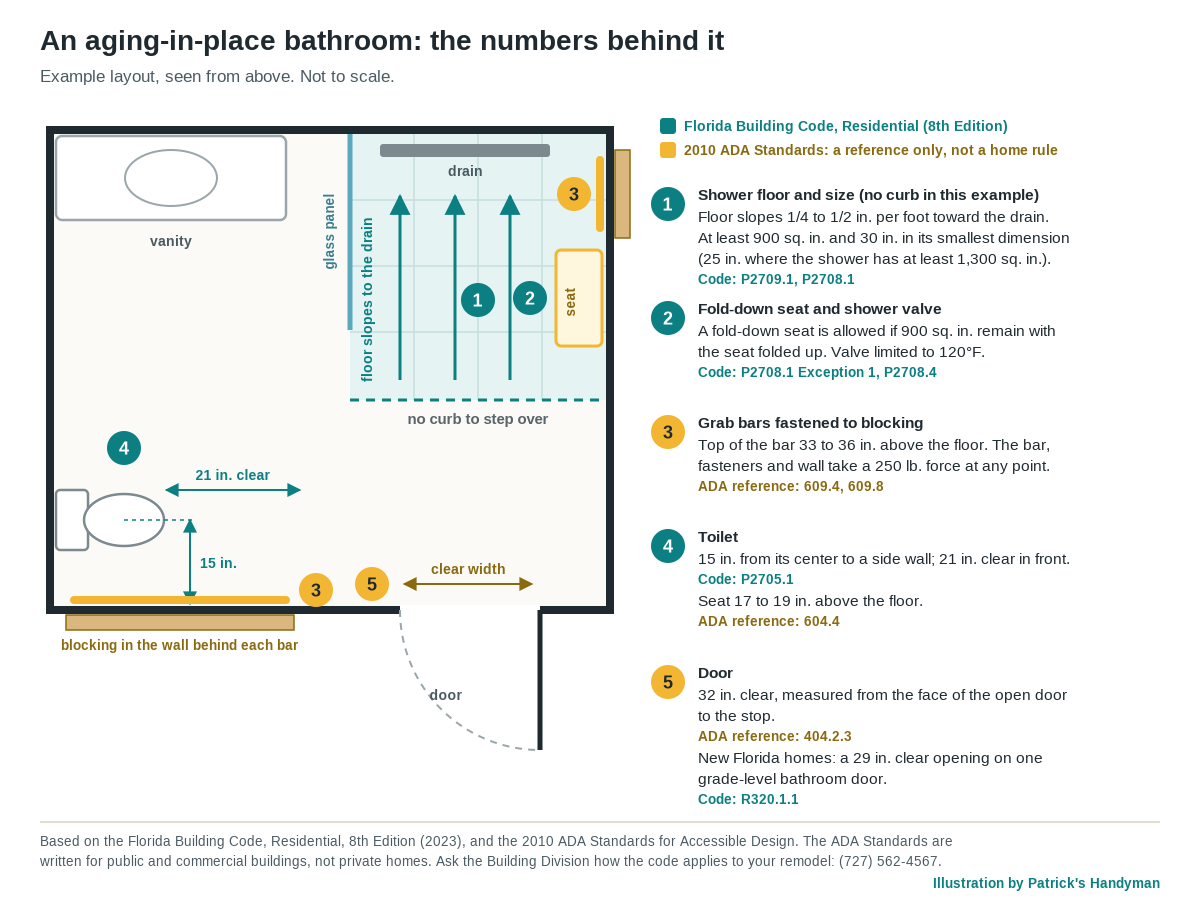
Florida's own code asks much less of a house. The Florida Building Code, Residential (8th Edition) says "All new single-family houses, duplexes, triplexes, condominiums and townhouses shall provide at least one bathroom, located with maximum possible privacy, where bathrooms are provided on habitable grade levels, with a door that has a 29-inch (737 mm) clear opening" (Section R320.1.1). That rule is for new homes. For a toilet, the same code calls for at least 15 inches from its center to any side wall, partition or vanity and 21 inches clear in front (Section P2705.1).
How is a curbless shower built?
A curbless shower has no curb at the entry, so the slope of the floor and the waterproofing under it have to keep the water in.

The Florida Building Code, Residential opens its shower floor section with a condition: "Where a shower receptor has a finished curb threshold, it shall be not less than 1 inch (25 mm) below the sides and back of the receptor." It then says "The curb shall be not less than 2 inches (51 mm) and not more than 9 inches (229 mm) deep when measured from the top of the curb to the top of the drain," and "The finished floor shall slope uniformly toward the drain," at 1/4 to 1/2 inch per foot (Section P2709.1). The section doesn't mention a shower without a curb, so ask the Building Division how it reads it for your design.
Three more details from the same chapter:
- Size. At least 900 square inches and 30 inches in the smallest dimension, or 25 inches where the shower has at least 1,300 square inches. The code measures that "exclusive of fixture valves, shower heads, soap dishes, and safety grab bars or rails," so grab bars don't count against it (P2708.1).
- A seat. "Fold-down seats shall be permitted in the shower, provided the required 900-square-inch (0.6 m2) dimension is maintained when the seat is in the folded-up position" (P2708.1, Exception 1).
- Water temperature. The shower valve must have "a means to limit the maximum setting of the valve to 120°F" (P2708.4).
An existing house being altered falls under the Florida Building Code, Existing Building (Residential code, Section R101.2), so ask Clearwater's Building Division how these sections apply to your remodel.

Why a conversion costs more. Angi says "Converting your existing shower to a curbless design requires lowering the floor and adding waterproofing," and that "going curbless requires a custom build and a custom shower pan priced at around $2,500" (national figure). How the floor gets lowered depends on what is under it, a concrete slab or a wood-framed floor, so ask for that step to be spelled out in any quote. Drain and valve work is plumbing. On a remodel we manage, it is done by our licensed plumbing trade partners (s. 489.113(3), Florida Statutes).
A change scheduled for December 31, 2026. The 9th Edition of the Florida Building Code is scheduled to take effect that day. The Florida Building Commission's analysis says its Section P2709.3 adds language "requiring the shower lining assembly to be tested in accordance with Section P2503.6."
Where do grab bars go, and what holds them up?
A grab bar is only as strong as what it is screwed into. Moen's installation sheet for its grab bars says "BOTH ends of the grab bar MUST be positioned over a wood stud (unless using SecureMount™ anchors)," and notes that "Studs are usually 16 in. apart." Unless the wall has extra backing or the maker's own rated anchors are used, the studs decide where a bar can go.
That is why blocking matters. Blocking is solid wood fastened between the studs before the wall is closed, so a bar can go where it is needed. The ADA Standards recognize the same idea for housing: in residential dwelling units, grab bars need not be installed in a shower "provided that reinforcement has been installed in walls and located so as to permit the installation of grab bars" (608.3, Exception). When a remodel opens the walls, we plan where grab bars will be anchored before the walls are closed up.
For placement, the ADA reference is a horizontal bar with its top 33 to 36 inches above the floor (609.4). Angi puts professional installation at $200 to $350 per bar nationally and says mounting on tile, fiberglass or masonry "may add $100 to $150."
How wide should the bathroom door be?
Apart from the 29-inch bathroom door rule for new homes above, the Florida Building Code, Residential sets its door width for the egress door: it needs "a clear width of not less than 32 inches," and "Other doors shall not be required to comply with these minimum dimensions" (R311.2). An older bathroom door can be much narrower. Angi says "standard interior doors are more narrow, measuring between 24 and 30 inches wide."
The ADA reference is 32 inches clear, "measured between the face of the door and the stop, with the door open 90 degrees" (404.2.3). Measured that way, the opening is narrower than the door, because the open door and the stop both sit inside the frame.
Angi lists three ways to gain width: "Removing trim, switching to offset hinges, and widening door frames." Widening the frame means cutting into the wall. Angi's national figures are $300 to $1,200 in a non-load-bearing wall and $1,200 to $6,000 in a load-bearing wall, where it says a structural engineer's consultation and drawings cost $300 to $800. Our Largo post on opening up a galley kitchen covers load-bearing walls.
Do you need a permit for an aging-in-place bathroom in Clearwater?
For most of it, yes. This table sets each change beside the words on the City of Clearwater's permit page:
| Change | What the city's page says |
|---|---|
| New tile | No permit: "installing tile/carpeting" |
| A taller toilet or new vanity in the same place | No permit: "replacing kitchen/ bathroom cabinets or fixtures" |
| Curbless shower with a moved or lowered drain | Permit: "Replacement, alteration, addition to or deletion from any electrical, plumbing (including fixture relocation) or air-conditioning system" |
| Widening the door | Permit: "Any building framing work" and "Construction, alteration, or replacement of any exterior or interior load-bearing or non-load-bearing wall" |
| New lights, fan or outlets | Permit: the same electrical line as above |
| Grab bars | Not named on either list |
Quotes are from the City of Clearwater's "Get a Building Permit" page, read November 15, 2026. The match between each job and a line on the page is ours.
The city decides the borderline cases. Call (727) 562-4567 before you start. On a remodel we manage, plumbing and electrical work is done by our licensed trade partners; we don't take stand-alone electrical jobs.
A permit exemption for grab bars and wider doors is scheduled. The Florida Building Commission's analysis of the 9th Edition code, scheduled to take effect December 31, 2026, says "A new exemption to a required permit has been added for renovation of an existing residential one- and two-family dwelling for purposes of providing accessibility access to and throughout the dwelling, including ramps with rise of 48 inches (610 mm) or less, alteration to widen openings of interior doors, grab bars, and fixtures." That is the Commission's summary, not the final code text, and we haven't seen how Clearwater will apply it. Ask the city whether your project qualifies.
What a permit costs. We ran the city's fee estimator on November 15, 2026, for a residential remodel:
| Job value | Trades on the permit | City's estimate |
|---|---|---|
| $8,000 | Building + plumbing | $149.18 |
| $12,000 | Building + electrical + plumbing | $213.20 |
The estimator says its figures don't include impact, fire or right-of-way fees.
Florida's under-$7,500 permit exemption excludes "Any electrical, plumbing, structural, mechanical, or gas work" and property in a flood hazard area (s. 553.79(1)(g), Florida Statutes). In a flood zone, Clearwater also counts "Bathroom tiling and fixtures" toward its 50% substantial improvement rule; our Clearwater bathroom remodel post explains it.
Is there help paying for it in Clearwater?
The City of Clearwater's Home Preservation Program page says "Eligible homeowners may also receive up to $15,000 in grant funds for ADA accessibility improvements." Two cautions. The same page describes that money as special-needs funding and says the funds "must be to serve persons with developmental disabilities as defined in section 393.063, Florida Statutes," so ask the city whether your household qualifies. It also says the city "is still accepting rehabilitation program applications, but applications will not advance until funding becomes available." The home must be your primary residence and homestead inside city limits, and the household must meet the program's income guidelines. The page lists (727) 444-7161.
Our Pinellas home repair assistance guide lists other city and county programs, and the Area Agency on Aging of Pasco-Pinellas, which calls itself "the region's Aging and Disability Resource Center," runs a helpline at 1-800-963-5337.
What's hiding in an older Clearwater bathroom?
Of Clearwater's 61,123 housing units, 55.9% were built before 1980 (ACS 2020–2024). When walls and floors are opened:
- Lead paint. Widening a door or opening a wall disturbs paint. The EPA's RRP Rule "requires that anyone paid to perform work that disturbs painted surfaces in homes ... built before 1978 be certified." Some exceptions apply (40 CFR 745.82). We are not EPA RRP-certified, so we refer paint-disturbing work in a pre-1978 home to an EPA Lead-Safe Certified firm.
- Old flooring. The EPA lists "Vinyl floor tiles and the backing on vinyl sheet flooring and adhesives" among products that may contain asbestos. Florida generally requires asbestos surveys by a licensed asbestos consultant and removal by a licensed asbestos contractor (s. 469.003), with limited exceptions (s. 469.002). We don't do either.
What does an aging-in-place bathroom cost?
| Item | Typical cost | Do it yourself? |
|---|---|---|
| Essential accessibility features for a bathroom | $3,030–$25,300 (Tampa, Angi) | No |
| Walk-in, stepless or curbless shower entry | $1,500–$6,500 (Tampa, Angi) | No: floor, drain and waterproofing |
| Curbless or barrier-free shower, average | $6,000 (national, Fixr) | No |
| Grab bar | $75–$600 per bar (Tampa, Angi) | Some of it: only into studs or blocking, by the maker's instructions |
| Built-in or fold-down shower seat | $200–$800 (Tampa, Angi) | No: it needs solid backing |
| Handheld showerhead | $75–$350 (Tampa, Angi) | Yes, on an existing shower arm |
| Widening a doorway, non-load-bearing wall | $300–$1,200 (national, Angi) | No: framing work, and a permit in Clearwater |
| Widening a doorway, load-bearing wall | $1,200–$6,000 (national, Angi) | No: engineer and permit |
Sources: Angi's Tampa pages on home accessibility (September 2026) and tub-to-shower conversions (July 2026); Angi's national page on doorway widening (October 2026); Fixr (March 2025).
How much does it cost to make a bathroom accessible in Clearwater?
Angi's Tampa page says "Remodeling a bathroom to add essential accessibility features adds $3,030 to $25,300 to your overall project budget." Angi says a curbless shower costs $500 to $700 more than a curbed one (national). See the full price guide for shower remodel cost, including curbless and accessible showers, plus bathroom remodel cost in Tampa Bay and tub-to-shower conversion cost.
What you can safely do yourself
- Put nonskid mats or strips on surfaces that get wet, and plug in a night light. Both are on the National Institute on Aging's list.
- Swap the showerhead for a handheld one on the existing shower arm.
- Measure each door the way the ADA Standards do: open it 90 degrees and measure from the face of the door to the stop.
- Look up your flood zone and any open permits with our guide to looking up permits on your property.
Leave to a pro: lowering a shower floor, drains and valves, wiring, widening a door, grab bars where you can't confirm what's in the wall, and paint or old flooring in an older home.
Local resources for Clearwater
- City of Clearwater: get a building permit (727-562-4567)
- City of Clearwater: fee estimator
- City of Clearwater: Home Preservation Program (727-444-7161)
- City of Clearwater: floodplain management
- City of Clearwater: emergency management
- Area Agency on Aging of Pasco-Pinellas (helpline 1-800-963-5337)
- Pinellas County flood zone lookup
- Pinellas County evacuation zone lookup
We're a Florida Certified General Contractor (Lic. #CGC1541672). On our jobs, you get a written quote within 48 hours of the free estimate, and we protect floors and clean up every day. Our bathroom remodeling page lists the bathroom work we take on in Clearwater and across Pinellas County.
Frequently asked questions
How high should grab bars be?
The 2010 ADA Standards, written for public and commercial buildings, put the top of a horizontal grab bar 33 to 36 inches above the floor (Section 609.4). A private house isn't held to that standard.
Do I need a permit to install grab bars in Clearwater?
The City of Clearwater's permit page doesn't name grab bars on its permit list or its no-permit list, so call (727) 562-4567. The Florida Building Commission's analysis says the 9th Edition code, scheduled to take effect December 31, 2026, adds a permit exemption for accessibility renovations of one- and two-family homes that names grab bars.
How much does a curbless shower cost?
In Tampa, Angi puts a walk-in, stepless or curbless shower entry at $1,500 to $6,500 (July 2026). Nationally, Angi puts a custom curbless shower pan at about $2,500, and Fixr puts the average curbless or barrier-free shower at $6,000.
Sources
- City of Clearwater: 02 Get a Building Permit / Apply Online (read Nov. 15, 2026)
- City of Clearwater: Estimate Your Permit Fees (runs on Nov. 15, 2026)
- City of Clearwater: Apply to the Home Preservation Program
- City of Clearwater: Application for Non-Substantial Damage / Improvement Review (PDF)
- Florida Building Code, Residential, 8th Edition (2023), Chapter 1: Section R101.2
- Florida Building Code, Residential, 8th Edition (2023), Chapter 3: Sections R311.2 and R320.1.1
- Florida Building Code, Residential, 8th Edition (2023), Chapter 27: Sections P2705.1, P2708 and P2709
- Florida Building Commission: Analysis of Changes, 9th Edition (2026) FBC, Building (Section 105.2 accessibility exemption) (PDF)
- Florida Building Commission: Analysis of Changes, 9th Edition (2026) FBC, Residential (Section P2709.3) (PDF)
- Florida Building Commission: 2026 FBC (9th Edition) workplan, effective date 12/31/2026
- U.S. Department of Justice: 2010 ADA Standards for Accessible Design
- Florida Statutes s. 489.113, Qualifications for practice; restrictions
- Florida Statutes s. 553.79, Permits
- Florida Statutes s. 469.003, License required (asbestos)
- Florida Statutes s. 469.002, Exemptions (asbestos)
- National Institute on Aging: Aging in Place: Growing Older at Home
- National Institute on Aging: Preventing Falls at Home: Room by Room
- CDC: Facts About Older Adult Falls (Sept. 8, 2026)
- EPA: Lead Renovation, Repair and Painting Program
- EPA: Learn About Asbestos
- U.S. Census Bureau, ACS 2020–2024 5-year, table S0101 (age and sex), Clearwater city
- U.S. Census Bureau, ACS 2020–2024 5-year, table B25007 (tenure by age of householder), Clearwater city
- U.S. Census Bureau, ACS 2020–2024 5-year, table B25034 (year structure built), Clearwater city
- Area Agency on Aging of Pasco-Pinellas
- Moen: Installation Instructions for Grab Bars, INS12875 (PDF)
- Angi: Home accessibility modification cost in Tampa (updated Sept. 11, 2026)
- Angi: Tub-to-shower conversion cost in Tampa (updated July 9, 2026)
- Angi: Walk-in shower cost (national, updated Oct. 30, 2026)
- Angi: Curbless shower pros and cons (updated July 8, 2026)
- Angi: What is a curbless shower? (updated July 8, 2026)
- Angi: Grab bar installation cost (national, updated Oct. 15, 2026)
- Angi: Doorway widening cost (national, updated Oct. 28, 2026)
- Angi: Door sizes for wheelchair access (updated Aug. 1, 2026)
- Fixr: Walk-in shower cost (national, updated March 4, 2025)