

Short answer: A soft floor around a toilet usually means water has been getting under the toilet long enough to soften or rot the wood floor below it. The USDA's Wood Handbook says plumbing leaks "can result in serious decay problems within buildings, particularly if they are undetected for long periods." The fix is to stop the leak, replace the rotted subfloor, and have the toilet reset by a licensed plumber. Ask Pinellas Park's Building Development Division about permits before the work starts.
A slightly spongy spot next to the toilet is easy to ignore. It doesn't hurt anything yet, and the toilet still flushes. But a floor that gives under your foot is telling you something is wet underneath, and wet wood doesn't stay strong.
In Pinellas Park, the median home was built in 1978, and 56.7% of homes date from before 1980 (U.S. Census Bureau, ACS 2024). In homes that age, the bathroom floor may still be the original. This post covers what's going on under a soft toilet floor, how to check it, how the repair works, Pinellas Park's permit rules and what it costs. For rot elsewhere in the house, see our guide to wood rot in Florida homes.
About 15% of Pinellas Park homes are mobile homes (ACS 2024). Mobile and manufactured homes are built differently, and we don't do mobile home repair, so this post is about site-built houses.
Is this urgent?
- Call now: the floor sags or cracks when you step on it, the toilet rocks hard or has shifted, or water is running out from under it. Stop using that toilet and turn off its water supply valve.
- Call today: water shows up at the base after flushing, or there's a stain on the ceiling below an upstairs bathroom.
- Can wait: a small soft spot with a toilet that sits firm and a dry floor. Have it checked soon; it won't fix itself.
Why does the floor around a toilet get soft?
Wood rots when it stays wet. The USDA Forest Products Laboratory's Wood Handbook says "serious decay occurs only when the moisture content of the wood is above the fiber saturation point (average 30%)," and that humid air alone "will not wet wood sufficiently to support significant decay." It takes liquid water, and the handbook names "humidity and plumbing leaks" as the main sources of moisture inside a home.
Around a toilet, that water usually comes from small leaks at the base, flush after flush. Angi's guide to toilets leaking at the base lists the usual causes: an old or damaged wax ring, a loose or broken flange, loose bolts, a cracked bowl, a leaking supply line, or a clogged drain that puts pressure on the wax ring. Because the leak is under the toilet, it can soak the floor for months before anyone sees it.
One test you may have heard of won't find this. The EPA's food-coloring test (drops in the tank, color in the bowl after 10 minutes) finds a leaking flapper inside the toilet. That wastes water, but it doesn't wet the floor. Our DIY guide shows how to check for water leaks, including that test.
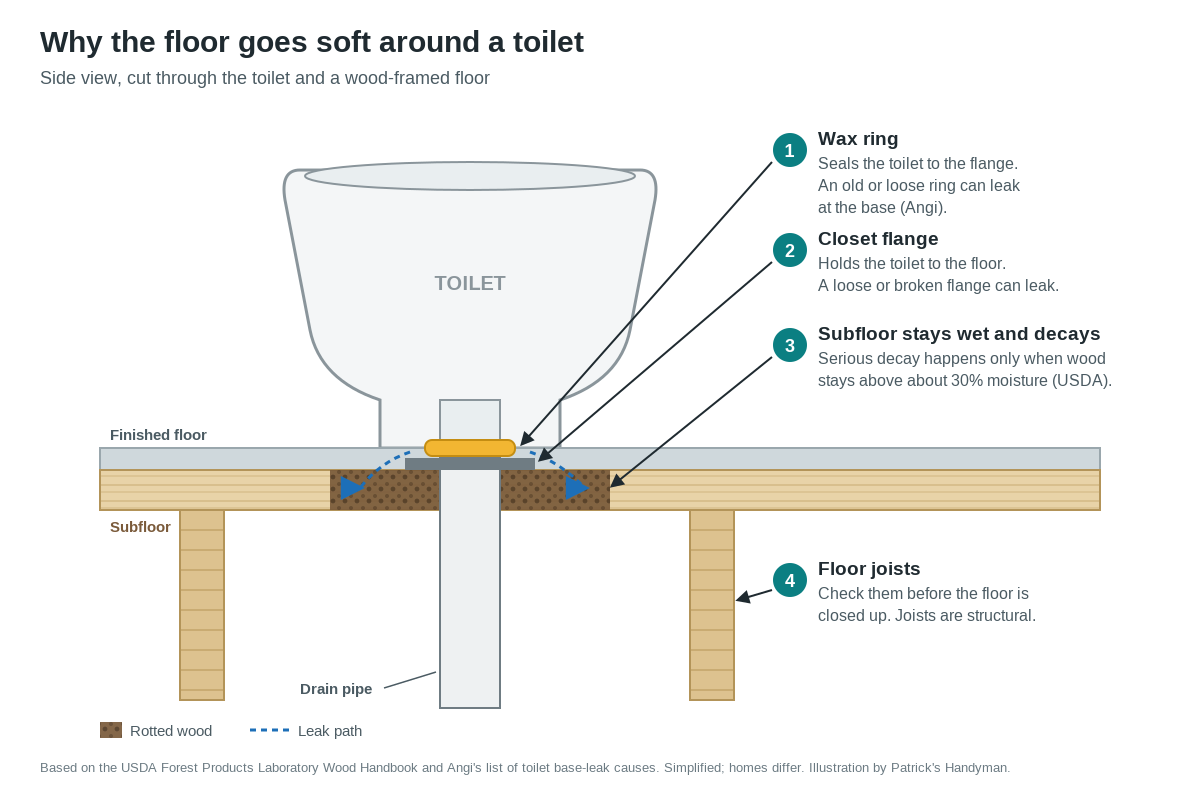
How to check a soft spot by the toilet
These are the signs we look for (our advice, not an official checklist):
- Press test. Stand beside the toilet and shift your weight. A firm floor doesn't move. Flex or a dip near the base means trouble.
- A toilet that rocks. If it moves when you sit down, the seal may be broken, and every flush can leak.
- Stains and loose tile. Dark grout, cracked tile, curling vinyl or discoloration at the base all point to water underneath.
- The room below. For an upstairs bathroom, look for a stain on the ceiling under the toilet.
If your house has a concrete slab floor, there's no wood subfloor under the toilet to rot. In our experience, a soft or loose spot there points to the flooring on top, which still needs a look.

Photograph it before you touch anything
Take photos and a short video of the base of the toilet, any stains, cracked tile and the ceiling below. Write down when you first noticed the soft spot and anything that changed, such as a rocking toilet or a higher water bill. It helps whoever fixes it understand how long the leak ran, and it gives you a record.
How is a rotted subfloor around a toilet repaired?
The usual order of work on our jobs (steps 1 and 4 follow the Wood Handbook):
- Find and stop the leak. The Wood Handbook says that in repairs "every effort should be made to correct the moisture condition that led to the damage." New wood over an old leak just rots again.
- Pull the toilet. We treat removing the toilet and disconnecting its water supply as plumbing work, so a licensed plumbing partner does it.
- Cut out the soft wood. The rotted subfloor around the flange comes out until the edges are solid. If rot reached the floor joists, they get repaired too.
- Replace it. The handbook says that once the moisture source is gone, "it is necessary only to replace the weakened wood with dry lumber." If the moisture can't be fully fixed, it calls for preservative-treated wood or naturally decay-resistant heartwood.
- New floor, then the toilet goes back. The finished floor is replaced, and a licensed plumber resets the toilet with a new seal, plus a new flange if the old one is damaged.
Who does what matters here. Under s. 489.113(3), Fla. Stat., a contractor must subcontract plumbing work unless it holds a state certificate or registration in plumbing, and a general, building or residential contractor is responsible for work on a building's structural components. On our jobs, PHRS handles the floor and framing, and licensed plumbing partners handle the toilet, flange and water lines. See our wood rot repair service.

Old floors: asbestos and lead paint
Older bathroom floors can hide two hazards.
- Asbestos. The EPA lists "vinyl floor tiles and the backing on vinyl sheet flooring and adhesives" among the places asbestos may be found, and says you generally "can't tell whether a material contains asbestos simply by looking at it." It also says, "Don't sand or try to level asbestos flooring or its backing." Have older flooring tested before it's torn out. Under s. 469.003, Fla. Stat., anyone you hire to remove it must be a licensed asbestos contractor.
- Lead paint. Removing painted baseboard or trim in a home built before 1978 disturbs paint. Under the EPA's lead renovation rule, a firm hired for that work generally must be EPA lead-safe certified (40 CFR 745.81(a)(2)(ii)), with exceptions in 40 CFR 745.82. We refer that part of the work to a certified firm.
If you find mold, the EPA says patches under about 10 square feet can usually be cleaned by the homeowner, and that wet areas should be dried within 24 to 48 hours. See our guide to cleaning a small mold patch.
Do you need a permit in Pinellas Park?
It depends on the job. Pinellas Park's own pages don't say whether a subfloor-only repair or a toilet reset needs a permit, so call Building Development at (727) 369-5647 before work starts. Here's what we did find:
- Plumbing. The Florida Building Code requires a permit before anyone installs, alters, repairs or replaces a plumbing system (FBC-Building, 8th Edition, section 105.1, as quoted on the city's Post-Storm Recovery Permitting Plan page). The city's Building FAQs say, "Some minor projects are allowed without obtaining building permits." Ask the city whether pulling and resetting the same toilet needs one.
- Fees. Under the city's fee schedule (Resolution 2026-13), a one- or two-family plumbing permit is $0.05 per square foot with a $100 minimum. A one- or two-family building permit is $100 for the first $1,000 of work plus $5.75 for each additional $1,000 (or fraction), up to $50,000.
- Unpermitted work. The city's Building FAQs say work without a required permit gets a stop work order and "additional fees (twice the amount of the original fee)," and covered work may have to be opened for inspection.
- Homeowners. Owners of owner-occupied single-family homes can pull their own permits after signing an Owner/Occupant Affidavit, according to the city's FAQs.
- Notice of Commencement. The city's permit procedures for single-family homes and additions list one as "Required in excess of $2,500.00" (see s. 713.13 and s. 713.02(5), Fla. Stat., which exempts improvements of $2,500 or less).
- Flood zones. The city's floodplain page says that if improvements cost "50% or more of the structure's market value," the building must meet current flood standards.
Florida's under-$7,500 permit exemption (s. 553.79(1)(g), Fla. Stat.) doesn't apply to plumbing or structural work on a single-family home, or to property in a flood hazard area, and we found no Pinellas Park procedure for it. You can look up past permits on your address in the city's online permit portal.
What you can safely do yourself
- Turn off the toilet's water supply valve if water is leaking at the base.
- Check for leaks with the meter and dye tests in our water leak guide.
- Wipe up water and dry the area; clean a small mold spot following our mold patch guide.
- Take photos and notes before any work starts.
Leave to a pro: pulling and resetting the toilet (plumbing), cutting out subfloor or joists, and removing old vinyl flooring or painted trim in an older home.
Local resources for Pinellas Park
What does fixing a soft floor around a toilet cost?
| Job | Typical cost | Do it yourself? |
|---|---|---|
| Wax ring replacement | $55–$205 (Tampa) | No: plumbing work |
| Toilet flange replacement | $150–$355 (Tampa) | No: plumbing work |
| Leaky toilet repair | $105–$610 (Tampa) | No: plumbing work |
| Bathroom subfloor replacement | $100–$570 (national) | No: may need a permit; may be structural |
| Subfloor replacement, per sq ft | $3–$10 (national) | No |
| Floor joist replacement | $350–$1,000 per joist (national) | No: structural |
| Pinellas Park plumbing permit | $100 minimum | Owner-occupants of single-family homes can apply |
Sources: Angi, toilet repair cost in Tampa (July 2026); HomeGuide, subfloor replacement cost; Angi, floor repair cost (May 2026); City of Pinellas Park Resolution 2026-13. The finished floor and any trim are extra.
How much does it cost to replace the subfloor under a toilet?
HomeGuide puts a bathroom subfloor replacement at $100 to $570 (national), and Angi puts subfloor replacement at $3 to $10 per square foot. In Tampa, Angi puts a toilet repair at $340 on average. What moves the price is how far the rot spread, whether joists are damaged, the new floor covering, and whether the flange has to be replaced. See the full price guide for wood rot repair costs, including framing and subfloors. If the floor repair turns into a bigger project, our bathroom remodeling page covers what that involves. If you're thinking about a second bathroom while the floor is open, see our post on adding a bathroom in Pinellas Park.
Frequently asked questions
Is a soft floor around a toilet dangerous?
It can be. Wood with visible decay has lost much of its strength, according to the USDA Wood Handbook, and a leak at the base can keep it wet. If the floor sags or the toilet moves, stop using it and have it checked.
How do you fix a soft floor around a toilet?
Stop the leak, remove the toilet, cut out the rotted subfloor, repair any damaged joists, install new subfloor and flooring, then reset the toilet with a new seal. The toilet and flange work is plumbing, done by a licensed plumber.
Can I just replace the wax ring?
A new wax ring can stop a leak, but it won't firm up a floor that has already rotted. If the floor is soft, the damaged wood needs to be replaced first.
Do I need a permit to fix a subfloor in Pinellas Park?
The city's pages don't say for a subfloor-only repair, so call Building Development at (727) 369-5647. Florida's under-$7,500 exemption doesn't cover plumbing or structural work on a single-family home, so ask the city before the toilet comes off.
Sources
- U.S. Census Bureau, ACS 2024 5-year, Pinellas Park: year structure built (B25034), median year built (B25035) and units in structure (B25024)
- USDA Forest Products Laboratory, Wood Handbook, ch. 14: Biodeterioration of wood
- EPA WaterSense: Fix a Leak Week
- EPA: A brief guide to mold, moisture and your home
- EPA: Learn about asbestos and Protect your family from exposures to asbestos
- EPA lead renovation rule, 40 CFR 745.81 and 745.82
- City of Pinellas Park: Permits and Building FAQs
- City of Pinellas Park: Resolution 2026-13, administrative fee schedule (PDF)
- City of Pinellas Park: Building permit procedures, single family (PDF)
- City of Pinellas Park: Floodplain development permitting
- City of Pinellas Park: Post-Storm Recovery Permitting Plan
- Florida Statutes s. 489.113, s. 469.003, s. 553.79, s. 713.13 and s. 713.02
- Angi: Toilet repair cost in Tampa (updated July 7, 2026)
- Angi: Why your toilet is leaking at the base
- Angi: Floor repair cost (updated May 30, 2026)
- HomeGuide: Cost to replace a subfloor