

Short answer: A condo bathroom remodel in St. Pete Beach, Florida, usually involves two sign-offs: your association's, if its declaration and rules require one, and a City of St. Pete Beach permit for work beyond routine maintenance and repairs. The city has its own condo kitchen and bath checklist, and Pinellas County says an asbestos survey must be done before a condo renovation. In Tampa, Angi puts most bathroom remodels at $5,352 to $13,631.
A condo bathroom shares a floor, walls and pipes with your neighbors, and that changes who has to say yes. In this city that's a lot of bathrooms: 44% of St. Pete Beach's 8,400 housing units are in buildings with 10 or more units, and 75% of the city's housing was built before 1980 (U.S. Census Bureau, ACS 2020–2024). This post covers the condo-specific steps. For fixtures and timelines, see our posts on a bathroom remodel in Clearwater and a bathroom remodel in Palm Harbor.
Is this urgent?
- Call now: water is running into the unit below or coming through your ceiling, or an outlet near water sparks or trips. Tell building management right away, and call a licensed plumber or electrician.
- Call today: a slow leak at a toilet, valve or shower. If the floor feels soft, see our post on a soft floor around the toilet.
- Can wait: a dated but dry bathroom. Start with your association's documents.
Can you remodel the inside of a condo in Florida?
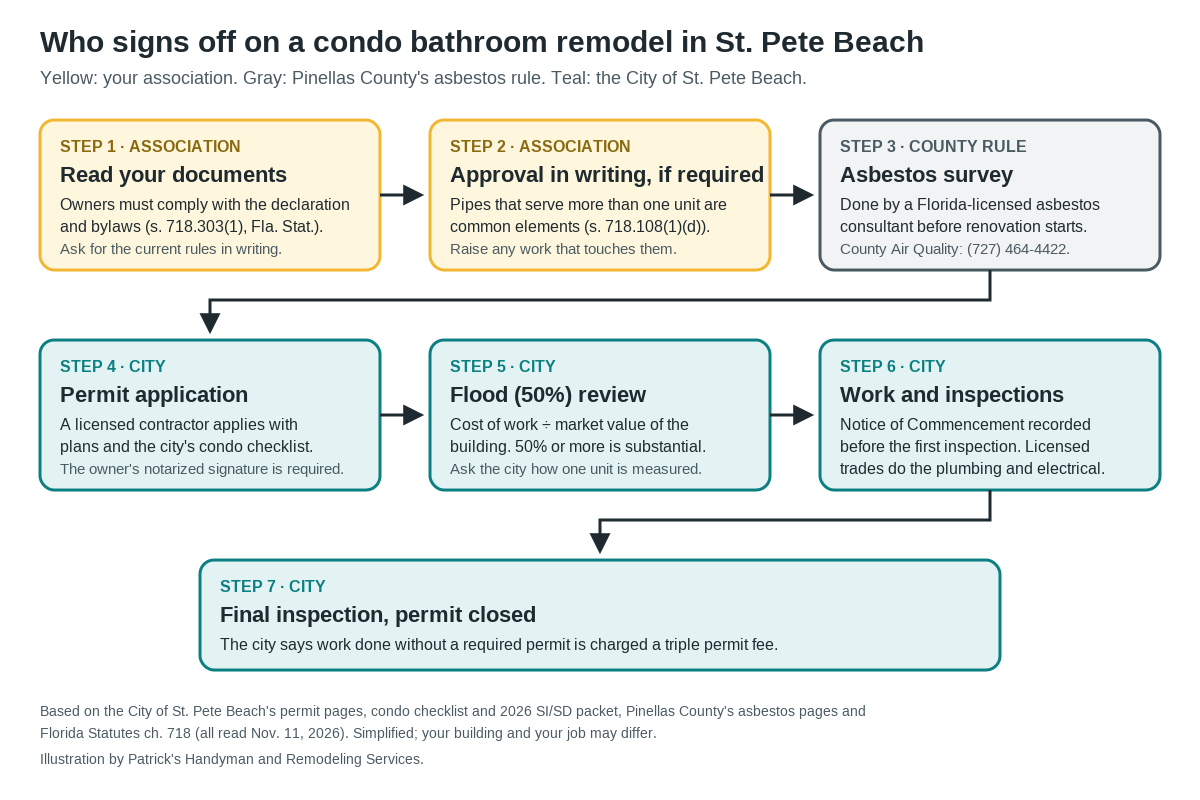
Yes, but your association's documents come first. Florida's Condominium Act says each unit owner "is governed by, and must comply with the provisions of, this chapter, the declaration, the documents creating the association, and the association bylaws" (s. 718.303(1), Florida Statutes). The sections we read for this post (ss. 718.108, 718.113 and 718.303) don't set out an approval process for work that stays inside a unit. If your building requires written approval, insured contractors or set work hours, that comes from its declaration and rules. Ask for them in writing before you get quotes.
The statute does draw three lines that matter in a bathroom:
- Shared pipes aren't yours. Common elements include "the property and installations required for the furnishing of utilities and other services to more than one unit" (s. 718.108(1)(d)). A drain stack serving several units fits that wording; your declaration draws the exact line.
- Changing common elements takes approval. There "shall be no material alteration or substantial additions to the common elements" except as the declaration provides. Where it is silent, 75% of the total voting interests must approve (s. 718.113(2)(a)).
- Don't weaken the building. An owner "shall not do anything within his or her unit or on the common elements which would adversely affect the safety or soundness of the common elements" (s. 718.113(3)).
Whether a change to a shared pipe is a "material alteration" is a question for your association and its attorney. This is general information, not legal advice.
Do you need a permit to remodel a condo bathroom in St. Pete Beach?
For most real remodels, yes. The city's FAQ says "Generally when any work exceeds the scope of routine maintenance and repairs, you will need a permit." Its hurricane recovery page lists the little that doesn't, including painting and minor water-leak repairs that don't reduce or extend the plumbing. Tile, tubs, showers and vanities aren't on that list.
The city's "Condo Kitchen/Bath Renovation" checklist shows what the plan reviewer looks at:
- Fire protection: any "new or relocated fire sprinklers/fire alarms/smoke detectors" on the plans, and a UL detail for "Any change to the fire rated corridor, tenant 1hr wall, or penetration of wall or floor."
- Trade work: "PLBG: Relocated or new fixtures," "ELEC: New/altered GFCI circuits" and "HVAC: Relocated supply/RA or exhaust duct."
- Floors: "Replacing tile/wood flooring? Sound underlayment ~ Minimum 50 STC impact IIC rating required," citing Section 1207 of the 2020 (7th Edition) Florida Building Code. The city now requires plans to comply with the 2023 8th Edition, so ask the reviewer how the sound rule applies to a replacement floor.
The city's submittal list has an entry called "Commercial Condo Remodel (no structural work)." It asks for plans "showing existing and proposed work (no design professional seal required for non-structural work)." The application requires the owner's notarized signature. The city also says "All subcontractors must sign onto the prime contractor's permit prior to permit issuance," and a recorded Notice of Commencement "is required prior to scheduling the first inspection."
Who pulls the permit? The city's FAQ says permits go to "a properly licensed contractor within the appropriate construction trade or by an owner of a single family residence." That wording doesn't mention condo units, so ask the city, at (727) 367-2735, before assuming you can pull an owner-builder permit. On a remodel we manage, plumbing and electrical work is done by our licensed trade partners (s. 489.113(3), Florida Statutes).
Florida's under-$7,500 permit exemption is unlikely to help: it covers "an owner of a single-family dwelling" and excludes plumbing and electrical work and flood hazard areas (s. 553.79(1)(g)). And the city describes a "standard triple (3x) permit fee for work performed without a permit."

How does St. Pete Beach's 50% flood rule apply to a condo unit?
The city's FEMA page says "The entire City of St. Pete Beach is located within a flood zone." Its 2026 substantial improvement packet, dated February 10, 2026, defines a substantial improvement as work "the cost of which equals or exceeds 50 percent of the market value of the building or structure before the improvement or repair is started." At 50% or more, the plans must show how the building will be brought into compliance with current flood requirements.
The packet's cost list names bathroom fixtures and piping, cabinets, floor finishes, electrical wiring, demolition labor and "Overhead and profit." Costs also stack: "When a property has an open permit, the costs of the proposed new work will be added to the cost of the previously permitted work."
For a condo, the question is what that cost is divided by. The packet says "We divide the total cost of the work by the market value of the building," and its definitions say "building or structure," not unit. It doesn't spell out the math for one unit. Its market-value section says only: "Contact us if your property is a manufactured home, condominium unit, or other building for which tax assessed values may not be provided." It adds that if the city finds your building already complies with current flood requirements, "the rest of this form is not required."
So before you set a budget, ask the Building Department at (727) 367-2735 (option 1, then option 1) how your unit will be measured.
What's hiding in an older St. Pete Beach condo bathroom?
Of the city's 8,400 housing units, 2,494 (about 30%) were built in the 1970s, more than in any other decade (ACS 2020–2024). Plan for two things before tear-out.
Asbestos. Pinellas County's page for condo associations says "An asbestos survey must be completed for all areas that are being renovated or demolished. By law, the survey must be performed by a licensed asbestos consultant." Its suspect list includes floor and tile mastic, joint compound, wallboard and vinyl sheet flooring. The county says a single-family home or "an apartment building with four or fewer dwellings units" "may be exempt from specific asbestos requirements" under certain conditions; a larger building isn't on that list. Removing at least 160 square feet of regulated asbestos material (or 260 linear feet on pipes) requires notice to the county 10 working days ahead, and "A permit or advisory statement from the local building department DOES NOT MEET the notification requirement." We don't survey or remove asbestos (s. 469.003, Florida Statutes).
Lead paint. EPA's RRP Rule "requires that anyone paid to perform work that disturbs painted surfaces in homes, childcare facilities and preschools built before 1978 be certified." We are not EPA RRP-certified, so we refer paint-disturbing work in a pre-1978 unit to an EPA Lead-Safe Certified firm. EPA says the rule generally doesn't cover owners working in their own homes, but "it does apply if you rent all or part of your home."

What does a condo bathroom remodel cost?
These are Angi's Tampa figures from our price guides. They aren't condo-specific.
| Job (Tampa) | Typical cost (Angi, 2026) | Do it yourself? |
|---|---|---|
| Most bathroom remodels | $5,352–$13,631, average $9,491 | Depends on the scope |
| Small bathroom or half bath | $1,514–$15,135, average $6,559 | Some of it: paint and accessories |
| Tub-to-shower conversion | $1,514–$8,072, average $3,027 | No: plumbing, waterproofing and a permit |
| Walk-in shower | $6,054–$12,108, average $9,081 | No: drain, valve and waterproofing |
| Toilet installation | $218–$459, average $332 | Some of it: a like-for-like swap; ask your association and the city first |
| Exhaust fan installation | $278–$590, average $427 | No: wiring by a licensed electrician |
A condo adds the asbestos survey, sound underlayment under new tile, plans for the city's checklist, and whatever your association requires. Our Tarpon Springs post covers the tub-to-shower conversion itself.
How much does it cost to remodel a condo bathroom?
Plan on Angi's Tampa range of $5,352 to $13,631 for most bathroom remodels, and more when plumbing moves or the shower is custom tile. The condo extras depend on your building. See the full price guide for bathroom remodel cost in Tampa Bay, plus shower remodel cost and tub-to-shower conversion cost.
What you can safely do yourself
- Read your declaration and rules, and ask the association for its remodeling requirements in writing.
- Paint: the city lists painting as work that doesn't need a building permit. In a pre-1978 unit, EPA says to use lead-safe work practices if you do it yourself.
- Look up your unit's permits in the city's portal with our guide to looking up permits on your property.
- Check for leaks with our guide to checking for a water leak.
Leave to a pro: anything that moves plumbing or wiring, shower pans and waterproofing, work that touches shared pipes or fire-rated walls and floors, and tearing out old flooring or tile before the asbestos survey.
Local resources for St. Pete Beach
- City of St. Pete Beach: permits, applications and forms
- City of St. Pete Beach: condo kitchen and bath permit checklist (PDF)
- City of St. Pete Beach: 2026 50% rule packet
- Pinellas County flood zone lookup
- Pinellas County evacuation zone lookup
- City of St. Pete Beach: flooding and hurricane resources
- Pinellas County: asbestos FAQs for condominium associations
Our bathroom remodeling page lists the bathroom jobs we take on across Pinellas County, condos included.
Frequently asked questions
Do I need a permit to remodel a condo bathroom in St. Pete Beach?
Usually. The City of St. Pete Beach says work beyond "routine maintenance and repairs" generally needs a permit, and its condo checklist covers new or relocated plumbing fixtures, GFCI circuits, exhaust ducts and flooring underlayment. Call (727) 367-2735 to confirm.
Do I need my condo association's approval to remodel my bathroom in Florida?
Check your declaration and rules. Florida law requires owners to comply with them (s. 718.303(1)) and bars material alterations to common elements, which include utility installations serving more than one unit, except as the declaration provides (ss. 718.108 and 718.113(2)(a)).
Does the 50% rule apply to one condo unit in St. Pete Beach?
The city's 2026 packet measures the cost of work against "the market value of the building or structure" and tells owners of a condominium unit to contact the city about the value used. It doesn't spell out the math for a single unit, so ask at (727) 367-2735.
Do I need an asbestos survey before remodeling a condo bathroom in Pinellas County?
Pinellas County's page for condo associations says a survey by a licensed asbestos consultant "must be completed for all areas that are being renovated or demolished." The county says a single-family home or an apartment building with four or fewer dwelling units "may be exempt from specific asbestos requirements" under certain conditions. Call county Air Quality at (727) 464-4422.
Sources
- City of St. Pete Beach: Permits, Applications, Forms (read Nov. 11, 2026)
- City of St. Pete Beach: Condo Permit Checklist, Condo Kitchen/Bath Renovation (PDF)
- City of St. Pete Beach: Submittal Requirements by Permit Type (PDF)
- City of St. Pete Beach: Building Permit Application for Contractors, with subcontractor sign-on (PDF)
- City of St. Pete Beach: Building & Permitting Information
- City of St. Pete Beach: FAQs, Community Development, Getting a Permit
- City of St. Pete Beach: Hurricane Recovery Permitting Information (work that doesn't need a permit; triple fee)
- City of St. Pete Beach: 2026 50% Rule, Substantial Improvement or Substantial Damage Packet and the packet PDF, dated 2/10/2026
- City of St. Pete Beach: Federal Emergency Management Agency (FEMA) Information
- Florida Statutes s. 718.108, Common elements
- Florida Statutes s. 718.113, Maintenance; limitation upon improvement
- Florida Statutes s. 718.303, Obligations of owners and occupants; remedies
- Florida Statutes s. 553.79, Permits
- Florida Statutes s. 489.113, Qualifications for practice; restrictions
- Florida Statutes s. 469.003, License required
- Pinellas County: Asbestos FAQs for Property Managers and Condominium Association Members
- Pinellas County: Asbestos Notification Requirements
- EPA: Lead Renovation, Repair and Painting Program
- U.S. Census Bureau, ACS 2020–2024 5-year, table B25024 (units in structure), St. Pete Beach city
- U.S. Census Bureau, ACS 2020–2024 5-year, table B25034 (year structure built), St. Pete Beach city
- Angi: How much does a bathroom remodel cost in Tampa? and Angi's other Tampa bathroom pages, as cited with their dates in our bathroom remodel cost guide