

Short answer: Often, yes: once the water source is fixed, a rotted window sill in a Dunedin home can often be stabilized with epoxy, spliced with new wood or replaced without removing the whole window, according to the National Park Service and Angi. If rot reaches the frame or wall, replacing the window may make more sense. Dunedin requires a permit to replace a window, but its pages don't say whether a sill-only repair needs one, so ask the Building Division first.
The sill is the part of a window that takes the most water. Rain runs down the glass and sits on it, and when paint fails there, the wood underneath starts to soak it up. In Dunedin, where about 61% of homes were built before 1980 and the median home dates to 1976 (U.S. Census Bureau, ACS 2024), plenty of window sills have had decades of that.
This post covers the sill and the bottom of the window frame. For rot elsewhere on the house, see our guide to wood rot in Florida homes, and for doorways, our post on rotted door frames.
Is this urgent?
- Call now: the window won't close or lock, the frame is pulling away from the wall, or the wall below the window is soft or bulging. A window that can't be secured is a problem, especially with a storm coming.
- Call today: water comes in around the window when it rains, or the wall, drywall or floor below the window is wet.
- Can wait: peeling paint or a small soft spot on the sill, with a window that closes tightly and a dry wall below. Have it checked soon, before the rot spreads.
What causes wood rot around windows?
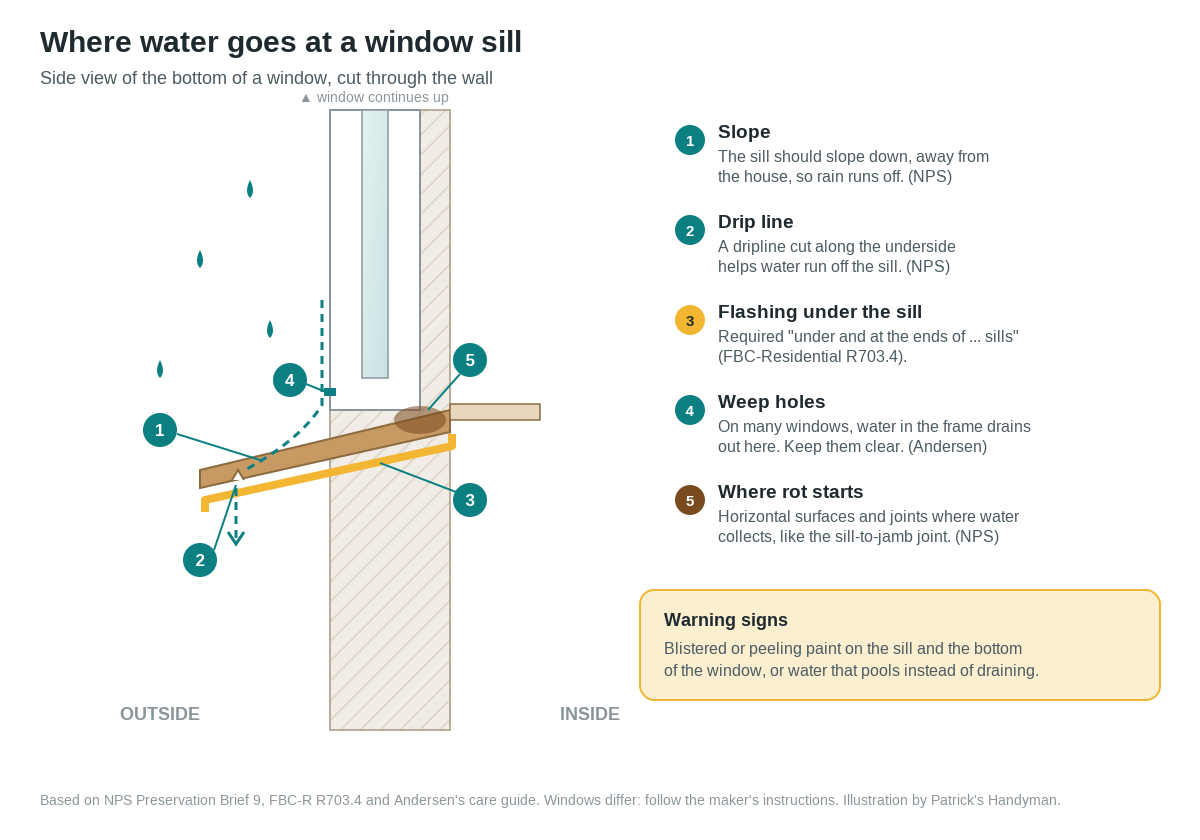
Water does. The National Park Service's guide to repairing wood windows, Preservation Brief 9, says that of all the causes of window deterioration, "moisture is the primary contributing factor in wooden window decay." It adds that decay "usually begins on horizontal surfaces and at joints where water can collect and saturate the wood." On a window, that means the sill, the joints where the sill meets the side jambs, and the bottom corners.
The usual ways water gets there:
- Rain that sits instead of running off. NPS says a sill should slope "downward away from the building," and that anything that lets water "puddle on the sill must be corrected."
- A window that already leaks a little. The Florida Division of Emergency Management's Hurricane Retrofit Guide says water on windowsills after a thunderstorm usually does little damage "other than cause paint to peel," but warns that a window leaking like that is "a disaster waiting to happen in a hurricane."
- Missing flashing under the sill. The Florida Building Code requires flashing "under and at the ends of masonry, wood or metal copings and sills" (FBC-Residential R703.4). When a window is replaced without it, the new window can look fine while the wood below stays wet.
- Paint that isn't kept up. Andersen's care guide for its windows says "finishing is the responsibility of the building owner and must be maintained over time."
Rotting window sill inside: condensation or a leak?
If the inside sill is rotting, check for condensation before you blame the window. The EPA's guide to mold and moisture says "if you see condensation or moisture collecting on windows, walls or pipes act quickly to dry the wet surface," and to keep indoor humidity "below 60 percent (ideally between 30 and 50 percent)." Andersen's guide says condensation on the glass comes from "too much moisture in the air" and "does not indicate a failure of the glass." If the sill only gets wet on cool mornings, humidity is the likely cause. Our DIY guide shows how to check your indoor humidity with a hygrometer. If it gets wet when it rains, it's a leak.
How to check a window sill for rot
Start with the paint. NPS says "areas of paint blistering, cracking, flaking, and peeling usually identify points of water penetration." The state's retrofit guide says blistered paint "especially on the lower end of the window" means the window may let a lot of water in during a hurricane.

Then check whether water drains off the sill or pools on it. On windows with weep holes, Andersen says pooled water should drain through them, and to clean them if it doesn't; our guide to clearing window weep holes shows how. Finally, probe any soft-looking wood. The ice-pick test in our wood rot guide works for sills, where NPS says probing straight in is "especially useful."
Two other things to look for: the U.S. Forest Service's Wood Handbook lists window sills among the places carpenter ants frequent, and the state guide says loose fasteners can mean "the wood of the house may be rotted because of water damage or termites." If you see insects, sawdust or mud tubes, call a licensed pest control company first.
Photograph it before you touch anything
Take close-ups of the sill, the joints at each end, the trim below it and the wall or drywall under the window inside. Add a wider shot that shows which window it is. If water comes in when it rains, take a short video while it's happening and write down the date. Photos help whoever repairs it see how far the damage went before anything is opened up.
Can you repair a rotted window sill, or does it need replacing?
Often it can be repaired. NPS sorts window repairs into three classes: "1) routine maintenance procedures, 2) structural stabilization, and 3) parts replacement," each one more costly than the last. Before any of them, it says, "all sources of moisture penetration should be identified and eliminated."
- Stabilize it (epoxy). For partly decayed wood, NPS describes saturating it with "semi-rigid epoxies which saturate the porous decayed wood and then harden," then filling the surface with an epoxy patching compound and painting it. After any patch, it says, "the finished surface should be sloped slightly to carry water away from the window."
- Splice in new wood or replace the sill. When the sill can't be stabilized, NPS describes "replacing the deteriorated parts with new matching pieces, or splicing new wood into existing members," and notes millwork shops can duplicate sills. Angi says rotted sills can often be replaced without removing the entire window.
- Replace the window. NPS says that even with parts replacement, "if the percentage of parts replacement per window is low... repair can still be a cost effective solution." NPS also says "there is a point when the condition of a window may clearly indicate replacement." Rot that has reached the frame and the wall around it, or a window that no longer seals, is a common reason to replace the whole window.
A replacement window is a bigger job in Florida. Windows need state or local product approval (ss. 553.842 and 553.8425, Florida Statutes), and replacement windows must meet the wind requirements in Chapter 16 of the building code (FBC-Existing Building 707.4). Dunedin's own Opening Protection Exception form says "all of Pinellas County including Dunedin is a windborne debris region," and explains the exception for one- and two-family homes permitted before March 1, 2002: they can replace up to 25% of their glazed area in any 12 months without opening protection, but the new windows must still be designed for enclosed-building wind pressures. Our post on whether impact windows are required covers that rule, and our window replacement page covers the work. Our wood rot repair service handles sills, trim and the framing behind them.
Do you need a permit in Dunedin?
Dunedin's residential permit brochure lists "Door or Window Replacement" among the work that needs a permit, and says "ordinary minor repairs" don't. Its storm recovery FAQ also lists "Replacing windows and doors." So replacing a window needs a permit, applied for through the city's online portal.
What about repairing or replacing just the sill and keeping the window? Dunedin's pages don't say. Call the Building Division at (727) 298-3210 or email permits@dunedin.gov before work starts. Dunedin's summary of the state's under-$7,500 permit exemption doesn't mention windows either way, but it says the exemption doesn't apply to structural work or properties in flood hazard areas.
Permit fees are 0.80% of the job's value with a $60 minimum, plus a plan review fee of 25% of the permit fee. Dunedin's online fee calculator came to $79 in total for any job valued up to $5,000 in our Nov. 2026 test, including a $4 state surcharge.
If your home is a designated Dunedin landmark, exterior changes need a Certificate of Appropriateness, but the city says "ordinary repair and maintenance" doesn't, and the city's Director will review a scope of work for free to say whether a COA is needed. For who can legally do which repairs, see our post on whether you need a handyman or a licensed contractor.
Older homes and lead paint
Window sills are a lead paint hot spot. The EPA says old paint "especially on surfaces subject to constant friction like doors or window sills" can produce hazardous chips and dust. Its renovation rule names "window repair" as renovation work, and says work that "involve[s] window replacement" never counts as minor repair and maintenance (40 CFR 745.83). Generally, a firm paid to do that work in a home built before 1978 must be EPA-certified (40 CFR 745.81(a)(2)(ii)), with limited exceptions (40 CFR 745.82).
We're not an EPA lead-safe certified firm. In a pre-1978 home, we refer work that disturbs painted surfaces to an EPA-certified firm, unless a certified inspector or renovator has found the paint isn't lead-based. If you're doing it yourself, the EPA's lead-safe renovations for DIYers page says a home built before 1978 may have lead-based paint and recommends having it tested by a certified lead inspector or risk assessor; if you can't tell how old the home is, it says it's safest to assume the paint contains lead.
What you can safely do yourself
- Look for blistered or peeling paint on the sill and the bottom of the window, and check that rain runs off the sill instead of pooling (NPS, FDEM).
- Clear the window's weep holes if water pools in the bottom track (Andersen).
- Wipe up condensation on inside sills and check your indoor humidity (EPA).
- Replace cracked caulk at the joints around the outside of the window. The state guide says regular silicone caulks are "not recommended" for this. Don't caulk over weep holes.
- Avoid pressure-washing windows; Andersen says it may cause damage and is not recommended.
Leave to a pro: sill replacement, frame and wall repairs, window replacement, termite treatment, and any paint-disturbing work in a pre-1978 home.
Local resources for Dunedin
What window sill repairs cost
| Job | Typical cost | Source | Do it yourself? |
|---|---|---|---|
| Window repair, average | $154–$422 (average $285) | Angi, Tampa (July 2026) | Some of it: caulk and weep holes; not sills or frames |
| Rotten window frame repair | $250–$800 | Angi, Tampa (July 2026) | No: rot usually runs past what you can see |
| Window sill repair | $200–$300 | Angi, national | Usually no: rot often runs deeper than it looks; in pre-1978 homes use EPA lead-safe practices |
| Window sill replacement | $150–$700 (average $400) | Angi, national | No: the sill ties into the window's flashing |
| Window sill replacement, per sill | $250–$800 | HomeGuide, national | No: same reason |
| Window replacement | about $900 per window | Angi, Tampa (July 2026) | No: needs a permit and product approval in Dunedin |
| Dunedin permit fee, job up to $5,000 | $79 | City fee calculator (Nov. 2026) | Not applicable |
How much does it cost to repair a rotted window sill?
In Tampa, Angi puts the average window repair at $285, and repairing a rotten window frame at $250 to $800. Nationally, Angi puts sill repair at $200 to $300 and a sill replacement at an average of $400. The price goes up when the rot has reached the frame or the wall below, when the window has to be replaced, and when lead-safe work is required in an older home. See the full price guide for wood rot repair cost, including Tampa sill and frame figures. If the whole window needs replacing, see our window replacement cost guide.
Frequently asked questions
What causes wood rot around windows?
Water that collects and stays. The National Park Service says decay usually starts on horizontal surfaces and at joints where water can collect, which on a window means the sill and its joints. Peeling paint, sills that don't slope away, leaks and missing flashing under the sill all let it in.
Can you replace a window sill without replacing the window?
Often, yes. NPS describes replacing or splicing in new wood for badly decayed parts like sills, and Angi says rotted sills can often be replaced without removing the whole window. If the rot reaches the frame or wall, replacing the window may make more sense.
Do I need a permit to replace a window in Dunedin?
Yes. Dunedin's permit brochure lists "Door or Window Replacement" as needing a permit. The city's pages don't say whether a sill-only repair needs one, so call the Building Division at (727) 298-3210.
Why is the inside of my window sill rotting?
Often it's condensation. The EPA says to dry condensation quickly and keep indoor humidity below 60%. If the sill gets wet when it rains, the window is leaking instead.
Can I fix a rotted window sill with epoxy?
For partly decayed wood, the National Park Service describes consolidating it with epoxy, filling the surface with an epoxy patch and painting it. In a home built before 1978, paid work that disturbs the paint falls under the EPA's lead rules, and deep rot usually needs the wood replaced.
Sources
- National Park Service: Preservation Brief 9, The Repair of Historic Wooden Windows (PDF)
- Florida Division of Emergency Management: Hurricane Retrofit Guide, Openings (windows)
- USDA Forest Service, Forest Products Laboratory: Wood Handbook, Chapter 14, Biodeterioration of Wood
- EPA: A Brief Guide to Mold, Moisture and Your Home (updated Feb. 18, 2026)
- Andersen: Important Product, Care, and Maintenance Information (PDF, rev. June 2, 2023)
- Florida Building Code, Residential, 8th Ed. (2023), Chapter 7, Wall Covering (R703.4)
- Florida Building Code, Existing Building, 8th Ed. (2023), Chapter 7, Alterations Level 1 (707.4)
- Florida Statutes s. 553.842, Product evaluation and approval (2026)
- Florida Statutes s. 553.8425, Local product approval (2026)
- City of Dunedin: Permits and inspections (fees, contact)
- City of Dunedin: Residential building permits brochure (PDF, Apr. 15, 2025)
- City of Dunedin: Storm recovery permitting FAQs (PDF)
- City of Dunedin: Opening Protection Exception Form (PDF, rev. Apr. 15, 2025)
- City of Dunedin: Permit exemptions effective July 1, 2026 (PDF)
- City of Dunedin: Permit fee calculator
- City of Dunedin: Historic preservation
- U.S. Census Bureau: ACS 2024 5-year, Year Structure Built (B25034), Dunedin city
- U.S. Census Bureau: ACS 2024 5-year, Median Year Structure Built (B25035), Dunedin city
- EPA: Lead Renovation, Repair and Painting Program
- eCFR: 40 CFR 745.83, Definitions (lead renovation rule)
- eCFR: 40 CFR 745.81, Effective dates (firm certification)
- eCFR: 40 CFR 745.82, Applicability
- Angi: How much does window repair cost in Tampa? (updated July 8, 2026)
- Angi: How much does window replacement cost in Tampa? (updated July 9, 2026)
- Angi: Window sill replacement cost
- HomeGuide: Window sill replacement cost