

Short answer: Gutting a bathroom in a St. Petersburg house built before 1960 can uncover cast-iron drains, galvanized steel water lines and plaster walls. The city's exempt-permits list says a defective concealed drain that has to be replaced may be treated as new work needing a permit, and its under-$7,500 exemption excludes plumbing and electrical work. Angi puts most Tampa bathroom remodels at $5,352 to $13,631.
St. Petersburg has a lot of homes that old. Of the city's 141,508 housing units, 52,302 (about 37%) were built before 1960, including 12,714 built in 1939 or earlier (U.S. Census Bureau, ACS 2020–2024, table B25034). The median year built is 1969 (table B25035).
You can't know what's behind old tile until it comes off. This post covers what may be there, what the City of St. Petersburg's own documents say about it, and who handles each part. For permit fees and timelines in a newer house, see our Clearwater bathroom remodel post; for small layouts, see our small bathroom remodel in Dunedin.
Is this urgent?
- Call now: water is reaching an outlet, light or wiring, or a ceiling below the bathroom is sagging. Stay clear of anything electrical and call a licensed plumber and a licensed electrical contractor.
- Call today: a drain that leaks every time the tub or toilet is used, sewage odor in the bathroom, or a floor that feels soft. See our posts on a leaking shower in Largo and a soft floor around the toilet.
- Can wait: a dated bathroom that is dry and works. Plan it, and test for lead and asbestos before anything is opened up.
What do you find when you open up a bathroom in an older St. Pete house?
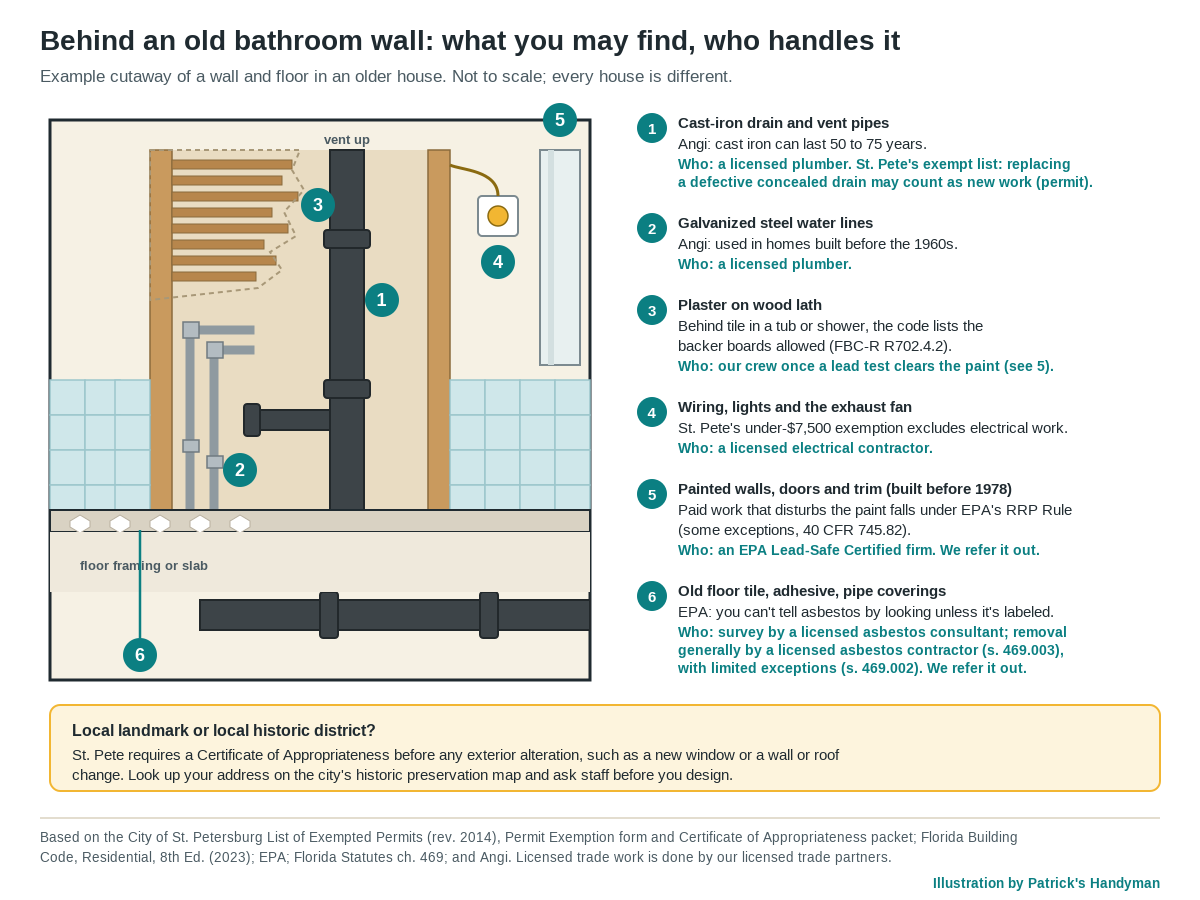
Three things are worth planning for in a house that old:
- Cast-iron drain and vent pipes. Angi says "Cast iron can last between 50 and 75 years." By our arithmetic, original drains in a house built in 1955 would be 71 years old in 2026, if no one has replaced them.
- Galvanized steel water lines. Angi's guide to old plumbing says "Galvanized pipes were used for water lines in homes built before the 1960s," and "As the zinc erodes, the metal can corrode, causing old pipes to clog with rust or break."
- Plaster walls and ceilings. In many older homes, plaster was applied over lath rather than hung in sheets like drywall. Angi notes that water-damaged or crumbling plaster "may require removing sections of the wall down to the lath before any repair can begin."
Should you replace old cast-iron drains during a bathroom remodel?
That is a call for a licensed plumber after the pipe is exposed or camera-inspected. Angi says a sewer line camera inspection runs $250 to $1,600 (national) and lets a pro find the damaged section "so only the damaged section of cast iron pipe needs replacing, rather than the entire run."
What the city says about permits is specific. St. Petersburg's List of Exempted Permits (revised January 1, 2014) says a plumbing permit may not be required for "The stopping of leaks in drains, soil, waste or vent pipe," and then adds: "However, should any concealed trap, drainpipe, soil, waste or vent pipe become defective and it becomes necessary to remove and replace the same with new material, the same may be considered as new work and a permit shall be procured and inspection made as provided in the Florida Building Code, Plumbing."
The same list exempts "The repair or replacement of an existing fixture in its present location provided such repair does not involve or require the replacement or re-arrangement of valves, pipes or fixtures." Moving a toilet, replacing a tub valve or swapping old drains for new ones involves that kind of pipe or valve work.
On a remodel we manage, drain and water line work is done by our licensed plumbing trade partners, who pull their own plumbing permits. Florida law requires a contractor to subcontract plumbing work unless it holds a state certificate or registration in that trade (s. 489.113(3), Florida Statutes).
Galvanized lines. If the bathroom still has galvanized supply pipes, ask your plumber whether to replace just the bathroom's lines or more of the house. Angi puts a whole-house repipe in Tampa at $1,514 to $15,135, with most homeowners paying around $7,568, and lists $605 to $1,615 for the piping to a shower.
Can you keep plaster walls in a bathroom remodel?
Often, outside the wet areas. Angi's plaster repair guide says plaster is "almost always worth a repair unless you're making significant renovations and will have to tear down walls," and tells buyers of older homes to "think twice about replacing—or covering—plaster with drywall." It puts replastering at $5 to $10 per square foot against $1.50 to $3 for drywall installation (national).

Inside a tub or shower, the wall behind new tile changes. The Florida Building Code, Residential (8th Edition) says "Materials used as backers for wall tile in tub and shower areas and wall panels in shower areas shall be of materials listed in Table R702.4.2." The table lists glass mat gypsum backing panel, fiber-reinforced gypsum panels, nonasbestos fiber-cement backer board and nonasbestos fiber mat reinforced cementitious backer units. It also says "Water-resistant gypsum backing board shall not be used where there will be direct exposure to water, or in areas subject to continuous high humidity" (R702.3.7.1). An existing house being altered falls under the Florida Building Code, Existing Building (Residential code, Section R101.2), so ask the city's building officials how these sections apply to your project.
For small patches, the city's exempt list includes "Interior wall or ceiling finish repair of a casual, minor or inconsequential nature in which the aggregate area of the repair does not exceed 100 square feet," unless the work affects a load-bearing wall or a fire-rated separation; in a flood zone the city also asks for a cost breakdown. Our Belleair post on moisture in older homes covers water-damaged plaster.
Do you need a permit for a bathroom remodel in St. Petersburg?
For most gut remodels, yes. This table sets common bathroom jobs beside the words in the city's documents:
| Job | What the City of St. Petersburg's documents say |
|---|---|
| New tile, paint, cabinets or countertop | Building permit may not be required: "Cabinetry, counter tops, painting, papering, tiling, carpeting and other similar finish work" |
| Toilet or sink replaced in the same place, no pipe or valve changes | Plumbing permit may not be required: "The repair or replacement of an existing fixture in its present location" |
| Replacing a defective concealed drain, waste or vent pipe | "may be considered as new work and a permit shall be procured" |
| Moving fixtures, new valves, new pipes | That fixture exemption applies only where the work "does not involve or require the replacement or re-arrangement of valves, pipes or fixtures" |
| New lights, outlets or exhaust fan wiring | The under-$7,500 exemption form: "Must not include work that is structural, mechanical, electrical, plumbing, and gas" |
| Plaster or drywall repair | Exempt only where "the aggregate area of the repair does not exceed 100 square feet" |
Quotes are from the city's List of Exempted Permits (rev. 2014) and Permit Exemption form, read November 16, 2026. The match between each job and a line in those documents is ours, and the list itself says separate building, electrical, gas, mechanical or plumbing permits "may be required for any of the exempted items shown in this list." Call (727) 893-7231 before you start.
The $7,500 exemption doesn't help much here. The city's Building Permits page says its exemption form applies only to single-family work "totaling less than $7,500," on property not in a flood hazard area, and not to "structural components (including window and door replacement, roofing, soffit and fascia, or siding), mechanical, electrical, plumbing, or gas work." State law sets the core limits: less than $7,500, no flood hazard area, and no electrical, plumbing, structural, mechanical or gas work on a single-family home (s. 553.79(1)(g)).
Doing it yourself. Florida lets an owner act as their own contractor on their own one- or two-family home, with conditions (s. 489.103(7)). St. Petersburg's Owner/Contractor Disclosure Statement must be signed by the owner, with a notarized signature, before the permit is issued. Its item 7 warns: "it is a frequent practice of unlicensed persons to have the property owner obtain an owner-builder permit that erroneously implies that the property owner is providing his or her own labor and materials." If someone you hire asks you to pull the permit, check their license with our guide to checking a contractor's license.
Permits for homes inside city limits come from the city's Construction Services and Permitting Division at the Municipal Services Center, One 4th St. N. Our St. Petersburg general contractor page covers contractor registration and inspections in the city.
Does a historic district change a bathroom remodel in St. Pete?
It depends on how the house is designated, and mostly for work on the outside.
- National Register only. The city says "The listing of a property in the National Register does not place restrictions on a private owner's future alterations unless Federal assistance is involved in the project."
- Local landmark or local historic district. The city's Certificate of Appropriateness packet says City Code Section 16.30.070 "requires issuance of a Certificate of Appropriateness (COA) prior to any exterior alteration to a locally designated landmark or property within a locally designated historic district," including "changes to walls, roof, or windows." Mirror Lake became the city's "eleventh local historic district" on December 12, 2024.
What that means for a bathroom: the packet's approval matrix lists interior alterations only under "Ad Valorem Tax Exemptions Only." The matrix says it "summarizes the decision authority for all exterior modifications," and it lists "Electrical, plumbing, pool equipment" and "HVAC" for staff review. So if your bathroom plan changes a window, adds a vent through an outside wall or the roof, or moves equipment outside, ask historic preservation staff first (727-892-5451 or 727-892-5470). The city's exempt list also warns that sites in a local or national historic district "may not be exempt from permit requirements." Look up your address on the city's historic preservation map.
How does St. Pete's 49% flood rule affect a bathroom remodel?
It matters most when the house sits low in a flood zone. The city's Substantial Improvement/Substantial Damage review package opens with: "If you are rebuilding your home after a storm, renovating, remodeling, or adding an addition to your home, here is information you need to know concerning The 49% RULE." The package is required "when the estimated construction value is 25 Percent or more of the market value of the structure," and the city estimates market value from "the tax assessment value of your structure (excluding the land)."
A remodel that equals or exceeds 49% of that value is a substantial improvement. The package says the building then "must be brought into compliance," and if the lowest floor is below the design flood elevation, "all electrical and mechanical (heating and cooling, etc.), bathrooms, and laundry rooms must be elevated to or above the DFE." The costs it counts include "Bathroom tiling and fixtures," wall finishes including "plaster," and "Repair or reconstruction of plumbing and electrical services."
Look up your flood zone first (how to look up your flood zone and elevation certificate), and see our post on repairing flood-damaged older homes in St. Petersburg for how the city adds up costs.
What about lead paint and asbestos in a pre-1960 bathroom?
Both are likely enough to plan for before anything is torn out.

- Lead paint. The EPA's RRP Rule "requires that anyone paid to perform work that disturbs painted surfaces in homes, childcare facilities and preschools built before 1978 be certified ..." Some exceptions apply (40 CFR 745.82). We are not EPA RRP-certified, so we refer paint-disturbing work in a pre-1978 home to an EPA Lead-Safe Certified firm. Angi puts a lead paint inspection in Tampa at $303 to $706, with an average of $505.
- Asbestos. The EPA lists "Vinyl floor tiles and the backing on vinyl sheet flooring and adhesives" and "Hot water and steam pipes coated with asbestos material or covered with an asbestos blanket or tape" among products that may contain asbestos, and says "you can't tell whether a material contains asbestos simply by looking at it, unless it is labeled." In Florida, asbestos surveys are done by licensed asbestos consultants, and anyone you hire to remove it generally must be a licensed asbestos contractor (s. 469.003), with limited exceptions (s. 469.002). We don't do either. HomeAdvisor puts professional asbestos testing at $231 to $776 (national).
What does a bathroom remodel in an older St. Pete home cost?
| Item | Typical cost | Do it yourself? |
|---|---|---|
| Most bathroom remodels | $5,352–$13,631, average $9,491 (Tampa, Angi) | Depends on the scope |
| Rough-in plumbing for a full remodel | Average $5,530 (Tampa, Angi) | No: licensed plumber and permit |
| Cast-iron pipe replacement, 30-foot run | $375–$900 (national, Angi) | No: licensed plumber and permit |
| Cast-iron pipe replacement under a slab | $3,000–$20,000 (national, Angi) | No: licensed plumber and permit |
| Whole-house repipe | $1,514–$15,135, average $7,568 (Tampa, Angi) | No: licensed plumber |
| Replastering a wall | $5–$10 per sq. ft. (national, Angi) | Some of it: small patches, after a lead test in an older home |
| Drywall installation | $1.50–$3 per sq. ft. (national, Angi) | Some of it: not behind tile in a tub or shower |
| Bathroom tile | About $12.50 per sq. ft. on average (Tampa, Angi) | Some of it: over a code-listed backer in wet areas |
| Lead paint inspection | $303–$706, average $505 (Tampa, Angi) | No |
| Asbestos testing | $231–$776 (national, HomeAdvisor) | No: licensed asbestos consultant |
Sources: Angi's Tampa pages on bathroom remodels (February 2026), repiping (May 2026) and lead paint inspection (June 2026); Angi's national pages on cast-iron pipe replacement (October 2026) and plaster repair (October 2026); HomeAdvisor on asbestos testing (June 2026).
How much does it cost to remodel a bathroom in an older St. Pete home?
Angi's Tampa page puts most bathroom remodels at $5,352 to $13,631, with an average of $9,491, and $70 to $250 per square foot. In a pre-1960 house, the items that push the price up are the ones behind the walls: drain and water line replacement, wall rebuilding behind tile, and lead or asbestos testing before work starts. See the full price guide for bathroom remodel cost in Tampa Bay, plus shower remodel cost, tub-to-shower conversion cost and plaster repair cost.
What you can safely do yourself
- Look up your permit history and flood zone with our guide to looking up permits on your property.
- Find your flood zone and elevation certificate with our guide to looking up your flood zone.
- Check for a hidden leak at the meter with our guide to checking for a water leak.
- Check your address on the city's historic preservation map.
Leave to a pro: drains, water lines, wiring, anything that disturbs paint in a pre-1978 home, old floor tile and adhesive, and any wall you're not sure is non-load-bearing.
Local resources for St. Petersburg
- City of St. Petersburg: Building permits (727-893-7231)
- City of St. Petersburg: List of Exempted Permits (PDF)
- City of St. Petersburg: Historic preservation
- City of St. Petersburg: Historic preservation map
- City of St. Petersburg: Permitting after a storm (the 49% rule)
- City of St. Petersburg: Flooding
- Pinellas County flood zone lookup
- Pinellas County evacuation zone lookup
We're a Florida Certified General Contractor (Lic. #CGC1541672). On our jobs, you get a written quote within 48 hours of the free estimate, and we protect floors and clean up every day. Plumbing and electrical work on our remodels is done by our licensed trade partners; we don't take stand-alone electrical jobs. Our bathroom remodeling page lists the bathroom work we take on in St. Petersburg and across Pinellas County.
Frequently asked questions
Do I need a permit to replace cast-iron pipes in St. Petersburg?
Plan on it. The city's List of Exempted Permits says that when a concealed drain, waste or vent pipe becomes defective and has to be replaced with new material, it "may be considered as new work and a permit shall be procured." Stopping a leak can be exempt. Your licensed plumber pulls the plumbing permit; call the city at (727) 893-7231 with questions.
Can I keep plaster walls when I remodel my bathroom?
Outside the tub and shower, often yes. Behind wall tile in tub and shower areas, the Florida Building Code, Residential calls for one of the backer materials listed in Table R702.4.2, such as fiber-cement or glass mat gypsum backer board. Ask the city's building officials how that applies to your remodel.
Do I need historic approval to remodel a bathroom in St. Pete?
For exterior changes to a local landmark or a home in a local historic district, yes: the city requires a Certificate of Appropriateness before any exterior alteration. National Register listing alone doesn't restrict a private owner's alterations unless federal assistance is involved, the city says. Ask historic preservation staff about vents, windows or equipment outside.
Does the 49% rule apply to a bathroom remodel in St. Petersburg?
It can, if the home is in a special flood hazard area. The city's review package covers renovating and remodeling, is required when construction value is 25% or more of the structure's market value, and treats work that equals or exceeds 49% of that value as a substantial improvement. Bathroom tile, fixtures, plaster and plumbing all count.
Sources
- City of St. Petersburg: Building permits (read Nov. 16, 2026)
- City of St. Petersburg: List of Exempted Permits, rev. Jan. 1, 2014 (PDF)
- City of St. Petersburg: Permit Exemption form (PDF)
- City of St. Petersburg: Owner/Contractor Disclosure Statement, rev. Dec. 2025 (PDF)
- City of St. Petersburg: Historic preservation
- City of St. Petersburg: Certificate of Appropriateness application packet (PDF)
- City of St. Petersburg: Mirror Lake Local Historic District
- City of St. Petersburg: Historic preservation map
- City of St. Petersburg: Floodplain Substantial Improvement/Substantial Damage review package (PDF)
- City of St. Petersburg: Permitting after a storm
- Florida Building Code, Residential, 8th Edition (2023), Chapter 1: Section R101.2
- Florida Building Code, Residential, 8th Edition (2023), Chapter 7: Sections R702.3.7.1 and R702.4.2
- Florida Statutes s. 489.113, Qualifications for practice; restrictions
- Florida Statutes s. 489.103, Exemptions (owner-builders)
- Florida Statutes s. 553.79, Permits
- Florida Statutes s. 469.003, License required (asbestos)
- Florida Statutes s. 469.002, Exemptions (asbestos)
- EPA: Lead Renovation, Repair and Painting Program
- eCFR: 40 CFR 745.82, Applicability (RRP Rule)
- EPA: Learn About Asbestos
- EPA: Protect Your Family from Exposures to Asbestos
- U.S. Census Bureau, ACS 2020–2024 5-year, table B25034 (year structure built), St. Petersburg city
- U.S. Census Bureau, ACS 2020–2024 5-year, table B25035 (median year structure built), St. Petersburg city
- Angi: Bathroom remodel cost in Tampa (updated Feb. 25, 2026)
- Angi: Cost to repipe a house in Tampa (updated May 27, 2026)
- Angi: Lead paint inspection cost in Tampa (updated June 24, 2026)
- Angi: Cost to replace cast iron pipes (national, updated Oct. 1, 2026)
- Angi: Plaster repair cost (national, updated Oct. 27, 2026)
- Angi: Old plumbing problems in historic homes (updated July 9, 2026)
- HomeAdvisor: Asbestos testing cost (national, updated June 17, 2026)