

Short answer: The Florida Building Code, Residential (8th Edition) says bathroom exhaust air must be exhausted "directly to the outdoors," not into an attic, and sets a minimum of 50 cfm intermittent or 20 cfm continuous. In Safety Harbor, the city's permit pages and Pinellas County's don't mention bathroom fans, so call 727-724-1515 before replacing or adding one. Angi puts bathroom fan installation in Tampa at $278 to $590, averaging $427.
Almost half of Safety Harbor's homes, 3,735 of 7,650 housing units (48.8%), were built in the 1980s, and the median year built is 1984 (U.S. Census Bureau, ACS 2020–2024). We found no official source for what the code required of bathroom fans in the 1980s, so don't assume the fan in your house is ducted outdoors. Check it.
This post covers the fan. For the humidity side, see our Palm Harbor post on A/C condensate and indoor humidity, and for mold after a leak or flood, our Oldsmar mold post. If you are redoing the whole room, our bathroom remodeling page covers how we handle that.
Is this urgent?
- Call now: water is dripping through a bathroom ceiling near a light or fan, or you smell burning from the fan. If you smell burning, leave the room and call 911; otherwise turn off the breaker if you can do so safely and call a licensed electrician.
- Call today: a ceiling or wall is wet, soft or growing mold after a leak. Find and stop the water first, then dry the area.
- Can wait: a fan that is noisy, old or just not clearing the mirror. Plan the fix with a licensed electrician and the building department.
Local resources for Safety Harbor
- City of Safety Harbor: Permits (City Hall, 750 Main St., (727) 724-1515, ebpermits@cityofsafetyharbor.com)
- City of Safety Harbor: Building permit and inspections summary (PDF)
- Pinellas County: Applying for a building permit (Building Services, 440 Court St., Clearwater, (727) 464-3888)
- Pinellas County: Flood zone lookup
- Pinellas County: Find your evacuation zone
Why does a bathroom fan matter so much in Safety Harbor?
Because the air outside is already wet. The National Weather Service in Tampa Bay says dew points across West Central and Southwest Florida reach "above 80°F" on sweltering summer days, and that "the higher the dew point the greater the amount of moisture in the air." A shower adds moisture to a small room.
The EPA says to keep indoor humidity below 60 percent, "ideally between 30 and 50 percent." It also says to "run the bathroom fan or open the window when showering," and that condensation on windows, walls or pipes "can be a sign of high humidity." The Florida Department of Health says "mold needs moisture to grow" and that indoors, mold is found "where humidity levels are high, like basements and showers."
The EPA's guidance has a bathroom tip: if mold in the shower or elsewhere in the bathroom keeps reappearing, "increasing ventilation (running a fan or opening a window) and cleaning more frequently will usually prevent mold from recurring, or at least keep the mold to a minimum." ENERGY STAR says the same about the equipment: "Installing adequate ventilation helps to alleviate many common household problems. It also helps to control moisture and remove objectionable odors."

For how to measure your own humidity, see our guide to checking indoor humidity with a hygrometer. The EPA says a humidity meter is "a small, inexpensive ($10-$50) instrument available at many hardware stores."
Where does a bathroom fan have to vent in Florida?
Outdoors. The 2023 Florida Building Code, Residential, 8th Edition (the version published on ICC Digital Codes, last updated March 2026) says it in three places:
- Section M1507.2: "Exhaust air from bathrooms and toilet rooms shall not be recirculated within a residence or to another dwelling unit and shall be exhausted directly to the outdoors. Exhaust air from bathrooms and toilet rooms shall not discharge into an attic, crawl space or other areas inside the building."
- Section M1501.1: "The air removed by every mechanical exhaust system shall be discharged to the outdoors in accordance with Section M1506.3. Air shall not be exhausted into an attic, soffit, ridge vent or crawl space."
- Section R303.3: a bathroom needs windows with at least 3 square feet of glass, half of it openable, with an exception "where artificial light and a local exhaust system are provided." That exception adds: "Exhaust air from the space shall be exhausted directly to the outdoors."
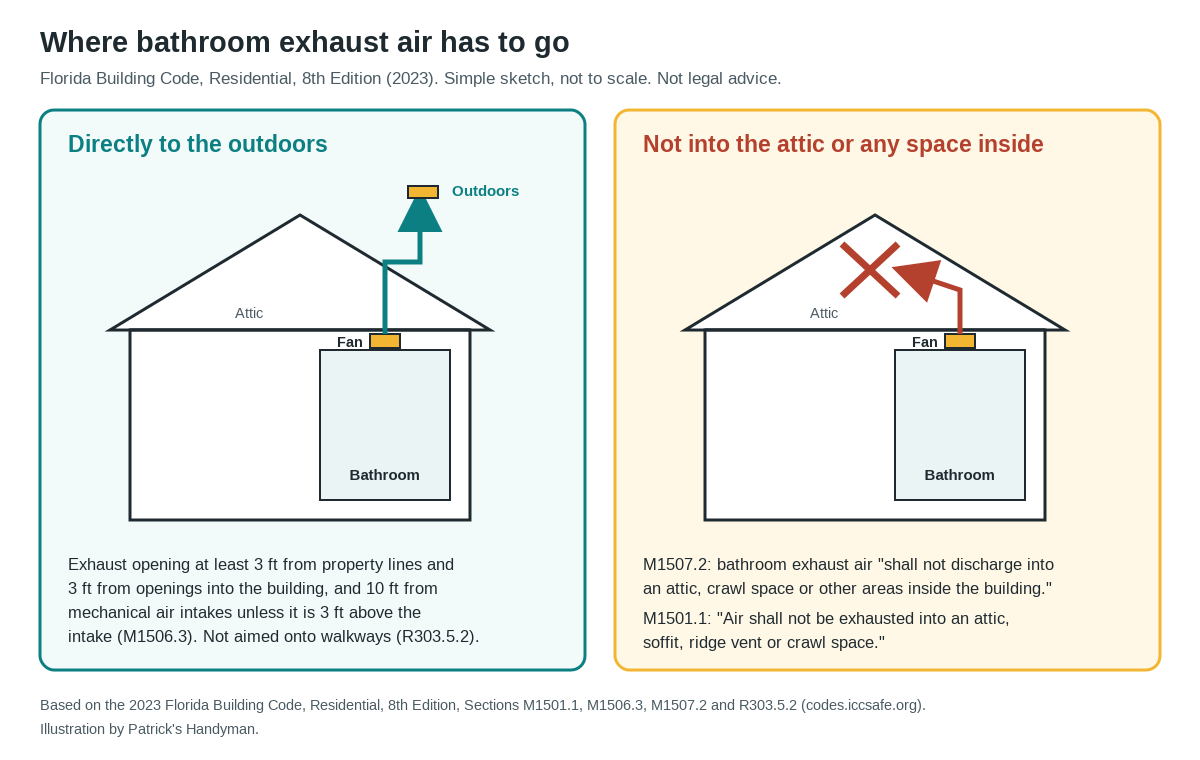
Section M1506.3 sets where the outdoor opening can be: "not less than 3 feet (914 mm) from property lines; 3 feet (914 mm) from operable and nonoperable openings into the building and 10 feet (3048 mm) from mechanical air intakes except where the opening is located 3 feet (914 mm) above the air intake." Section R303.5.2 adds: "Exhaust air shall not be directed onto walkways."
The Residential code sends existing buildings undergoing repair or alteration to the Florida Building Code, Existing Building (Section R101.2, Exception 3), so how these sections apply to a bathroom that already exists is a question for the building department.
How long can the duct be?
Section M1506.2 limits duct length by the fan's airflow rating and the duct size. Here are three entries from its Table M1506.2 (4-inch duct, no elbows):
| Fan airflow rating | 4-inch smooth-wall duct | 4-inch flex duct |
|---|---|---|
| 50 cfm | 114 feet | 56 feet |
| 80 cfm | 31 feet | 4 feet |
| 100 cfm | 10 feet | X (not allowed) |
The table's notes say fifteen feet of allowable length is deducted for each elbow, and "X = not allowed. Any length of duct of this size with assumed turns and fittings will exceed the rated pressure drop." The section has an exception: duct length is not limited "where the duct system complies with the manufacturer's design criteria or where the flow rate of the installed ventilating equipment is verified by the installer or approved third party using a flow hood, flow grid or other airflow measuring device." In plain terms, for the same 4-inch duct, the table allows a shorter run as the fan's airflow rating goes up.

What about going through the roof?
A fan duct that ends at a roof cap passes through the roof covering. Cutting that opening and flashing the cap is work on the roof, and a roofing contractor's licensed scope includes the ability to "install, maintain, repair, alter, extend" roofing (s. 489.105(3)(e)). Florida law says a general contractor generally must subcontract roofing work unless it holds the roofing license (s. 489.113(3), Florida Statutes), and a general contractor may not "act as, hold himself or herself out to be, or advertise himself or herself to be a roofing contractor" unless also certified or registered as one (s. 489.113(3)(g)). On a project we manage, a roof opening is subcontracted to and performed by our licensed roofing partners (s. 489.113(3)).
The City of Safety Harbor's permit summary lists "Roof" and "Re-Roof" as "County Only Review," meaning those permits go to Pinellas County Building Services. The summary doesn't say whether a new roof vent for a bathroom fan counts, so call the county at (727) 464-3888.

What size bathroom fan do I need, and how long should it run?
The code's minimum for a bathroom is in Table M1507.4: "Mechanical exhaust capacity of 50 cfm intermittent or 20 cfm continuous." A footnote says the listed rate "shall equal or exceed the exhaust rate at a minimum static pressure of 0.25 inch wc," so the rate is tied to a static pressure of 0.25 inch of water column.
A U.S. Department of Energy fact sheet on spot ventilation (December 2002) says bath fans "should be sized to provide the larger of 50 cfm or 8 ACH," meaning air changes per hour, and gives the math: multiply the room's volume in cubic feet by 8 and divide by 60. By that formula, a 5-by-8-foot bathroom with an 8-foot ceiling (320 cubic feet) works out to about 43 cfm, so the 50 cfm minimum governs. A 10-by-12-foot primary bath with an 8-foot ceiling (960 cubic feet) works out to 128 cfm. The sheet is older than the current code, so treat the code's table as the minimum and the fan manufacturer's instructions as the guide for your model.
For run time, the sources give a few things:
- The EPA says to run the fan "when showering."
- The same DOE sheet describes manual timers that "allow the fan to operate 20 minutes or more before turning off automatically," and says timers "are useful in bathrooms for improved moisture removal after showering."
- The code's continuous option is 20 cfm, a fan running all the time at a low rate. The code also describes local exhaust fans as one way to meet whole-house ventilation (Section M1507.3.1).
We did not find an official source that gives a single number of minutes for every bathroom, so follow the manufacturer's instructions for your fan.
On noise, ENERGY STAR certified bathroom fans from 10 to 200 cfm must be no louder than 2.0 sones, and the certification requires the fan to deliver at 0.25 in. of static pressure at least 70% of the airflow it delivers at 0.1 in.
Mold on the bathroom ceiling or walls: DIY or call a pro?
The EPA says that if the moldy area is "less than about 10 square feet (less than roughly a 3 ft. by 3 ft. patch), in most cases, you can handle the job yourself." Fix the moisture first, or the mold comes back. Our guide to cleaning a small patch of mold follows the EPA's steps.
Past that size, Florida's mold licensing law applies. The state defines mold assessment and mold remediation as work on mold growth "of greater than 10 square feet" (s. 468.8411). A residential property owner who does mold assessment or remediation on his or her own property is exempt, and so are people acting within the scope of certain other state licenses, such as a chapter 489 contractor license, as long as they do not hold themselves out as a "mold assessor" or "mold remediator" (s. 468.841). Otherwise, a person may not perform or offer to perform mold assessment or mold remediation, or use those titles, unless the person has complied with the law (s. 468.8419). Check a license on DBPR's license search.
We're a Florida Certified General Contractor, not a licensed mold assessor or mold remediator, and we don't hold ourselves out as one. For mold over 10 square feet, or mold behind the tile or inside the wall, the usual order is a licensed mold professional first (unless an owner handles it on his or her own home), then the cause fixed (a leak by a licensed plumber, a fan or its wiring by a licensed electrician), then the repair of the ceiling or wall.
Scraping or sanding painted surfaces in a home built before 1978 can disturb lead paint. The EPA's RRP Rule "requires that anyone paid to perform work that disturbs painted surfaces in homes, childcare facilities and preschools built before 1978 be certified." Some exceptions apply (40 CFR 745.82). We are not EPA RRP-certified, so we refer paint-disturbing work in a pre-1978 home to an EPA Lead-Safe Certified firm.
Do I need a permit to replace or add a bathroom fan in Safety Harbor?
We couldn't confirm it from the official pages, so call before you start. The City of Safety Harbor's permit page and its permit summary don't mention bathroom fans, and neither does Pinellas County's express permit list. What they do say:
- The city's summary lists "Electric on private property only," "Roof" and "Re-Roof" as County Only Review, and "Interior Renovation" and "Mechanical (not AC changeouts)" as City/County Review (city first, then the county).
- The permit page says that "Most permits will start out by being submitted to the Safety Harbor Building Department," and that electric (on private property only), roofs, and mechanical and A/C changeouts go solely to Pinellas County. The two city pages group mechanical work a little differently, so ask which applies.
- Florida's permit exemption for work valued at less than $7,500, in effect July 1, 2026, does not cover electrical or mechanical work or a property in a flood hazard area (s. 553.79, Florida Statutes). Pinellas County's page on the exemption is written for unincorporated Pinellas County, so ask the city how a request is handled at a Safety Harbor address.
The city's permit office is open 8 a.m. to 4:30 p.m. weekdays, and closes at 3 p.m. on the fourth Wednesday of each month. Call (727) 724-1515 for the city, and (727) 464-3888 for Pinellas County Building Services. Ask both whether swapping a fan for the same size, adding a new one, or putting in a new duct needs a permit, and who reviews it.
Who does the work?
A hardwired fan is electrical work. Florida's electrical contracting law bars anyone from practicing electrical contracting unless certified or registered, and from advertising as available to do it (s. 489.531).
On a bathroom project we manage, the electrical portion (the fan's wiring and any new circuit), the duct run, where one is needed, and any roof opening are subcontracted to and performed by our licensed trade partners (s. 489.113(3)). We don't take stand-alone electrical jobs. If you are planning a new bathroom or a remodel, the fan belongs in the plan from the start. See our bathroom remodeling page or our post on adding a bathroom in Pinellas Park, which covers where a windowless bathroom's exhaust has to go. For where Safety Harbor roofs are permitted, see our soffit and fascia post for Safety Harbor.
How much does it cost to install a bathroom exhaust fan in Safety Harbor?
Angi's Tampa page (updated August 4, 2026) puts bathroom fan installation at $278 to $590, with an average of $427.
| What | Tampa figure (Angi, Aug. 4, 2026) | Do it yourself? |
|---|---|---|
| Full installation, typical range | $278–$590 (average $427) | No: electrical work and a duct that has to reach the outdoors |
| Bathroom mold remediation | $525–$1,075 (Angi, Oct. 15, 2025) | Some of it, if under about 10 sq ft and on hard surfaces |
The mold figure comes from a different Angi page than the fan figures. For the bigger picture, see our price guides for bathroom remodel costs in Tampa Bay and mold remediation costs in Florida.
What you can safely do yourself
- Run the fan when you shower, as the EPA says, and wipe off condensation on walls and mirrors.
- Check your humidity with a meter: how to check indoor humidity with a hygrometer.
- Clean a small patch of mold, under about 10 square feet on a hard surface: how to clean a small patch of mold.
- Call the building department and ask the permit questions above.
Leave to a pro: replacing or adding a fan, any wiring, the duct and its outdoor opening, a roof opening, mold over about 10 square feet (see the EPA's larger-job guidance) or inside a wall, and paint-disturbing work in a pre-1978 home.
Frequently asked questions
Can a bathroom fan vent into the attic in Florida?
No. The Florida Building Code, Residential, 8th Edition says bathroom exhaust air "shall not discharge into an attic, crawl space or other areas inside the building" (Section M1507.2) and that air "shall not be exhausted into an attic, soffit, ridge vent or crawl space" (Section M1501.1). Ask the building department how this applies to an existing house.
How many CFM does a bathroom fan need?
The code's table calls for a bathroom exhaust capacity of 50 cfm intermittent or 20 cfm continuous, rated at 0.25 inch of static pressure (Table M1507.4). A U.S. Department of Energy fact sheet (December 2002) says to size to the larger of 50 cfm or 8 air changes per hour, which is the room volume in cubic feet times 8, divided by 60.
How long should I run the bathroom fan after a shower?
The EPA says to run the fan when showering. A U.S. Department of Energy fact sheet describes manual timers that let a fan operate 20 minutes or more before turning off automatically. We found no official minimum that fits every bathroom, so follow your fan's manufacturer instructions.
Do I need a permit to replace a bathroom exhaust fan in Safety Harbor?
We couldn't confirm it. The City of Safety Harbor's permit page and summary and Pinellas County's express permit list don't mention bathroom fans, and electrical permits on private property go to Pinellas County. Call the city at (727) 724-1515 and the county at (727) 464-3888.
Sources
- City of Safety Harbor: Permits
- City of Safety Harbor: Building permit and inspections summary (PDF, April 2024)
- Pinellas County: Applying for a building permit
- Pinellas County: Express permits
- Pinellas County: Permit exemptions for work under $7,500
- 2023 Florida Building Code, Residential, 8th Edition, Chapter 15: Exhaust Systems (ICC Digital Codes)
- 2023 Florida Building Code, Residential, 8th Edition, Chapter 3: Building Planning, Section R303 (ICC Digital Codes)
- 2023 Florida Building Code, Residential, 8th Edition, Chapter 1: Scope and Administration, Section R101.2 (ICC Digital Codes)
- Florida Statutes s. 489.113 (2026)
- Florida Statutes s. 489.105 (2026)
- Florida Statutes s. 489.531 (2026)
- Florida Statutes s. 553.79 (2026)
- Florida Statutes s. 468.8411: Mold-related services definitions
- Florida Statutes s. 468.8419: Prohibitions and penalties
- Florida Statutes s. 468.841: Exemptions
- U.S. EPA: A brief guide to mold, moisture and your home
- U.S. EPA: Mold cleanup in your home
- U.S. EPA: Renovation, Repair and Painting Program
- Florida Department of Health: Mold
- National Weather Service Tampa Bay: Dew point statistics
- ENERGY STAR: Ventilation fans
- ENERGY STAR: Ventilation fans key product criteria
- U.S. Department of Energy: Spot ventilation, source control to improve indoor air quality (PDF, December 2002)
- eCFR: 40 CFR 745.82, Applicability (RRP Rule)
- U.S. Census Bureau: ACS 2024 5-year, Safety Harbor city, FL, year structure built (B25034, B25035)
- Angi: Bathroom fan installation cost in Tampa (updated Aug. 4, 2026)
- Angi: Mold remediation cost in Tampa (updated Oct. 15, 2025)