

Short answer: Yes, a bathroom remodel counts toward Treasure Island's 50% flood rule. The city's list of included costs names "Bathroom tiling and fixtures," plumbing fixtures and piping, and the contractor's overhead and profit. The whole city is a Special Flood Hazard Area, and its permit list includes "Remodeling kitchen and bathroom." Under the city's definition, a cost that equals or exceeds 50% of the building's market value is a substantial improvement, and the building must then meet current floodplain regulations.
The city says the rule applies to "All non-compliant structures," and many homes here are older than the flood maps. The city's pages give two dates for those "Pre-FIRM" buildings: "built before 1974" on the Permits page and "built prior to May 1971" on a flood zone handout. About half the city's housing is older than either date: 3,127 of Treasure Island's 6,192 housing units (50.5%) were built before 1970, and the median year built is 1970 (U.S. Census Bureau, ACS 2020–2024, tables B25034 and B25035).
This post is about a planned remodel, not storm repairs. For repairs after a flood, see our posts on rebuilding after storm surge in Madeira Beach and repairing a flood-damaged older home in St. Petersburg.
Is this urgent?
- Call now: water is reaching an outlet, a light or the electrical panel, or sewage is backing up into the tub or shower. Stay away from anything electrical that is wet and call a licensed electrician or a licensed plumber.
- Call today: the city has sent you a substantial damage letter, or a stop work order is posted on the house. Call the Community Development Department at (727) 547-4575 ext. 230 before any more work is done.
- Can wait: planning a remodel of a dry, working bathroom. Get your structure value and the home's permit history before you ask for prices.
Does a bathroom remodel count toward Treasure Island's 50% rule?
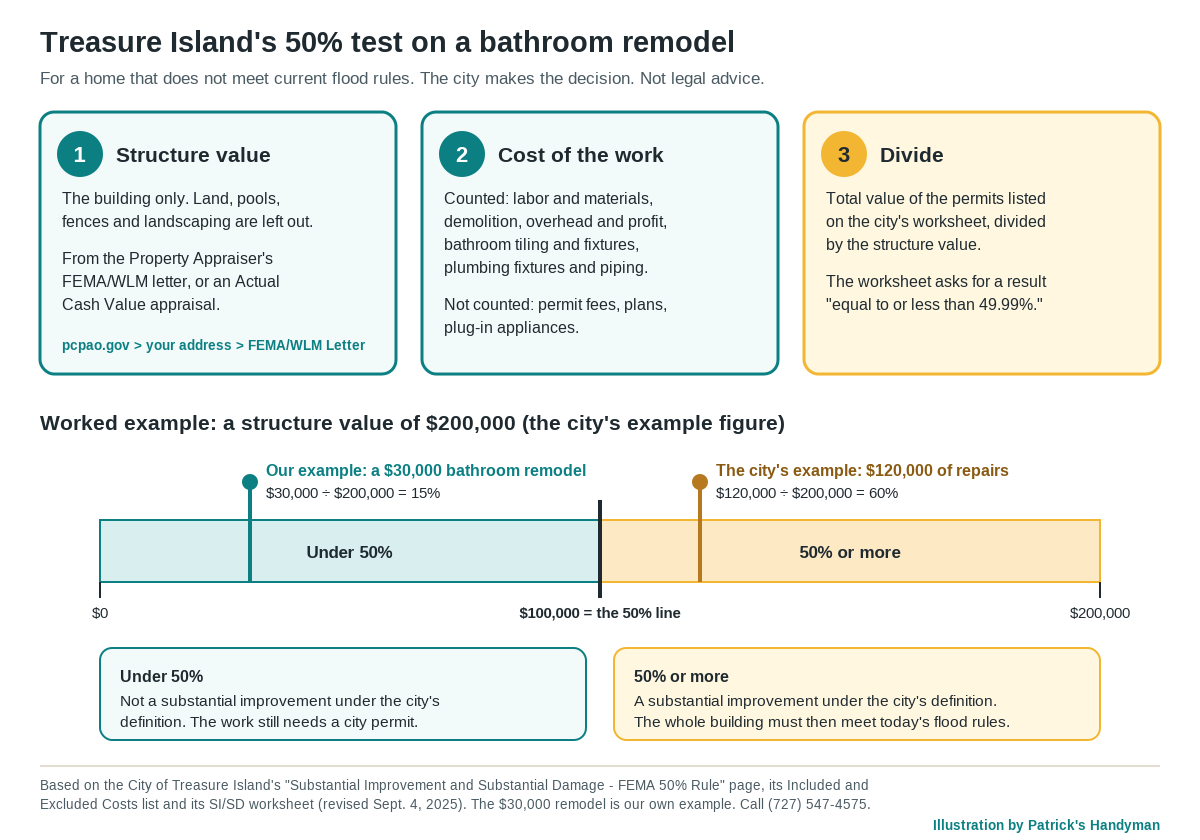
Yes. The city defines a substantial improvement as "Any repair, reconstruction, rehabilitation, alteration, addition, or other improvement of a building or structure the cost of which equals or exceeds 50 percent of the market value of the building or structure before the improvement or repair is started."
The same page also says "If the cost of improvements or repairs exceeds 50% of the structure's market value, the building must be brought into compliance with current floodplain regulations," which gives a different answer at exactly 50%. The city's worksheet asks for a result "equal to or less than 49.99%," so ask the city if your numbers are close.
The city's "Included Costs" list covers costs "directly associated with the building." These items from it show up in most bathroom remodels:
- "Materials and labor, including the estimated value of donated or discounted materials and owner or volunteered labor"
- "Demolition and construction debris disposal"
- "Bathroom tiling and fixtures"
- "Wall finishes (drywall, paint, stucco, plaster, paneling, marble, etc)" and built-in bathroom cabinets
- "Plumbing fixtures and piping" and "Electrical wiring, outlets and switches"
- "Construction management and supervision," "Contractor's overhead and profit" and "Sales tax on materials"
The "Excluded Costs" list includes "Permit fees," "Costs to obtain or prepare plans and specifications" and "Plug-in appliances such as washing machines, dryers, stoves."
Doing the work yourself doesn't lower the number: the city's rebuild FAQ says "Improvement costs cannot be discounted to keep the cost estimate below 50%."
How does the city figure what your home is worth?
Only the building counts. The city says "Only the structure value is used in this calculation. Land value and site improvements (pools, fences, landscaping, etc.) are not included." The city accepts two sources for that value:
- The Property Appraiser's FEMA/WLM letter. The city's steps: search your address at pcpao.gov, select the property, click "Tools" and select "FEMA/WLM Letter." The letter shows the structure value and "The maximum amount allowed for improvements or repairs."
- An Actual Cash Value appraisal by "a qualified independent appraiser." The city's appraisal checklist says that for an improvement, "the appraisal effective date should be before the start of construction of the improvement."
The city's "When Do I Need a Permit" page advises: "Consider getting a private FEMA appraisal prior to the start of any construction."
Condos differ. The city says "For condominium units, the Pinellas County Property Appraiser does not provide a FEMA/WLM value," so each permit application needs an appraisal and a cost allocation from the association. See our St. Pete Beach condo bathroom post.
Do earlier permits and small jobs count toward the 50%?
On the city's forms, some do. The city's Substantial Improvement/Substantial Damage worksheet (revised Sept. 4, 2025) asks the owner to list all "Relevant Permits" and total them. It defines the term: "Relevant permits are any permits that are currently open or are for repairs due to damage from a natural or manmade disaster (arson, civil disorder, etc.)."
The city's documents add two things:
- Small jobs are logged. The rebuild FAQ says "maintenance projects of any type are logged toward the 50% Rule," and that even when a permit is not required "(e.g., renovation of cabinets, countertops, painting, etc.), a renovations form is still required to be submitted to the city." We found no form by that name on the city's forms page, so ask the permit counter.
- Phasing. An undated city flood zone handout, still online, says "Phasing of projects is not permitted." The owner's affidavit says unforeseen repairs found mid-job "will require a permit revision or a new permit and be included in the cumulative cost of work."
State law also speaks to adding up work over time: a local government in the National Flood Insurance Program "may not adopt or enforce an ordinance for substantial improvements or repairs to a structure which includes a cumulative substantial improvement period" (s. 163.31795, Florida Statutes). The city pages we read give no look-back period in years, so ask the Floodplain Management Division (flood@mytreasureisland.org) which permits it will count with yours. The city's affidavits have the owner and the contractor swear that the permit value "encompasses the full scope of work," so put the whole job on the application and let the city decide.

What happens if a remodel reaches 50%?
The whole building has to meet today's flood rules, not just the bathroom. The city's FAQ says "Exceeding the Substantial Improvement threshold requires the entire structure to be brought into compliance" with flood insurance program regulations, the Florida Building Code and the city's codes, and "This may involve elevating the structure above BFE, floodproofing it, installing proper flood vents, and utilizing flood-resistant construction materials." The city's worksheet names "elevation of the structure to Base Flood Elevation (BFE) plus 2 feet at a minimum" as one outcome.
The Florida Building Code, Existing Building (8th Edition), Section 701.3, says that in flood hazard areas "Alterations that constitute substantial improvement shall require that the building comply with" the flood sections of the Building or Residential code.
The city says determinations "are made through the joint review and agreement of the City's Floodplain Administrator and Building Official," and an owner can appeal one to the city's Planning and Zoning Board.
We don't raise or elevate houses. For what that work costs, see our cost to raise a house in Florida guide.
Do you need a permit to remodel a bathroom in Treasure Island?
Yes. The city's "When Do I Need a Permit" page says "Because the city of Treasure Island is in a special flood hazard area (flood zone), most projects require a building permit." Its list of inside work that needs one includes "Remodeling kitchen and bathroom," "Altering the plumbing," "Altering the electrical system" and "Installing drywall." The city's FAQ cites its code: "according to our city code Section 66-104.1, a permit is required for all work in the floodplain, and all of Treasure Island is within a floodplain" (the Special Flood Hazard Area).
Florida's under-$7,500 permit exemption doesn't help here. It doesn't apply to "Work on a property that is partially or entirely located in a flood hazard area as defined by the Florida Building Code," or to electrical or plumbing work (s. 553.79(1)(g), Florida Statutes).
The city's no-permit examples include "Painting," "Replace Caulking" and "Drywall repair (not replacement)." If you aren't sure, the city says to email permits@mytreasureisland.org.
What the city's Interior Renovations checklist, application and pages ask for:
- The application. It asks for the "Value of Work" and the "Value of Existing Structure" and carries the line "ALL WORK SUBJECT TO THE FEMA 50% RULE."
- The 50% paperwork. The "Substantial Improvements/Damage Repairs Worksheet" and notarized project value affidavits from the owner and the contractor. The worksheet says the forms "are required for non-compliant structures."
- Notice of Commencement. "Notarized and recorded for projects more than $5,000 valuation (required prior to the first inspection)." State law exempts an improvement whose direct contract price is $2,500 or less from the notice requirement (ss. 713.02(5) and 713.13(1)(a)); above $5,000 is where the permit office must get a copy before the first inspection (s. 713.135(1)(e), Florida Statutes).
- Trades. The application says "a separate permit must be secured for ELECTRICAL WORK, PLUMBING" and other trades.
- Who can apply. Contractors "must complete the registration process prior to applying for permits." An owner can "build or improve a one-family or two-family residential dwelling" under the state's owner-builder exemption, which has conditions: the home is for the owner's own occupancy or use and "not offered for sale or lease," and the owner supervises any work not done by licensed contractors (s. 489.103(7), Florida Statutes). The city says that option is "Not available for condominiums."
- Work without a permit. The city says it "will result in a stop work order and/or possible FEMA 50% Rule violations." The fee schedule sets an after-the-fact permit at "Two (2) times the permit fee" on a first occurrence, three times on a second and five times after that.
What does a Treasure Island permit cost?
The city's FY27 fee schedule (last amended October 6, 2026; the forms page still links the FY26 one, which lists the same building fees) bases the building permit on the job's value: a base fee of "$53 plus $11 for each thousand or fraction thereof" for jobs over $1,000 and under $1,000,000.
The schedule also lists a building plan review fee "equal to one-half of the total building permit fee," paid when you apply, a floodplain permit fee of $35 for a single-family or duplex "New, remodel or addition," and two state surcharges of 1% and 1.5% with a $2 minimum each. Ask the permit counter for your total. Our building permit cost guide compares fees across Pinellas cities.
| Job value | Building permit fee |
|---|---|
| $10,000 | $163 |
| $20,000 | $273 |
| $40,000 | $493 |
Our arithmetic from the schedule, not a quote from the city. Building permit fee only, before plan review, the floodplain fee and surcharges.
Which bathroom materials can go below the flood elevation?
The Florida Building Code, Residential (8th Edition), Section R322.1.8, says materials used for flooring, walls and wall coverings below the required elevation "shall be flood damage-resistant materials that conform to the provisions of FEMA TB-2."
FEMA's Technical Bulletin 2 (January 2025) "rates them as acceptable or unacceptable for flood damage-resistance," and says "buildings in coastal areas that experience relatively short-duration flooding (generally less than 24 hours) must be constructed with flood damage-resistant materials below the BFE."
How its tables rate common bathroom materials:
| Bathroom material | Technical Bulletin 2 rating |
|---|---|
| Ceramic and porcelain tile "With mortar set" | Acceptable |
| Ceramic and porcelain tile "With organic adhesives" | Unacceptable |
| "Non-paper-faced gypsum board" | Acceptable |
| "Paper-faced gypsum board," greenboard and plaster | Unacceptable |
| Built-in cabinets, metal | Acceptable, with the note "Not recommended in areas subject to saltwater flooding" |
| Built-in cabinets, "Wood, particle board" | Unacceptable |
| Cement board or fiber-cement board | Acceptable |
The bulletin warns that a listing "is not a precise indication of how the material will perform" in a real flood.
Section R322 applies to new buildings and to "substantial improvement and repair of substantial damage" of existing ones. For a remodel that stays under 50%, ask the city's floodplain reviewer what your permit requires. Our own view, not from a source: when a wall or floor below the flood elevation is open anyway, the "acceptable" column is a good shopping list.
Can an elevated Treasure Island home have a bathroom at ground level?
For a new or substantially improved home, the code limits that space to three uses. Section R322.2.2 says enclosed areas below the required elevation shall "Be used solely for parking of vehicles, building access or storage," and Section R322.3.6 says the same for coastal high-hazard areas.
Treasure Island backs that up with a recorded document. Its Nonconversion Agreement, written for new or substantially improved structures, says an enclosure below an elevated building "shall be used solely for parking of vehicles, storage, or access to the elevated building, as applicable." A conversion or change in use "Shall not occur without the issuance of a permit," and an unauthorized one "may render the structure uninsurable by the National Flood Insurance Program or increase the cost for flood insurance." The city's Permits page puts the current Design Flood Elevation at "Base Flood Elevation + 2 feet."
So before you remodel a bathroom under an elevated house, look up the permit history and ask whether a nonconversion agreement is recorded. An older house with its living floor at ground level is a different case: the 50% test above is what applies. Either way, the city makes the call. Our Madeira Beach post explains flood vents and breakaway walls.
What about lead paint and asbestos in an older Treasure Island bathroom?
About three of every four housing units in the city, 4,661 of 6,192 (75.3%), were built before 1980 (ACS 2020–2024).
We are not EPA RRP-certified, so we refer paint-disturbing work in a pre-1978 home to an EPA Lead-Safe Certified firm; some exceptions apply (40 CFR 745.82). Florida generally requires asbestos surveys by a licensed asbestos consultant and removal by a licensed asbestos contractor (s. 469.003), with limited exceptions (s. 469.002). We don't do either. Our pre-1960 St. Petersburg bathroom post covers both.
When should you schedule a bathroom remodel on a barrier island?
The National Hurricane Center says "The Atlantic hurricane season runs from June 1 to November 30." The city's worksheet counts permits that are "currently open" together with disaster repairs, so an open remodel permit and storm repairs can land on the same worksheet. That is our reading; ask the city how it would count yours. The city's Permits page also lists "any other open building permits, regardless of the value of work" among the things that keep a storm repair permit from being issued over the counter after a declared emergency.
If you can choose, pick a start date that lets the job pass its final inspection and close before the season. Our Treasure Island storm preparation post covers getting the house ready.
What does a bathroom remodel cost in Treasure Island?
| Item | Typical cost | Do it yourself? |
|---|---|---|
| Minor remodel: same layout, paint, vanity, accessories | $2,557–$9,960 (Tampa, Angi) | Some of it, such as painting. The city still lists a bathroom remodel as permit work |
| Partial remodel: one or more main fixtures replaced | $9,424–$24,530 (Tampa, Angi) | No: plumbing and a permit |
| Full remodel: every fixture and surface, plumbing not moved | $24,154–$77,496 (Tampa, Angi) | No |
| Building permit on a $20,000 job | $273, plus plan review, the floodplain fee and state surcharges | Owner-occupants of one- and two-family homes can apply as owner-builders, with conditions |
Sources: Angi's Tampa bathroom remodel page (updated Feb. 25, 2026) and the City of Treasure Island's fee schedule. The permit figure is our arithmetic.
How much does it cost to remodel a bathroom in a flood zone?
Angi puts the average bathroom remodel in Tampa at $9,491, with most homeowners spending $5,352 to $13,631, or $70 to $250 per square foot (updated February 25, 2026). Angi lists the bathroom's size, the materials and the scope of the project among its cost factors. We found no Florida figure for what a flood zone adds, such as an appraisal or sealed drawings, so ask for those as separate lines. See the full price guides for bathroom remodel costs in Tampa Bay and shower remodel costs.
What you can safely do yourself
- Pull your FEMA/WLM letter from the Property Appraiser's site and write down the structure value and the 50% figure.
- Look up your flood zone, base flood elevation and elevation certificate: how to look up your flood zone.
- Check the permit history on the house, including any permits still open: how to look up permits on your property.
- Check any contractor's license before you sign: how to check a contractor's license in Florida.
Leave to a pro: plumbing and wiring, the appraisal, sealed drawings, anything that disturbs paint or old flooring in a pre-1978 home before it has been tested, and any structural or elevation work.
Local resources for Treasure Island
- City of Treasure Island: Substantial Improvement and Substantial Damage, the FEMA 50% Rule
- City of Treasure Island: When do I need a permit for home improvements
- City of Treasure Island: Applications, forms and online permitting (City Hall, 10451 Gulf Blvd., (727) 547-4575 ext. 230; call for counter hours)
- City of Treasure Island: Floodplain Management Division (flood@mytreasureisland.org)
- City of Treasure Island: flood map by address
- City of Treasure Island: Hurricane and storm preparedness
- Pinellas County Property Appraiser: Find my FEMA 50% (49%) value
- Pinellas County: Look up your flood zone
- Pinellas County: Find your evacuation zone
We're a Florida Certified General Contractor (Lic. #CGC1541672). On our jobs, you get a written quote within 48 hours of the free estimate, and we protect floors and clean up every day. On a bathroom remodel we manage, the plumbing and electrical portions are subcontracted to and performed by our licensed trade partners, as Florida law generally requires (s. 489.113(3), Florida Statutes). We don't take stand-alone electrical jobs. Our bathroom remodeling page lists the bathroom work we take on across Pinellas County.
Frequently asked questions
Does a bathroom remodel count toward the FEMA 50% rule in Treasure Island?
Yes. The City of Treasure Island's list of included costs names "Bathroom tiling and fixtures," plumbing fixtures and piping, labor and materials, and the contractor's overhead and profit. The city compares the total with the market value of the building alone, without the land.
Do I need a permit to remodel a bathroom in Treasure Island?
Yes. The city's permit list includes "Remodeling kitchen and bathroom," and its FAQ says a permit is required for all work in the floodplain, which is the whole city. Call (727) 547-4575 ext. 230 to confirm what your project needs.
Can I split a bathroom remodel into phases to stay under 50%?
An undated City of Treasure Island flood zone handout says "Phasing of projects is not permitted," and the city's worksheet totals the permits that are open on the house. Ask the Floodplain Management Division how it will count yours.
Does Treasure Island use the 49% rule or the 50% rule?
Treasure Island's pages use 50%. Pinellas County's 49% figure is on a county page that covers unincorporated areas, so check the rule for the city your house is in.
Sources
- City of Treasure Island: Substantial Improvement and Substantial Damage, FEMA 50% Rule (read Nov. 19, 2026)
- City of Treasure Island: Costs for Substantial Improvements / Repair of Substantial Damage, Included and Excluded Costs (PDF)
- City of Treasure Island: Substantial Improvements / Substantial Damage Package, Single Owner Structures: worksheet and affidavits (PDF, revised Sept. 4, 2025)
- City of Treasure Island: Actual Cash Value Appraisal Checklist for SI/SD Determinations (PDF)
- City of Treasure Island: Post Hurricane Rebuild Frequently Asked Questions
- City of Treasure Island: Understanding Your Flood Zone for Construction Purposes (city handout)
- City of Treasure Island: When Do I Need a Permit for Home Improvements
- City of Treasure Island: Permits
- City of Treasure Island: Building Division
- City of Treasure Island: Building/Renovating in a Floodplain
- City of Treasure Island: Applications, Forms and Online Permitting
- City of Treasure Island: Interior Renovations checklist, Residential and Commercial (PDF)
- City of Treasure Island: Permit Application, All Permits (PDF)
- City of Treasure Island: Declaration of Land Restriction (Nonconversion Agreement) (PDF)
- City of Treasure Island: FY27 Fee Schedule (PDF, last amended October 6, 2026)
- City of Treasure Island: Contractor Registration and Licensing Guide
- City of Treasure Island: Floodplain Management Division
- Pinellas County Property Appraiser: Find My FEMA 50% or 49% Structure Valuation
- Pinellas County: Substantial Damage and Storm Permits
- Florida Statutes s. 163.31795, Participation in the National Flood Insurance Program
- Florida Statutes s. 553.79, Permits
- Florida Statutes s. 489.103, Exemptions
- Florida Statutes s. 489.113, Qualifications for practice; restrictions
- Florida Statutes s. 713.02, Types of lienors and exemptions
- Florida Statutes s. 713.13, Notice of commencement
- Florida Statutes s. 713.135, Notice of commencement and applicability of lien
- Florida Statutes s. 469.003, License required (asbestos)
- Florida Statutes s. 469.002, Exemptions (asbestos)
- Florida Building Code, Residential, 8th Edition (2023), Chapter 3: Section R322, Flood-resistant construction
- Florida Building Code, Existing Building, 8th Edition (2023), Chapter 7: Section 701.3, Flood hazard areas
- FEMA: NFIP Technical Bulletin 2, Flood Damage-Resistant Materials Requirements (January 2025, PDF)
- National Hurricane Center: Tropical Cyclone Climatology
- U.S. Census Bureau, ACS 2020–2024 5-year, table B25034 (year structure built), Treasure Island city
- U.S. Census Bureau, ACS 2020–2024 5-year, table B25035 (median year built), Treasure Island city
- EPA: Lead Renovation, Repair and Painting Program
- eCFR: 40 CFR 745.82, Applicability (RRP Rule)
- Angi: Bathroom remodel cost in Tampa, FL (updated Feb. 25, 2026)